
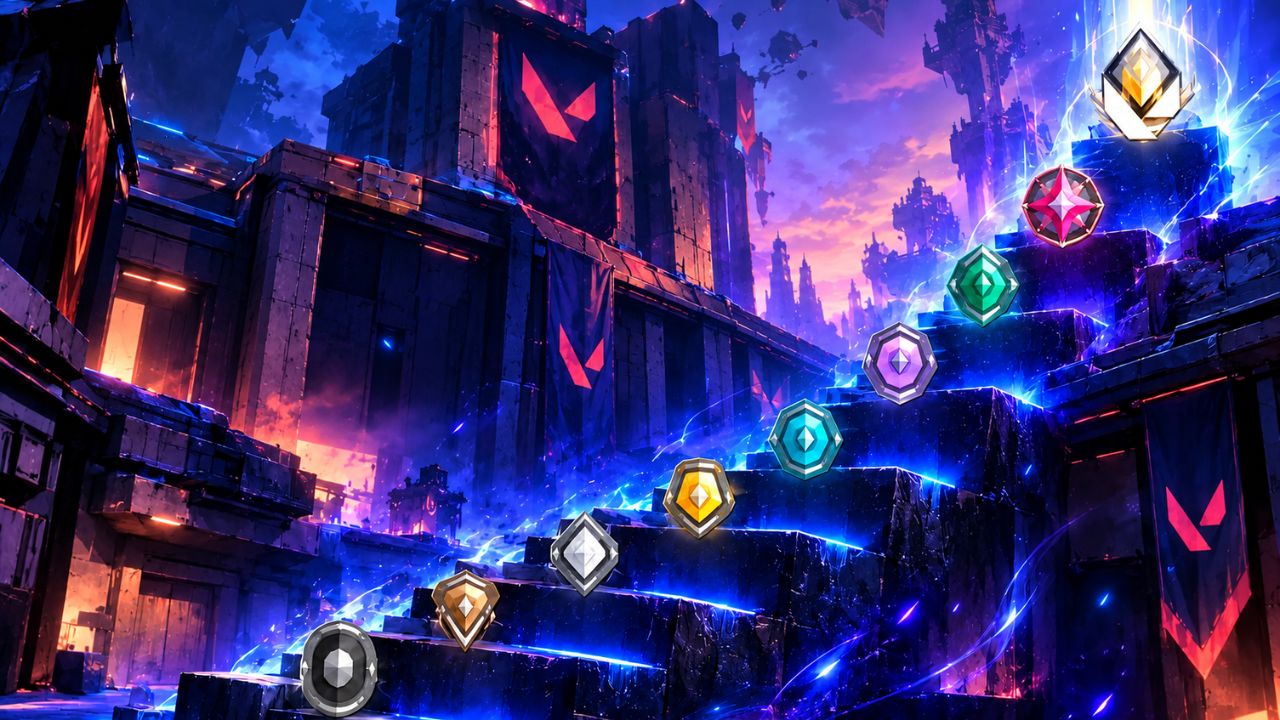
To climb ranked in Valorant in 2026, focus on winning matches consistently, play a small agent pool on the current map rotation, and use your career tab data to identify patterns in your losses. The 25-rank ladder from Iron through Radiant rewards steady win rates far more than individual performance stats, and understanding how hidden MMR interacts with your visible rank is the single most important concept every serious climber needs to grasp.
Prerequisites: What You Need Before You Start
Before you run a single placement match, there are a few things you need before you start climbing effectively. You need a level 20 account to unlock competitive mode, a basic understanding of the 25-rank ladder, and at least a working crosshair and sensitivity setup you can reproduce every session.
- Account level: Reach level 20 through unrated, spike rush, or deathmatch. This is a hard gate Riot enforces to ensure players understand the game before they enter ranked.
- Agent fundamentals: Know at least two agents across two roles so you can adapt to team composition every match.
- Hardware and settings: Lock in your sensitivity, resolution, and crosshair before placement matches. Changing these mid-climb resets your muscle memory and costs you ranks.
- Mental baseline: Decide in advance how many matches you’ll play per session. Tilt-queuing after losses is one of the biggest rank killers at every tier.
Everything you need to know about prerequisites comes down to one rule: do not enter ranked until you can win unrated games consistently. If you’re losing more than 55% of unrated matches, you need more practice time before placement matches matter.
Step 1: Memorize the Full 25-Rank Ladder
The full 25-rank ladder in Valorant 2026 runs from Iron 1 at the bottom to Radiant at the top. Every tier except Radiant has three divisions (1, 2, 3), and you need 100 RR in your current division to promote. This structure is the foundation of everything need to know about how rank actually works.
The nine tiers in order from lowest to highest:
- Iron (1, 2, 3)
- Bronze (1, 2, 3)
- Silver (1, 2, 3)
- Gold (1, 2, 3)
- Platinum (1, 2, 3)
- Diamond (1, 2, 3)
- Ascendant (1, 2, 3)
- Immortal (1, 2, 3)
- Radiant (top 500 players per region, no divisions)
You generally start a new division with around 50 RR. Win a match and you gain RR; lose and you drop. At the bottom of a division (0 RR), you can demote to the tier below after a loss. Step one for every serious climber is to memorize this ladder so you always know exactly how far you are from your next milestone.
Step 2: Understand How RR and MMR Actually Interact
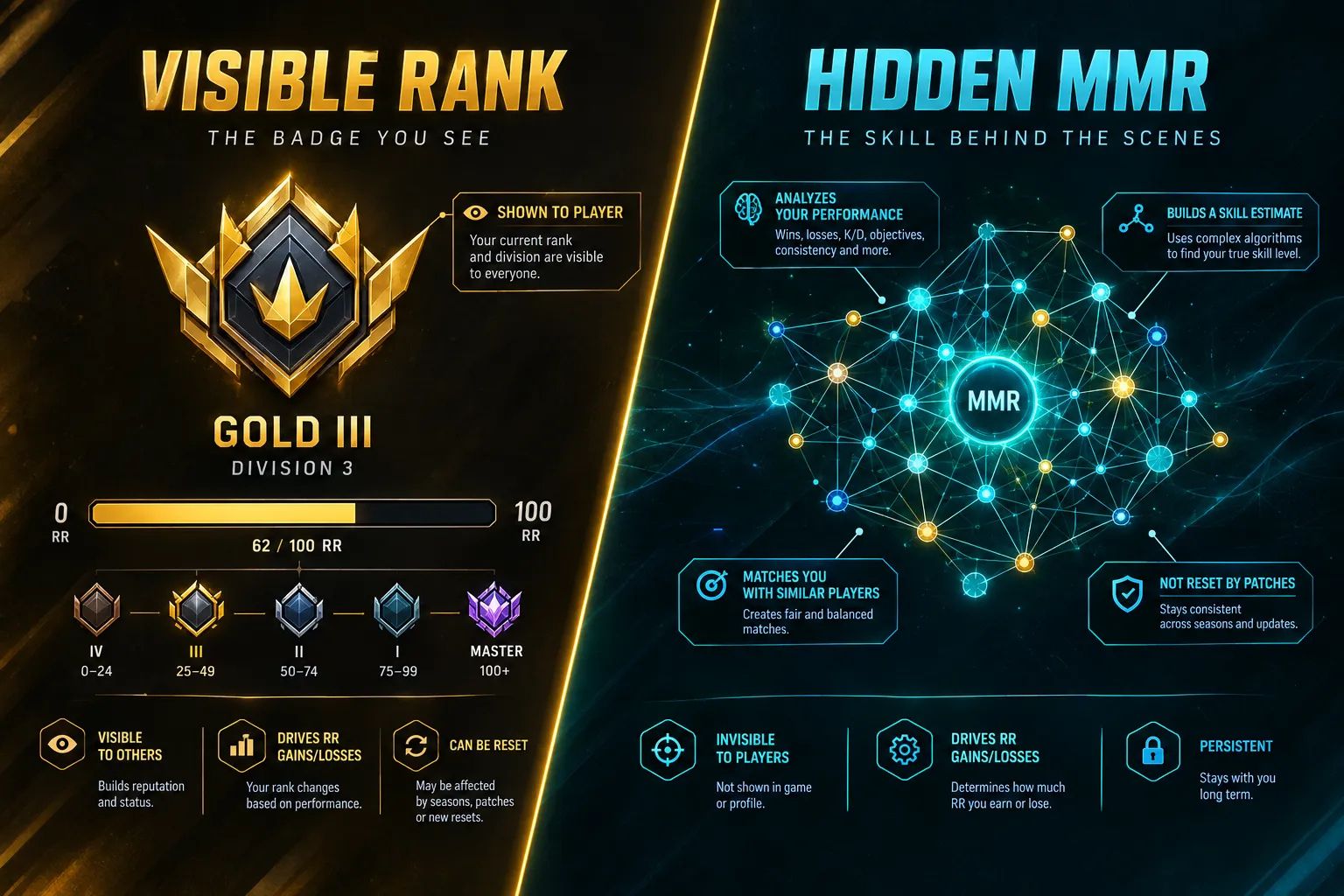
Your visible rank shows your tier and division, but your hidden MMR is what actually drives your RR gains and losses after every match. When your MMR is higher than your visible rank, the system gives you more RR for wins and takes less for losses, this is the fast-climb window every player wants to be in.
Step two is to understand MMR actually interact with your visible rank in these key ways:
- Win above expectation: If your MMR predicts a loss but you win, RR gains spike.
- Lose below expectation: If your MMR predicts a win but you lose, RR losses are heavier.
- MMR is not reset by patches: Even after Patch 13.04’s major rank reset in August 2026, hidden MMR stayed intact. High-MMR players who queued immediately after the reset climbed back to Radiant faster than rivals who took breaks.
- Streaks matter early: When the system is still calibrating your MMR (especially after placement matches), consecutive wins push your MMR up fast, creating a compounding gain effect.
The practical takeaway: if you’re gaining only 15-18 RR per win while losing 22-25 per loss, your MMR is below your visible rank. The fix is to win more matches in a row, not to play more total games.
Step 3: Decode Your Career Tab and Placement Matches
The career tab in Valorant’s client shows your match history, RR changes, and performance data after every game. Step three is to decode career tab placement matches by reviewing your last 20 games for win/loss patterns, not just KDA.
At the start of each act, you play five placement matches. These use your past MMR plus your current performance to seed your rank. First-time ranked players are capped around Ascendant 3 regardless of performance, which prevents new accounts from jumping directly into top tiers. Returning players typically land near their previous rank but can climb faster if they overperform during placements.
What to track in your career tab:
- RR gained or lost per match (not just win/loss)
- Maps where your win rate drops below 50%
- Rounds lost on attack vs. defense (reveals strategic weaknesses)
- Agent-specific performance to find your strongest picks
Use a community tracker like the tools available at valorantranks or follow the path valorant-rank-tracker options in the community to export this data. Many trackers let you download a CSV of your match history, which makes it easy to run a quick analysis in a spreadsheet. Store match history in a CSV database and review it weekly, this is the same approach serious climbers and coaches use to find fixable leaks in a player’s game.
Understanding Episodes, Acts, and Rank Resets in 2026
Every episode and act reset in Valorant 2026 is a climb opportunity, not just an inconvenience. Acts rank resets compress the ladder temporarily, which means players with high hidden MMR gain RR faster than normal in the first two weeks of a new act.
Key 2026 reset dates to know:
- Season V26 started June 24, 2026 with full placement matches for all players.
- Act 5 (V26A5) launched August 18, 2026 with a soft reset and Patch 13.04’s major changes.
- Patch 13.04 specifics: Immortal and Radiant players had accumulated RR reduced by 90%. Radiant players were dropped to Immortal and had to requalify. At least one calibration match became mandatory to reappear on regional leaderboards.
For players in Iron through Diamond, act resets are less dramatic but still meaningful. Your visible rank drops slightly, but if your MMR is strong, you’ll gain more RR per win for the first several matches. Queue aggressively in the first week of every new act.
Understanding episodes acts rank resets in 2026 by tier impact:
| Tier | Reset Impact | Recovery Speed |
|---|---|---|
| Iron to Gold | Minimal | 1-2 weeks |
| Platinum to Diamond | Moderate | 2-3 weeks |
| Ascendant | Noticeable | 3-4 weeks |
| Immortal/Radiant | Severe (Patch 13.04) | Depends on MMR |
Steps 4-9: Build a Personal RR Tracker With Python and a Stats API
For players who want data-driven climbing, building a simple RR logger takes about an hour and gives you insights no in-game screen provides. These steps walk through the technical setup that serious climbers use to track every match systematically.
Step 4: Install Python and set up your project folder. Download Python 3.11 or later from python.org. Create a folder called valorant_tracker and set up a virtual environment. Install the requests and pandas libraries using pip.
Step 5: Get access to a community stats API. Riot’s official API at developer.riotgames.com provides match data endpoints. Register for a development key, which gives you access to match history, MMR estimates, and player data. Community wrappers like valclient simplify the API calls significantly.
Step 6: Write the RR logger script. The script should call the match history endpoint after every match, parse the RR change from the response, and append a row to a local CSV file. Each row should include: timestamp, map, agent, outcome, RR before, RR after, and KDA.
Step 7: Store match history in a CSV database. A CSV file is the simplest format for this data. Name columns clearly (date, map, agent, win, rr_before, rr_after, kda) so you can open it in Excel or Google Sheets without any extra setup. Store match history in a CSV and back it up weekly.
Step 8: Automate the logger on a schedule. On Windows, use Task Scheduler to run the script every 30 minutes. On Mac or Linux, a cron job works the same way. This means the tracker runs in the background and you never need to remember to log manually.
Step 9: Plot your RR curve with Matplotlib. Install matplotlib and write a five-line script that reads your CSV and plots RR over time. A rising curve with small dips is healthy. A flat or falling curve after many matches signals a systemic problem, usually tilt, wrong agent picks, or bad queue timing.
Step 10: Tune Crosshair, Sensitivity, and Video Settings for Consistency
Consistent settings are a prerequisite for consistent rank gains. Step 10 is to tune crosshair, sensitivity, and video settings once and then never change them mid-climb.
Crosshair: Use a small, static dot or classic crosshair with no dynamic movement. Aiming while moving is already penalized by Valorant’s spread mechanics, so a crosshair that expands during movement gives you no useful information. Keep it small and centered.
Sensitivity: Most high-rank players use 400 DPI with an in-game sensitivity between 0.3 and 0.8, giving an effective eDPI of 160-320. The exact number matters less than keeping it the same every session. Focus on the head, not the body, lower sensitivity helps with precise micro-adjustments.
Video settings: Run the game at a stable frame rate above 144 FPS if your hardware allows. Set texture quality to low or medium, keep shadows off, and use a 4:3 or 16:9 resolution that your hardware and chips can sustain without frame drops. Hardware amp chips in modern CPUs handle Valorant’s engine well even on mid-range machines, prioritize stable FPS over maximum visual quality.
Step 11: Read Your Data to Plan Queue Times and Duo Strategy
After two to three weeks of logging, your CSV will reveal patterns that are invisible during play. Step 11 is to read your data to plan queue times and duo strategy based on actual win rate trends, not gut feeling.
What the data typically shows:
- Peak hours win rate: Most players win more during peak regional hours (evenings, weekends) because matchmaking pools are larger and MMR matching is more accurate.
- Map-specific losses: If your win rate on one map is below 40%, either practice that map in unrated or dodge it in agent select when the option exists.
- Duo impact: Coordinated duo partners who play complementary roles (e.g., controller + duelist) consistently show higher win rates than solo queue in the same rank band. Above Diamond, duo queue with a player at the same MMR level is the fastest climb path.
- Session length: Data from community analysis of Season V26 shows that win rates drop sharply after the fourth consecutive match in a session. Stop at three to four matches per session unless you’re on a winning streak.
Step 12: Break Into Immortal and Fight for the Radiant Leaderboard
Breaking into Immortal requires a sustained win rate above 55% at Ascendant 3, combined with consistent individual impact. Step 12 is the hardest step: climb past Ascendant and into the top 1% of players where every match is decided by small execution edges.
How to climb past Immortal toward Radiant:
- Queue immediately after act resets when high-MMR players have compressed visible ranks.
- Play the meta agents on the current map pool. In V26A5, Abyss is in the competitive rotation and Breeze is out, practice Abyss-specific setups.
- Track the regional leaderboard via a Riot-connected tracker. After Patch 13.04, Radiant players must complete at least one calibration match to reappear on the leaderboard.
- The 2026 VCT Path to Champions qualification route now runs through Challengers circuits, making consistent Immortal/Radiant performance more meaningful for aspiring pros than ever before.
Role and Agent Strategy for Each Rank Band
The best agent and role strategy changes as you climb ranked. At lower ranks, duelists who can carry individually (like Jett or Reyna) perform well because teammates often can’t execute structured setups. At higher ranks, controllers and initiators that enable team play become more valuable.
By rank band:
- Iron through Silver: Play a duelist. Learn to entry-frag and trade your teammates efficiently. The rule of twos when fighting at this level is simple: always have a teammate nearby so every duel is a 2v1 if you trade.
- Gold through Platinum: Add a controller to your pool. Learn how to win 1v2 clutches by using utility to isolate duels. Platinum is where above-average players stall out because mechanical skill alone stops working.
- Diamond through Ascendant: Play initiators or controllers. Understand economy, site executes, and how to trade your teammates efficiently at a macro level. Gunfighting mastery, knowing when to take a fight and when to hold, separates Diamond from Ascendant players.
- Immortal and Radiant: Every role is viable if played at a high level. Advanced movement, crosshair placement on the head, and deep map knowledge are the real differentiators.
Common Pitfalls When Climbing Valorant Ranks
The most common pitfalls climbing Valorant ranks are tilt-queuing, playing too many agents, and ignoring map-specific weaknesses. These three mistakes keep more players stuck than any mechanical skill gap.
Pitfalls climbing ranked in 2026:
- Playing too many agents: Players who run 6-8 agents never develop deep map knowledge on any of them. Stick to two or three agents maximum per act.
- Tilt queuing: Losing three in a row and immediately queuing again is the fastest way to drop a full division. Take a 20-minute break after two consecutive losses.
- Ignoring the career tab: Most players never review their own data. The career tab and a CSV tracker reveal fixable patterns in under 10 minutes per week.
- Bad queue timing: Queuing at off-peak hours means smaller matchmaking pools and worse MMR accuracy. Queue during peak regional hours whenever possible.
- Neglecting economy: At Gold and above, losing rounds because of bad buy decisions costs more RR than losing gunfights. Learn the full economy rules before every match.
- Aiming while moving: This is one of the most common mechanical errors at every rank below Diamond. Stop moving before every shot.
How to Climb Ranked in Valorant Solo vs. With a Team
Solo queue is fully viable for climbing ranked in Valorant at every rank below Immortal. Above Diamond, coordinated duo or trio queue with players at the same MMR level provides a measurable advantage because communication quality drops sharply in solo queue at high ranks.
Solo queue tips:
- Play a role that doesn’t depend on teammates executing correctly (controller or sentinel).
- Use voice comms every match, even if teammates don’t respond.
- Focus on your own decisions, not your team’s mistakes.
Duo queue tips:
- Partner with someone at the same rank or within one division.
- Agree on a role split before queuing (e.g., one duelist, one initiator).
- Avoid trio or five-stack unless all players are at the same skill level, rank disparity in a stack creates MMR distortions.
What Rank Should I Start At and How Many Hours Does It Take?
New players start at Iron after completing placement matches, regardless of skill level. The system needs match data to calibrate MMR, so the first five placement matches are critical, play them on your best agents and during peak hours.
As for hours: reaching Gold from Iron typically takes 150-300 hours for a dedicated player who actively studies their mistakes. Reaching Diamond from Gold takes another 300-500 hours for most players. Radiant-level play requires thousands of hours and active coaching or review. There’s no shortcut, but the steps in this guide cut wasted time significantly.
Final Thoughts
Climbing ranked in Valorant in 2026 is a data problem as much as a skill problem. The players who climb fastest are not always the best mechanical players, they’re the ones who understand how MMR and RR interact, queue strategically around act resets, and review their match data to fix specific leaks rather than grinding blindly.
Actionable next steps:
- Check your current rank distribution, know exactly where you sit in the player base percentage.
- Set up a CSV tracker (even a manual spreadsheet works) and log your last 20 matches today.
- Cut your agent pool to two or three picks and commit to them for the rest of Act 5.
- Queue during peak hours for the next two weeks and track whether your RR gains per win improve.
- If you’re Ascendant or above, queue within the first 48 hours of every act reset to exploit the MMR-visible rank gap.
The path valorant-rank-tracker tools, the community data from valorantranks com, and the steps in this valorant guide give you everything need know to make 2026 your best ranked season yet. The ladder is waiting, start with step one and work forward.