

Climbing the solo queue ladder in League of Legends has never been more competitive. With the 2026 meta constantly evolving through balance updates, champion adjustments, and shifting strategies, winning consistently requires much more than strong mechanics. Success comes from making smarter decisions, mastering a small champion pool, adapting to the current meta, and maintaining the right mindset even during losing streaks.
Whether you’re aiming to escape Bronze, reach Diamond, or finally break into Master, this guide covers the most effective strategies to improve your win rate in 2026. From champion selection and macro play to mental resilience and common mistakes to avoid, you’ll learn the practical tips that can help you climb the ranked ladder faster and become a more consistent player.
What Is Solo Queue in League of Legends
Solo queue is League of Legends’ individual ranked mode, where players queue alone or with one duo partner and are matched based on their MMR (Matchmaking Rating). It is distinct from Flex Queue, which allows groups of up to five. Solo queue is the mode most players and the esports community treat as the true measure of individual skill, because it removes premade coordination as a variable.
In 2026, Riot Games’ ranked system uses a tiered structure: Iron, Bronze, Silver, Gold, Platinum, Emerald, Diamond, Master, Grandmaster, and Challenger. Each tier (except the top three) is divided into four divisions. Players earn or lose LP (League Points) per game, and reaching 100 LP triggers a promotion to the next division.
Key distinction: Solo queue MMR and Flex Queue MMR are tracked separately, so a Diamond solo queue player may be Platinum in Flex, and vice versa.
Solo Queue vs Flex Queue: What Is the Difference
Solo queue and Flex Queue use separate MMR systems and attract different player behaviors. Solo queue is generally considered more competitive because players cannot rely on premade five-man voice communication, which forces individual decision-making. Flex Queue allows groups of two, three, or five, making it more social but less reflective of pure individual skill.
For players focused on how to climb solo queue in League of Legends, the recommendation is clear: practice and rank up in solo queue first. Flex Queue is better used for playing with friends or testing new roles without risking solo queue LP.
Best Champions for Climbing Solo Queue in 2026
The best champions for climbing solo queue in 2026 are those with strong carry potential, low reliance on team follow-up, and a relatively forgiving skill floor. Riot’s balance patches shift the meta regularly, but certain champion archetypes consistently outperform in solo queue environments.
Top-performing archetypes by role in 2026:
| Role | Recommended Archetype | Example Champions |
|---|---|---|
| Top | Split-push bruisers | Darius, Fiora, Garen |
| Jungle | Objective-focused carries | Vi, Warwick, Hecarim |
| Mid | Roaming assassins / mages | Syndra, Zed, Lux |
| ADC | Hypercarry marksmen | Jinx, Caitlyn, Jhin |
| Support | Engage / vision supports | Thresh, Leona, Lulu |
Choosing your champion pool: Pick two to three champions that cover different matchup scenarios. For example, a mid laner might play Syndra into mage matchups, Zed into AP-heavy compositions, and Lux as a comfort pick into difficult games.
Common mistake: Chasing the “meta” champion every patch. A player with 200 games on Warwick will outperform a player with 10 games on a newly buffed champion, even if the buffed champion has a slightly higher win rate in aggregate.
Best Role to Climb Solo Queue With
The best roles for climbing solo queue in League of Legends are mid lane and jungle, because both positions have the most map-wide influence and can directly impact every other lane. Jungle controls objective timing (Dragon, Baron, Rift Herald), while mid lane has the shortest rotation distance to both side lanes.
That said, the best role for any individual player is the one they understand most deeply. A player who has 500 games on support and 50 on jungle will almost certainly climb faster by sticking to support.
Role-by-role breakdown:
- Jungle: Highest skill ceiling for climbing; rewards players who can track the enemy jungler and prioritize objectives over kills.
- Mid lane: Strong roaming potential; can snowball both side lanes early.
- Top lane: More isolated; effective for split-push specialists but slower to influence games.
- ADC: High mechanical ceiling; heavily dependent on support synergy in lower elos.
- Support: Underrated carry potential through vision control and engage timing; see the dedicated section below.
How to Improve Map Awareness in Solo Queue
Map awareness in solo queue means consistently checking the minimap every 5 to 10 seconds, tracking enemy positions, and making decisions based on where threats are rather than reacting to them after it is too late. For players below Diamond, poor minimap habits are the most common mechanical gap.
Practical steps to improve map awareness:
- Set a minimap timer habit. After every ability cast or auto-attack animation, glance at the minimap. This builds the habit without disrupting your mechanical focus.
- Track the enemy jungler. When you see the enemy jungler on one side of the map, note the time. If they disappear, assume they are rotating toward you.
- Use pings actively. Pinging “enemy missing” when your lane opponent leaves costs nothing and can save a teammate’s life.
- Ward river entrances before level 6. Most solo queue deaths below Gold are from unseen ganks through river. One ward at the 3:30 mark prevents the majority of these.
- Watch your own death replays. After a game, review deaths specifically to identify whether a minimap check would have prevented them.
Edge case: In very high-elo games (Master+), enemy players will intentionally bait minimap reads. At lower elos, this is rare, trust your minimap more, not less.
How Many Games Does It Take to Climb Solo Queue
Most players need between 200 and 500 ranked games per season to climb one to two full tiers, assuming they are actively reviewing mistakes and not playing on tilt. This is an estimate based on community-reported data from sites like OP.GG and U.GG, which track win rates and rank progression across millions of accounts.
The number varies significantly based on:
- Starting rank vs. target rank: Climbing from Gold to Platinum takes fewer games than climbing from Diamond to Master.
- Win rate above 50%: A 55% win rate climbs roughly twice as fast as a 52% win rate over the same game volume.
- Active review: Players who watch their own replays after losses climb faster than those who queue immediately after a loss.
Decision rule: If your win rate is below 50% after 50 games on a champion, that champion is not the right pick for your current skill level. Switch before investing more games.
Common Mistakes Players Make in Solo Queue
The most common mistakes in solo queue are overextending after winning a fight, playing too many champions, and continuing to queue while mentally exhausted. These three habits account for the majority of preventable LP loss across all rank brackets.
Full list of frequent errors:
- Dying for free: Taking a fight without vision or backup after winning a teamfight, giving the enemy a free gold reset.
- Ignoring objectives: Killing five enemies but failing to take Dragon or Baron is a common Gold-and-below error.
- Champion pool bloat: Playing eight different champions in a week prevents mastery from building.
- Blaming teammates in chat: Typing in all-chat or team chat during a losing game costs mental focus and rarely changes outcomes.
- Playing past the stop-loss: Queuing for a fifth game after losing four in a row almost always results in a fifth loss.
- Skipping the loading screen prep: Not checking enemy champions and planning your build path before the game starts.
How to Stop Tilting in Solo Queue
Tilt, the mental state where frustration degrades decision-making, is the single largest LP drain for the average player. Stopping tilt requires a structural rule, not willpower: set a hard stop-loss of two consecutive losses per session, then close the client.
Practical anti-tilt habits:
- Separate your identity from your rank. LP is a measurement tool, not a reflection of self-worth.
- Use the mute button early. If a teammate is being toxic in the first five minutes, mute them. Do not engage.
- Take a five-minute break between games. Stand up, drink water, reset. The next game starts fresh.
- Review the loss, not the teammate. After a bad game, find one thing you personally could have done differently. One thing is enough.
- Track your emotional state before queuing. If you are already frustrated from work, school, or a previous session, that frustration will compound in-game.
Mental health under competitive pressure is a real factor. For broader strategies on managing stress and mental performance, resources on nervous system regulation can provide useful grounding techniques that apply directly to gaming sessions.
Does Muting All Help You Climb Solo Queue
Muting all teammates at the start of every game is a popular piece of advice, but it is not universally correct. Muting all removes toxic noise, but it also removes useful callouts like “jungler bot” or “Baron is up.” The better approach is selective muting: mute players who are being toxic, keep pings and chat open for players who are communicating productively.
When muting all is the right call:
- You are already on a two-game loss streak and feel tilted.
- A teammate is spamming negative chat in the first two minutes.
- You are in a game mode or rank where callouts are rare anyway (Iron through Gold).
When to keep chat open:
- Diamond and above, where teammates more often provide genuine information.
- Games where your team is coordinating around objectives.
Solo Queue Climbing Tips for Mid Lane
Mid lane is one of the strongest roles for climbing solo queue in League of Legends because it offers the fastest access to both side lanes and the most opportunities to create advantages through roaming. The core mid lane climbing principle is: win your lane or go even, then roam to create advantages elsewhere.
Mid lane-specific tips:
- Shove the wave before roaming. A pushed wave denies your opponent farm while you roam, and it prevents them from following safely.
- Prioritize bot lane roams at level 6. Bot lane has two players, so a successful roam there creates a 3v2 advantage and sets up Dragon control.
- Track the enemy mid laner’s roams. If they leave lane, ping your teammates immediately and shove the wave to take tower plates.
- Learn two wave management patterns: Slow push (building a large wave to crash) and fast push (clearing quickly to roam). Knowing when to use each is what separates Gold mid laners from Platinum.
- Pick champions with reliable engage or disengage for roams. Assassins like Zed or Talon are effective roamers; immobile mages are better suited to wave control and side lane pressure.
How to Deal With Autofilled Teammates in Solo Queue
Autofilled teammates are an unavoidable part of solo queue. The best response is to adapt your strategy around their likely weaker performance rather than expecting them to carry. If your support is autofilled, play a self-sufficient ADC. If your jungler is autofilled, play a champion that does not require early jungle pressure to succeed.
Practical adjustments:
- Avoid playing around autofilled players as win conditions. Do not build a strategy that requires an autofilled support to land perfect engage.
- Offer lane swap options in champion select. Sometimes an autofilled player has a secondary role they are comfortable with, asking early prevents a worse outcome.
- Do not flame. An autofilled player who is trying is more useful than one who has given up because their team was hostile.
Is One-Tricking Better for Climbing Solo Queue
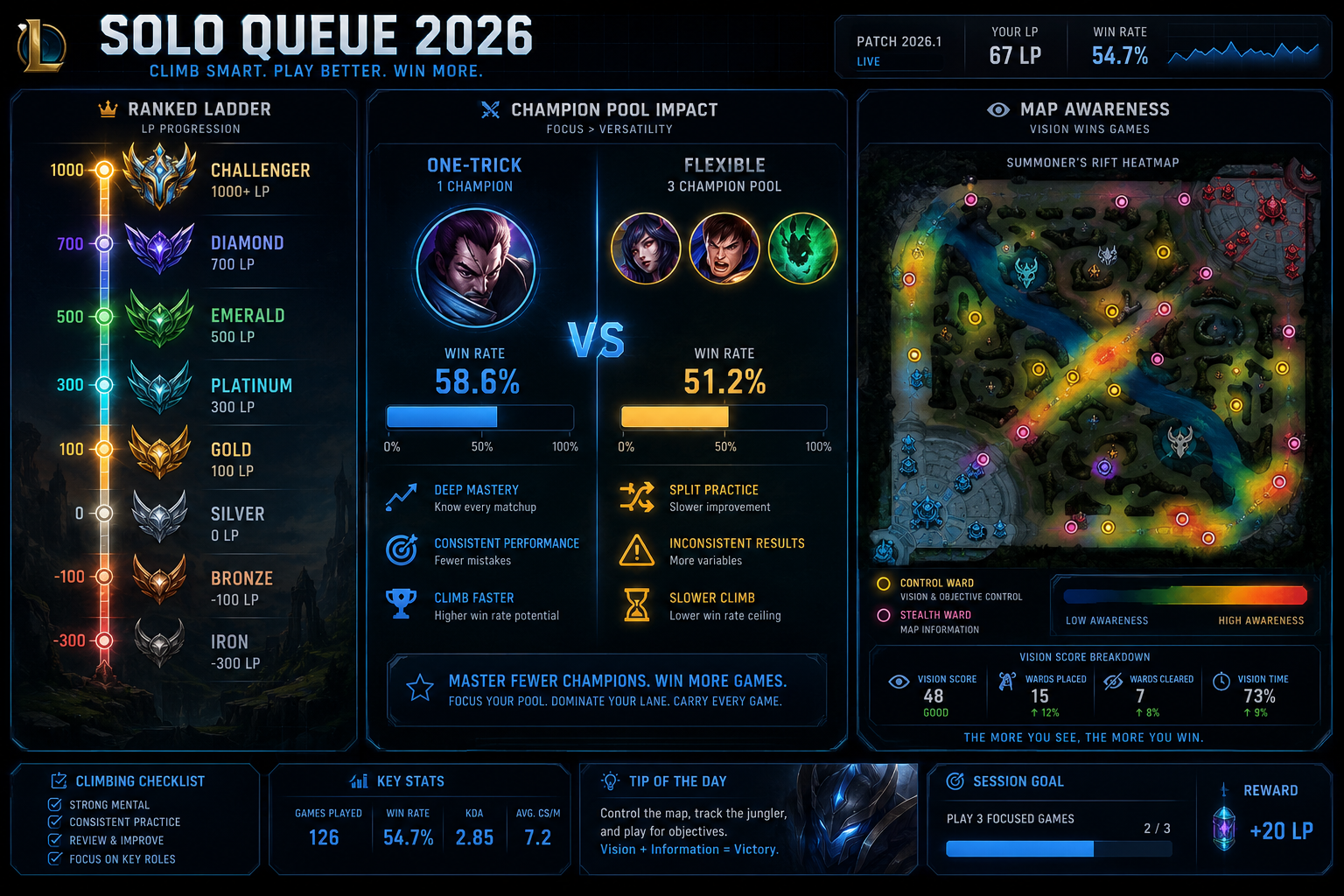
One-tricking (playing a single champion exclusively) is statistically effective for climbing, particularly in Iron through Emerald, because deep champion mastery outweighs the disadvantage of being counterpicked. One-tricks develop an intuitive understanding of their champion’s power spikes, optimal itemization, and matchup-specific adjustments that multi-role players rarely achieve.
Pros of one-tricking:
- Faster mastery accumulation.
- Consistent mental model, you always know what to do.
- Easier to identify and fix mistakes (same champion every game).
Cons of one-tricking:
- Vulnerable to hard counters in champion select.
- Some champions fall off in the meta after patches.
- Can create predictability at higher elos where opponents will target-ban your champion.
Recommendation: One-trick up to Diamond, then expand to a two to three champion pool to handle ban pressure and meta shifts.
How to Climb Solo Queue as a Support Main
Support mains can absolutely climb solo queue in League of Legends, but it requires treating vision control and engage timing as primary win conditions rather than waiting for carries to perform. The most effective support archetypes for climbing in 2026 are engage supports (Thresh, Leona, Nautilus) and roaming supports (Pyke, Bard), because both create advantages independently of ADC performance.
Support-specific climbing habits:
- Control ward every back. Always buy at least one Control Ward on every base trip. Vision denial is a direct win condition.
- Roam at level 6. Once your ADC can solo the wave, rotate mid to create a numbers advantage.
- Track Dragon and Baron timers. As support, you are often the player with the most map awareness, own that role.
- Play engage supports in lower elos. Enchanters (Lulu, Soraka) are powerful but require competent ADCs to function. Engage supports create value independently.
- Do not over-peel. A common support mistake is staying with the ADC while the rest of the team dies in a fight. Sometimes the correct play is to engage on the enemy backline.
For players managing the mental load of competitive play, it is worth noting that structured habits, whether in gaming or daily life, reduce decision fatigue. Resources on cooking as a mental health sanctuary explore how routine and focus transfer across high-pressure activities, including competitive gaming.
Is Elo Boosting Worth It for Solo Queue
Elo boosting services are not worth it for any player who wants to genuinely improve at League of Legends. Beyond the ethical issues, boosting violates Riot Games’ Terms of Service and carries a permanent ban risk. More practically, arriving at a rank you did not earn means you will be matched against players significantly better than your actual skill level, resulting in a frustrating losing streak that often drops you back down anyway.
The actual cost of boosting:
- Account ban risk (permanent on first offense in many cases, per Riot’s enforcement history).
- No skill development, the underlying MMR gap remains.
- Financial cost with no lasting benefit.
The only legitimate path for how to climb solo queue in League of Legends is developing the skills to hold the rank you reach. Shortcuts undermine that process entirely.
Step-by-Step Checklist: How to Climb Solo Queue in League of Legends
Use this checklist at the start of each ranked session:
Before queuing:
- Confirm your champion pool (two to three picks per role, no more).
- Check the current patch notes for any significant balance changes to your champions.
- Set a session stop-loss: quit after two consecutive losses.
- Verify you are mentally ready, not tired, not already frustrated.
During champion select:
- Lock in your primary champion unless it is banned or hard-countered.
- Check enemy team composition for engage threats and adjust summoner spells accordingly.
- Note the enemy jungler, their pathing will affect your lane.
During the game:
- Check the minimap every 5 to 10 seconds.
- Place a ward at river before level 6.
- Ping enemy missing when your lane opponent leaves.
- Track Dragon and Baron timers from minute 5 onward.
After the game:
- If you lost, review one death in the replay tool.
- Identify one decision (not a teammate’s decision, yours) that could have been better.
- Log the game result and your mental state (a simple note is enough).
Final Thoughts
Climbing solo queue in League of Legends in 2026 is a skill-development process, not a grind. The players who climb consistently are not necessarily the ones with the most hours played, they are the ones who play with intention, review their mistakes honestly, and maintain mental discipline across a full season.
Actionable next steps:
- Narrow your champion pool to two to three picks this week and commit to them for 30 games.
- Set a two-loss stop-loss rule starting with your next session.
- After your next loss, open the replay tool and find one personal mistake, not a teammate’s.
- Place a Control Ward on every single base trip for the next 20 games and track how your vision score changes.
- Pick one map awareness habit (minimap check every 10 seconds) and focus on it exclusively for one week before adding another.
The rank you want is achievable. The process is straightforward, even if it is not easy. Start with the fundamentals, stay consistent, and the LP will follow.
Frequently Asked Questions (FAQs)
What rank do most League of Legends players reach in solo queue?
According to Riot Games’ published rank distribution data, the majority of ranked players sit in Silver and Gold, with Gold being the most populated tier. Platinum and above represents roughly the top 25 to 30 percent of the ranked player base.
How long does a typical solo queue game last in 2026?
Most solo queue games in 2026 last between 28 and 35 minutes. Games that end before 25 minutes are early surrenders or snowballs; games that go past 40 minutes are typically even matchups or games with poor objective control.
Can you climb solo queue by only playing one role?
Yes. Playing one primary role with a clear secondary is the recommended approach. Spreading across three or more roles slows mastery development and makes it harder to identify consistent mistakes.
What is LP and how does it work?
LP stands for League Points. Players earn LP for wins and lose LP for losses. Reaching 100 LP triggers a promotion to the next division. The amount of LP gained or lost per game depends on your MMR relative to your current rank, if your MMR is higher than your visible rank, you gain more LP per win.
Is duo queue better for climbing than solo queue?
Duo queue can help if your duo partner is on a complementary role and has a similar or higher MMR. A mid/jungle duo is the most effective pairing because both roles directly influence each other. Duoing with a player of significantly lower MMR will drag your matchmaking quality down.
How do I know if I am ready to climb to the next tier?
A sustained win rate above 55% over at least 50 games at your current rank is a reliable signal that you are ready to climb. If your win rate is between 50 and 54%, you will climb but slowly. Below 50%, focus on skill development before grinding volume.
Does server or ping affect solo queue climbing?
Yes, but less than most players assume. High ping (above 80ms) meaningfully impacts mechanical champions that require precise ability timing. For macro-focused players on less mechanically demanding champions, the impact is smaller. Playing on your home server is always recommended.