

Baldur’s Gate 3 continues to be one of the most popular RPGs in 2026, offering players countless ways to customize their characters through unique classes, subclasses, feats, and multiclass combinations. Whether you prefer devastating enemies with powerful spells, dominating the battlefield as a frontline warrior, or supporting your party with healing and utility abilities, choosing the right build can dramatically improve your adventure across the Forgotten Realms.
In this complete guide, we break down the best BG3 builds for every class in 2026, highlighting the strongest subclass choices, optimal ability score distributions, recommended feats, equipment priorities, and effective multiclass options. From beginner-friendly setups to high-damage endgame builds, these recommendations are designed to help you maximize your character’s potential in both single-player and multiplayer campaigns. No matter your preferred playstyle, you’ll find a powerful build to make your journey through Baldur’s Gate 3 more rewarding, efficient, and fun.
What Are the Best BG3 Builds for Every Class Right Now
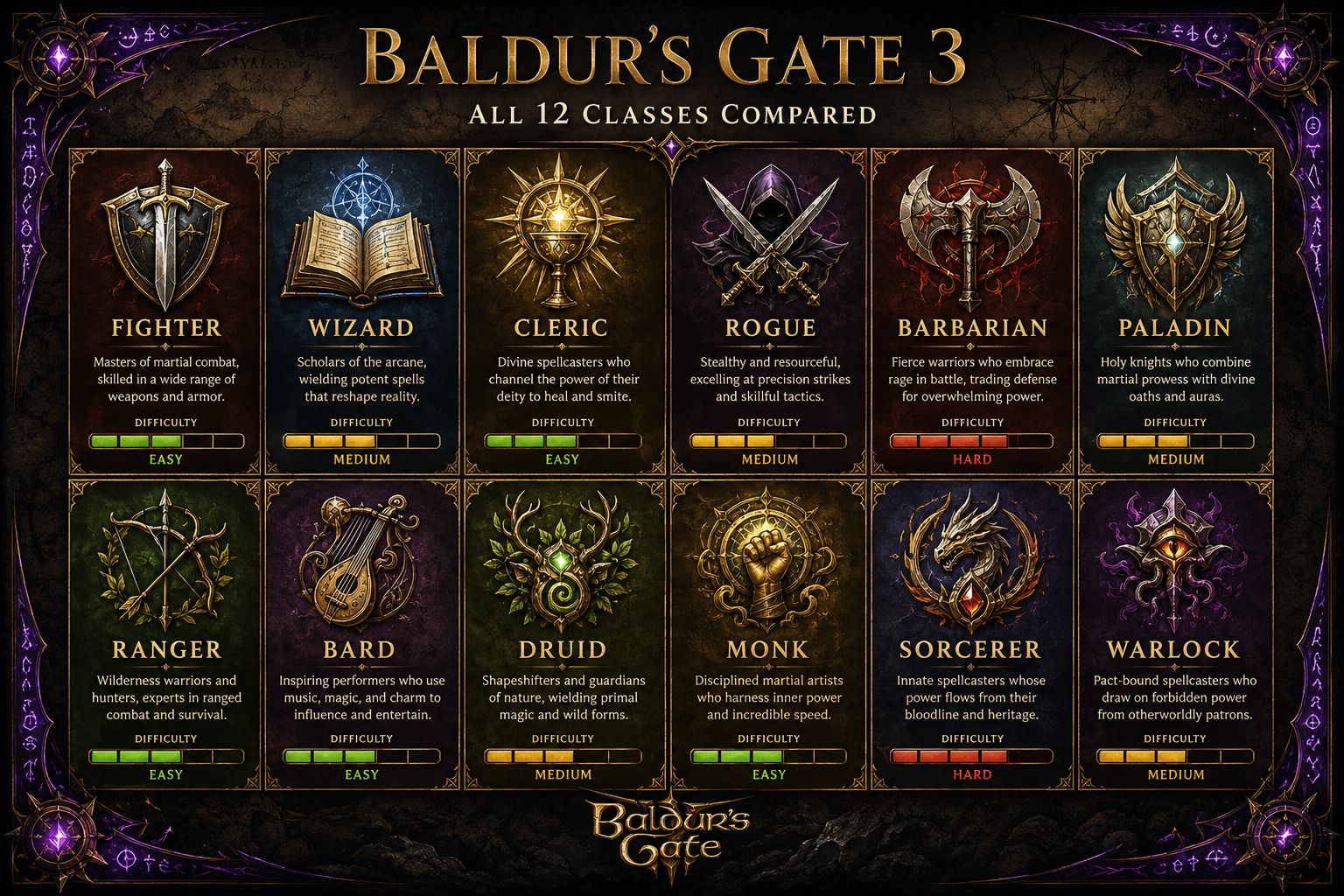
The best BG3 builds for every class in 2026 are those that maximize a class’s core strength while covering its main weakness through subclass choice or multiclassing. Below is a quick-reference breakdown of the top build for each class.
| Class | Best Subclass | Role | Difficulty |
|---|---|---|---|
| Fighter | Battle Master | Damage + Control | Easy |
| Paladin | Oath of the Ancients | Tank + Burst | Easy |
| Sorcerer | Storm Sorcery | Ranged Burst | Medium |
| Rogue | Thief | Burst + Mobility | Medium |
| Wizard | Evocation | Spell Damage | Medium |
| Cleric | Life or Light | Healer + Support | Easy |
| Barbarian | Berserker | Melee Damage | Easy |
| Ranger | Gloom Stalker | Stealth + Burst | Medium |
| Bard | College of Lore | Support + Utility | Medium |
| Druid | Circle of Spores | Control + Damage | Hard |
| Monk | Way of Shadow | Mobility + Burst | Hard |
| Warlock | The Fiend | Sustained Damage | Medium |
Choose Fighter or Paladin if you want strong results with minimal system knowledge. Choose Wizard or Monk if you enjoy reading tooltips and planning ahead.
Top 3 Baldur’s Gate 3 Fighter Builds
The Fighter is the most forgiving class in BG3 and produces strong results across all three major subclasses. The top three Fighter builds for 2026 are Battle Master, Eldritch Knight, and Champion — in that order of power.
1. Battle Master (Best Overall Fighter Build)
Battle Master gets Superiority Dice, which fuel combat maneuvers like Trip Attack, Precision Attack, and Disarming Strike. These add crowd control on top of raw damage, making this subclass useful on every difficulty. Prioritize Strength (16+) and Constitution (14+). Take the Great Weapon Master feat at level 4 for massive damage spikes.
2. Eldritch Knight (Best for Versatility)
Eldritch Knight adds spellcasting to the Fighter’s action economy. You get Shield and Absorb Elements for defense, plus the ability to use Booming Blade for melee control. This build works best with a 1-hand weapon and shield setup. It’s slightly harder to play than Battle Master but much stronger in Act 3 boss fights.
3. Champion (Best for Beginners Who Want Simple)
Champion expands your critical hit range to 19-20, which pairs well with high-attack-roll builds. It’s the simplest Fighter subclass — no resource management, no complex combos. The downside is a lower ceiling than Battle Master in late-game content.
Common mistake: New Fighter players dump Dexterity completely and then get destroyed by ranged attackers in Act 2. Keep Dexterity at 12 minimum or pick up the Sentinel feat to punish enemies who try to disengage.
If you’re new to the game entirely, the Baldur’s Gate 3 Best Class for Beginners: 2026 Starter Guide covers the full onboarding process before you commit to a build.
How Do Different BG3 Classes Compare in Difficulty
Baldur’s Gate 3 classes range from nearly automatic (Barbarian, Fighter) to genuinely complex (Monk, Druid). Difficulty here means how much system knowledge you need to perform well, not how strong the class is at its peak.
Easy tier (pick up and play):
- Barbarian: Rage, hit things, win. Constitution and Strength carry you.
- Fighter: Extra Attack + Action Surge makes combat feel straightforward.
- Paladin: Smites do enormous damage automatically. Hard to mess up.
- Life Cleric: Healing and armor make mistakes survivable.
Medium tier (some reading required):
- Rogue: Sneak Attack conditions need setup but the payoff is clear.
- Ranger: Spell slots are limited; you need to know when to cast vs. attack.
- Sorcerer: Metamagic choices matter a lot, especially Twinned Spell.
- Bard: Inspiration management and knowing which spells to Concentration on.
Hard tier (system knowledge required):
- Monk: Ki points run out fast; positioning is critical every turn.
- Druid: Wild Shape forms have separate HP pools and action rules that confuse new players.
- Wizard: Spell preparation, spell slots, and concentration stacking require planning.
How Much Does a Good BG3 Character Build Cost to Respec
Respeccing at Withers costs exactly 100 gold per respec, regardless of your character level. This is one of the most player-friendly design choices in the game — it means no build is permanent, and experimentation is cheap.
Withers becomes available after you find him in the Dank Crypt early in Act 1. From that point forward, you can respec as many times as you want for 100 gold each time. By mid-Act 1, most players have several hundred gold from looting alone.
What respeccing does NOT reset:
- Story choices and dialogue flags
- Companion approval ratings
- Items already in your inventory
What it DOES reset:
- All class levels (you rebuild from level 1 each time)
- Feat selections
- Ability score distribution
- Spell and cantrip choices
This means the best BG3 builds for every class can be tested before you commit. Build a Fighter, try it for a few hours, then respec into a Paladin if it feels wrong. The 100 gold cost is negligible by Act 2.
Why Your BG3 Build Is Not Working in Act 3 Combat
If a build that worked in Act 1 and Act 2 is falling apart in Act 3, the most common cause is a failure to scale action economy or crowd control alongside enemy stat inflation. Act 3 enemies hit harder, have more HP, and often have resistance or immunity to common damage types.
The most frequent Act 3 failure points:
- Pure damage builds with no crowd control: Enemies in Act 3 have enough HP that killing them in one round is rare. If your build can’t stun, prone, or slow enemies, you’ll take full damage every turn.
- Concentration spell dependency without War Caster or Resilient (Constitution): One hit can break your best spell. Grab War Caster feat or Resilient (Constitution) before Act 3.
- Ignoring saving throw proficiencies: Act 3 bosses cast high-DC spells. If your character has no proficiency in Wisdom saves, expect to be Charmed or Feared regularly.
- Underpowered weapons: Many Act 3 enemies have damage resistances. Make sure your weapon has a damage type that bypasses resistances, or use spells that deal Force damage (which almost nothing resists).
Quick fix checklist for Act 3:
- Respec if your subclass has no crowd control option.
- Equip the best available weapon for your damage type.
- Add at least one AoE crowd control option to your spell list.
- Check your party composition — you need at least one character who can impose the Prone or Restrained condition.
What Are Some Underrated BG3 Class Builds Most Players Ignore
Several strong builds get overlooked because they don’t appear in top-10 lists or require a non-obvious subclass choice. The most underrated builds in 2026 are the Spore Druid, the Arcane Trickster Rogue, and the Oathbreaker Paladin.
Spore Druid: Most players assume Druid means Wild Shape combat. Spore Druid ignores Wild Shape almost entirely and instead focuses on Symbiotic Entity (a massive temp HP and melee damage buff) combined with Halo of Spores for passive chip damage. It plays more like a tanky melee caster and handles Act 3 better than most Wild Shape builds.
Arcane Trickster Rogue: Adding spells to a Rogue’s toolkit creates one of the best solo-play characters in the game. Mage Hand Legerdemain lets you steal and manipulate objects without triggering combat. Shield spell prevents the main weakness of Rogue (low AC). Most players skip this subclass because they assume Thief’s extra Bonus Action is always better — it often isn’t.
Oathbreaker Paladin: Breaking your Paladin oath unlocks a necromancy-focused subclass with Animate Dead and Aura of Hate. It’s genuinely powerful in Act 3, where you can maintain a small undead army alongside your Smite damage. The stigma of “breaking the oath” keeps most players from trying it.
Which BG3 Builds Work Best for Solo Play vs. Multiplayer
Solo play and multiplayer demand different things from a build. In solo play, you control all four party members, so your personal character needs to be self-sufficient. In multiplayer, you can specialize more aggressively because teammates cover your weaknesses.
Best builds for solo play (controlling all four characters):
- Paladin: Auras benefit the whole party passively without requiring action.
- Sorcerer: Twinned Spell doubles your impact without extra actions.
- Gloom Stalker Ranger: First-round burst damage often ends fights before they scale.
Best builds for multiplayer (one character, specialized role):
- Pure Wizard: Extremely powerful but needs a tank in front — fine when a friend plays Fighter.
- College of Lore Bard: Full support role shines when you’re not managing four characters alone.
- Thief Rogue: High burst damage without needing to also provide crowd control.
Edge case: In four-player co-op, avoid having two Concentration casters. Both players will compete for the same buff window, and one will always be wasting their best spell slot.
For players who enjoy competitive optimization in other games, the same “know your role” logic applies — similar to how Apex Legends tier lists separate solo-carry legends from team-dependent ones.
Common Mistakes Beginners Make With Baldur’s Gate 3 Builds
The single biggest mistake beginners make is not choosing a subclass direction before level 1. Your subclass unlocks at level 3, but your ability scores, starting spells, and feat choices should all point toward it from the start.
Other frequent beginner mistakes:
- Spreading ability scores too thin: Putting 12 in five different stats instead of 16+ in two. Every class has one or two primary stats — max those first.
- Ignoring Constitution: Constitution affects HP and Concentration saves. Most builds need at least 14 Constitution, and casters need 16.
- Not using the environment: BG3 rewards players who shove enemies off ledges, use explosive barrels, and cast Grease before lighting it on fire. Builds that ignore environmental interaction lose significant damage output.
- Hoarding spell slots: New players save their best spells for a “harder fight” that never comes. Use resources — Withers can respec you, and long rests are free.
- Multiclassing too early: Dipping into a second class before level 5 means missing Extra Attack, which is one of the biggest power spikes in the game. Stay single-class until level 5 unless you have a specific plan.
Best BG3 Builds for Players Who Hate Micromanaging
The best BG3 builds for players who hate micromanaging are Barbarian (Berserker), Paladin (Oath of the Ancients), and Life Cleric. All three perform well with simple, repetitive turn structures that don’t require memorizing spell interactions.
Barbarian Berserker: Rage at the start of combat, then attack with a two-handed weapon every turn. Frenzy adds a Bonus Action attack. No spell slots, no concentration, no resource juggling beyond Rage charges (which recharge on long rest).
Paladin Oath of the Ancients: Attack, sometimes Smite when you see a big hit land. Your auras work passively. You have spell slots for healing when needed. The decision tree each turn is short: attack, or smite, or heal.
Life Cleric: Cast Spiritual Weapon once, then use your action to heal or cast Bless. Repeat. Life Cleric has some of the highest healing numbers in the game with almost no complexity.
Avoid if you hate micromanaging: Wizard (constant spell preparation), Monk (Ki point tracking every turn), and Bard (Inspiration timing and Concentration management).
Can You Make a Viable BG3 Build If You’re Bad at Strategy Games
Yes, absolutely. Baldur’s Gate 3 on Balanced difficulty is forgiving enough that almost any build with reasonable ability scores will complete the game. The game also offers Explorer mode, which reduces enemy damage and HP significantly.
The key insight: BG3 rewards preparation more than in-combat genius. If you position your party before combat starts, cast Bless on your first turn, and use long rests regularly, most builds will carry you through the main story.
Recommended starting point for strategy-averse players:
- Play a Life Cleric or Paladin on Balanced difficulty.
- Use the pre-built “Origin” characters (Shadowheart, Lae’zel) as companions — they come with functional builds already set up.
- Don’t skip long rests. Resource depletion is the main reason players feel like their build “isn’t working.”
For players exploring other games with accessible difficulty options, check out the Genshin Impact Best Characters Tier List 2026 for another RPG that scales well for casual players.
What BG3 Builds Are Broken or Overpowered Right Now
The most overpowered build in BG3 in 2026 remains the Sorcerer/Paladin multiclass (commonly called “Sorlock” or “Sorcadin”). Taking 2 levels of Paladin and 10 levels of Sorcerer gives you Divine Smite powered by Sorcery Points converted to spell slots — effectively unlimited burst damage on demand.
Other currently strong (near-broken) builds:
- Gloom Stalker Ranger / Assassin Rogue multiclass: First-round burst that can one-shot most non-boss enemies on Tactician. The combination of Gloom Stalker’s extra attack in round 1 and Assassin’s auto-crit on surprised enemies is the highest single-turn damage in the game.
- Spore Druid + Tavern Brawler Monk: A niche multiclass that converts unarmed strikes into enormous damage using the Tavern Brawler feat’s Strength bonus. Requires specific gear from Act 2 to reach full potential.
- Thrower Barbarian: Using the Tavern Brawler feat with a Barbarian who throws enemies (or objects) creates absurd damage numbers. Karlach is the best companion for this build due to her Rage bonuses.
Important caveat: Larian Studios has patched several exploits since launch. The Bloodlust Elixir stacking exploit and the infinite spell slot glitch were both removed in 2024 patches. The builds listed above use only intended game mechanics as of 2026.
How Do BG3 Builds Change Between Tactician and Normal Mode
On Balanced (Normal) mode, almost any build with correct ability scores works. On Tactician, enemy HP, damage, and saving throw DCs increase substantially, and the game stops holding back certain enemy abilities. This changes which builds are viable.
What changes on Tactician:
- Enemies use more crowd control abilities and target your weakest saving throws.
- Action economy becomes critical — losing a turn to being Stunned or Charmed can cost a fight.
- Healing in combat becomes less effective relative to enemy damage output. Prevention (high AC, crowd control) matters more than reaction healing.
Builds that rise on Tactician:
- Battle Master Fighter (maneuvers provide crowd control)
- Lore Bard (Cutting Words and Hypnotic Pattern are fight-winners)
- Sorcerer with Twinned Haste (doubling your best party member’s action economy)
Builds that fall on Tactician:
- Pure Berserker Barbarian (high damage but no crowd control, takes full punishment)
- Pure Champion Fighter (no maneuvers means no control options)
- Single-target-only Rogues without a party setup to guarantee Sneak Attack
What Are the Worst BG3 Builds You Should Avoid
The worst BG3 builds are not necessarily weak classes — they’re builds that misuse a class’s mechanics or create dead-end stat distributions. The clearest examples are the Strength-based Rogue, the pure Berserker on Tactician, and the Wild Shape-focused Druid without proper gear.
Builds to avoid:
- Strength Rogue: Rogue’s Sneak Attack scales with Finesse weapons (Dexterity-based). Building Strength on a Rogue wastes your primary damage multiplier. Always go Dexterity.
- Berserker Barbarian on Tactician (no multiclass): Frenzy’s Exhaustion penalty was adjusted in patches, but pure Berserker still lacks the crowd control needed for Tactician’s harder encounters. At minimum, dip 2 levels into Fighter for Action Surge.
- Underpowered Wild Shape Druid without gear: Wild Shape forms don’t scale with your character’s ability scores or equipment. Without the Shapeshifter’s Boon Ring and specific Act 2 items, Wild Shape combat falls off hard after Act 1.
- Jack-of-all-trades multiclass with no clear goal: Taking 3 levels of four different classes to “try everything” results in a character who has no Extra Attack, no high-level spells, and no feat until very late. Multiclassing works when you have a specific synergy in mind, not as a way to sample classes.
If you’re looking for more games with deep build systems, the Most Anticipated Games of June 2026 includes several RPGs with comparable character customization.
Best BG3 Builds for Every Class: Final Recommendations by Playstyle
The best BG3 builds for every class ultimately come down to three questions: How much complexity do you want? Are you playing solo or with friends? And what difficulty are you targeting?
For new players on Balanced: Paladin (Oath of the Ancients) or Life Cleric. Both are forgiving, powerful, and teach you the game’s core systems without overwhelming you.
For experienced players on Tactician: Sorcadin multiclass or Gloom Stalker / Assassin Rogue. Both require planning but deliver the highest consistent output.
For players who want to try every class: Use Withers to respec freely. Spend 100 gold, try a new class for one act, then decide. No build is locked in permanently.
For players who enjoy optimizing across different game genres, the same analytical approach applies to other competitive titles — whether that’s studying Fortnite Chapter 6 best weapons or reviewing Marvel Rivals tier lists for character selection.
Final Thoughts
Baldur’s Gate 3 rewards players who understand their class’s core loop and build around it consistently. The best BG3 builds for every class share a common thread: clear ability score priorities, a subclass chosen for synergy rather than flavor alone, and a willingness to use Withers for cheap course corrections.
Actionable next steps:
- Pick one class from the Easy tier (Fighter, Paladin, Barbarian, or Life Cleric) if this is your first run.
- Max your primary ability score to 16 at character creation, then 20 with your first feat.
- Visit Withers in the Dank Crypt (Act 1) as soon as possible to unlock cheap respeccing.
- Play through Act 1 before committing to a multiclass — most builds don’t need it.
- On your second playthrough, try one of the overpowered multiclass options (Sorcadin or Gloom Stalker/Assassin) to see the game’s full depth.
For players just starting out, the Baldur’s Gate 3 Best Class for Beginners: 2026 Starter Guide is the logical next read before locking in your first character.
Frequently Asked Questions (FAQs)
What is the strongest single class in BG3 right now?
Paladin is widely considered the strongest single-class option in 2026. It combines high AC, burst damage through Divine Smite, and party-wide auras that benefit every companion without requiring actions.
Can you respec companion characters in BG3?
Yes. Withers can respec any companion for 100 gold, just like your main character. This means you can rebuild Shadowheart as a Light Cleric or turn Astarion into an Arcane Trickster at any point.
What level should I multiclass in BG3?
Wait until level 5 in your primary class before multiclassing. Level 5 unlocks Extra Attack for martial classes and 3rd-level spells for casters — both are major power spikes that should not be delayed.
Is the Monk class viable in BG3?
Yes, but only with the right gear. The Way of Shadow Monk becomes very strong in Act 2 and Act 3 with items that boost Unarmored Defense and Ki save DCs. It’s rated hard because it requires knowing which items to prioritize.
What is the best race for a Fighter in BG3?
Half-Orc is the strongest race for a Fighter focused on melee damage — Savage Attacks adds an extra damage die on critical hits, which pairs well with Battle Master’s high crit frequency. Human is the best choice if you want the extra feat at level 1.
Does difficulty affect which class is best?
Yes. On Balanced mode, almost any class works. On Tactician, classes with crowd control (Bard, Battle Master Fighter, Sorcerer) outperform pure damage dealers because preventing enemy actions is more valuable than dealing more damage.
What is the best build for a first playthrough?
Paladin (Oath of the Ancients) for players who want to engage with the story without fighting the combat system. It’s powerful enough to handle every encounter on Balanced without optimization.