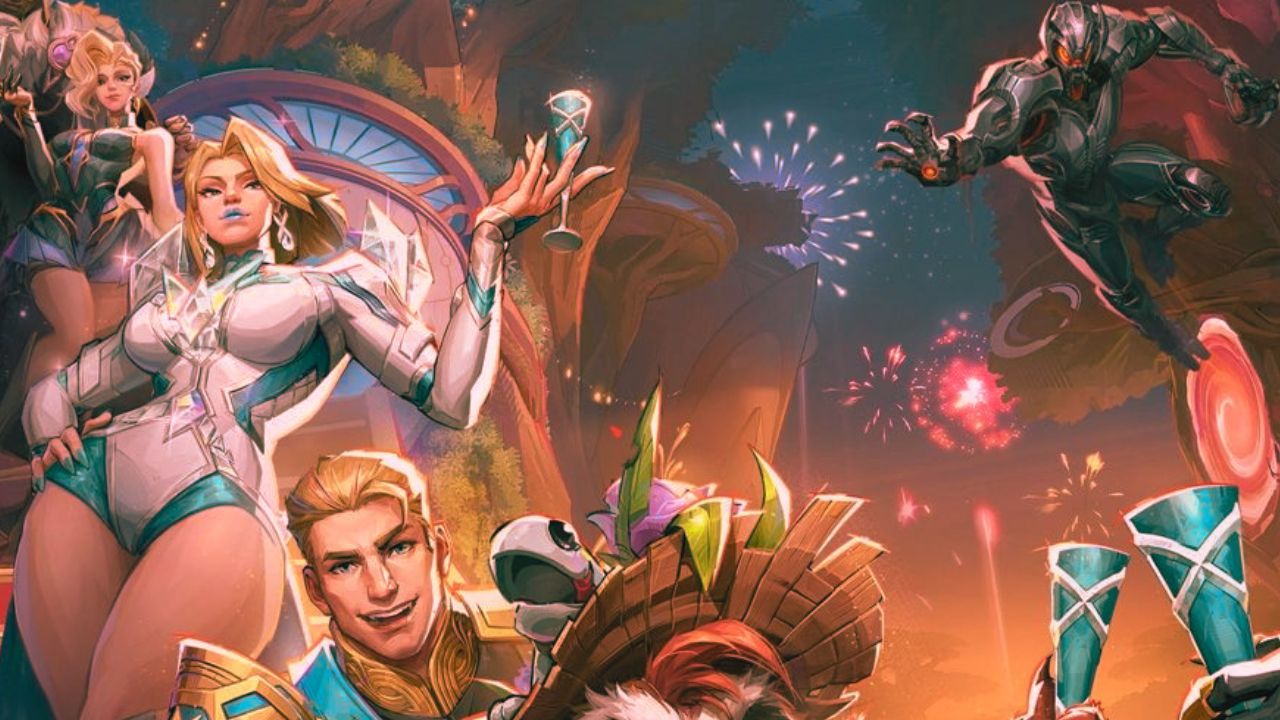
Marvel Rivals Season 2 has reshaped the battlefield with major balance updates, new hero additions, and evolving team compositions that continue to redefine the competitive meta. With the arrival of powerful characters like Emma Frost and ongoing adjustments to existing heroes, players are constantly adapting their strategies to stay ahead in ranked matches and tournaments. Season 2 has also shifted the focus toward stronger Vanguard-centric lineups, creating new opportunities for aggressive plays, defensive setups, and game-changing team synergies.
Whether you’re climbing the competitive ladder, searching for the strongest carry heroes, or simply looking for the best character to main in 2026, understanding the current tier list is essential. In this comprehensive Marvel Rivals Season 2 tier list, we rank every hero based on their overall effectiveness, win potential, versatility, and impact in the current meta, helping you identify which characters dominate matches and which ones struggle to keep pace with the competition.
What Are the Top Heroes in the Marvel Rivals Season 2 Tier List
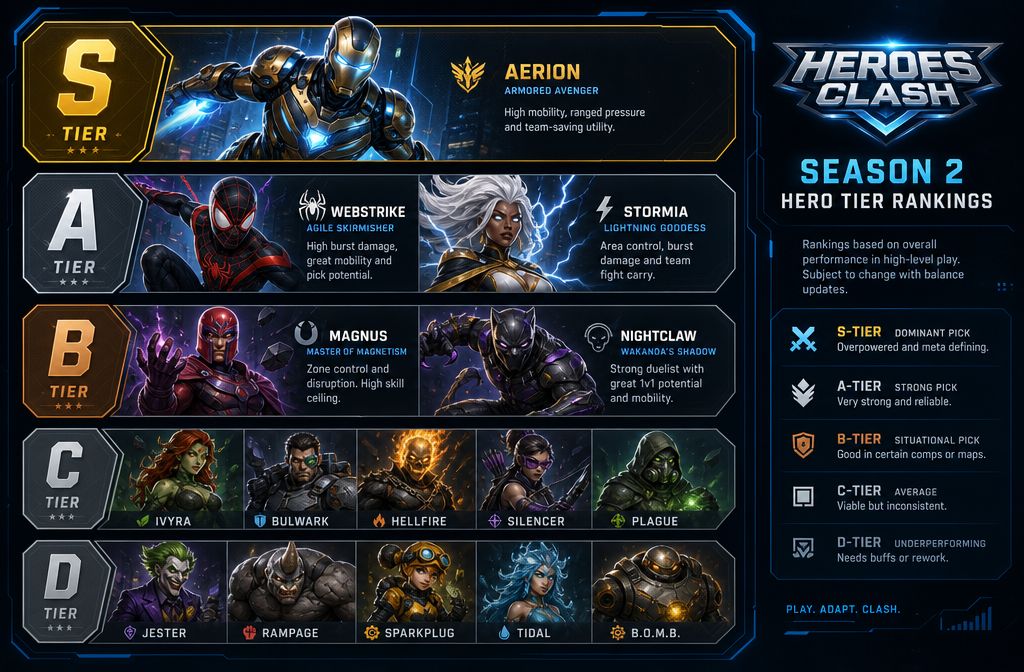
The top-ranked heroes in the Marvel Rivals Tier List Season 2 are Iron Man (S-Tier), Scarlet Witch (S-Tier), and Storm (S-Tier). These three characters dominate ranked lobbies because their kits offer high damage output, strong survivability tools, and flexible positioning that suits both aggressive and defensive play styles.
S-Tier (Best in Meta):
- Iron Man — High mobility, consistent ranged burst, and a powerful ultimate that resets on multi-kills
- Scarlet Witch — Area-denial chaos bolts, a team-wide debuff aura, and one of the best escape tools in the game
- Storm — Zone control, sustained AOE pressure, and a passive that rewards staying airborne
A-Tier (Strong, Reliable Picks):
- Spider-Man, Magneto, Captain America, Thor
B-Tier (Situationally Good):
- Venom, Black Panther, Hulk, Rocket Raccoon
C-Tier (Below Average):
- Hawkeye, Ant-Man, Winter Soldier
D-Tier (Hard to Justify in Ranked):
- Classic Loki (pre-rework), Squirrel Girl
Choose S-Tier heroes if your goal is climbing ranked quickly. Choose A-Tier picks if you prefer a more versatile playstyle that adapts to different enemy compositions.
How Does the Season 2 Tier List Change From Season 1
Season 2 brought the most significant meta shift since the game launched. The biggest change is the move away from dive-heavy compositions that dominated Season 1, toward ranged burst and zone-control lineups.
Key changes from Season 1 to Season 2:
- Venom dropped from S-Tier to B-Tier after a 12% damage reduction to his Symbiote Slam ability and a nerf to his passive healing
- Black Panther lost his Season 1 dominance following a cooldown increase on Vibranium Dash, his primary engage tool
- Iron Man rose from A-Tier to S-Tier after buffs to his repulsor beam range and a reduction in his ultimate charge time
- Storm was newly introduced in Season 2 and immediately entered S-Tier based on competitive play data from the first ranked split
- The team-up mechanic was reworked so that synergy bonuses now apply to three-hero combos rather than two, which fundamentally changed how teams are built
For players who invested heavily in mastering Venom or Black Panther in Season 1, the transition requires learning new positioning habits rather than completely rebuilding muscle memory.
Which Characters Got Nerfed or Buffed in Season 2
Fourteen heroes received changes in the Season 2 launch patch, with additional adjustments in the mid-season update released in April 2026.
Notable Buffs:
- Iron Man: +15% repulsor range, -20% ultimate charge requirement
- Scarlet Witch: Chaos bolt now applies a 1.5-second slow on hit
- Thor: Mjolnir throw cooldown reduced from 8 seconds to 6 seconds
- Magneto: Shield duration increased by 2 seconds
Notable Nerfs:
- Venom: Symbiote Slam damage reduced by 12%, passive healing halved
- Black Panther: Vibranium Dash cooldown increased from 5 to 7 seconds
- Hawkeye: Arrow damage reduced by 8%, quiver capacity lowered
- Ant-Man: Shrink ability no longer grants full damage immunity, only 60% reduction
New Heroes Added:
- Silver Surfer (A-Tier): High-speed traversal, energy beam burst damage
- Ms. Marvel (B-Tier): Reach-based melee, strong in close-range brawls
- Ghost Rider (Rework, B-Tier): Chain-based AOE, new hellfire passive
How Much Does Marvel Rivals Cost to Play Right Now
Marvel Rivals is free to play on all platforms in 2026. There is no base game purchase required. Players can download it at no cost on PC via Steam, on PlayStation 5, and on Xbox Series X/S.
The monetization model includes:
- Season Pass (approximately $9.99 USD per season): Unlocks cosmetic skins, sprays, and titles — no gameplay advantages
- Hero Bundles: Cosmetic-only packs ranging from $4.99 to $19.99
- In-game currency (Chrono Tokens): Earned through gameplay or purchased; used for cosmetics only
All 32 playable heroes in Season 2 are available to every player for free. No hero is locked behind a paywall. This makes Marvel Rivals one of the more player-friendly free-to-play hero shooters available in 2026, comparable to how Fortnite Chapter 6 handles its battle pass model.
What Team Compositions Work Best in Competitive Play
The strongest team compositions in Season 2 are built around two core archetypes: burst-and-zone and dive-disruption. Three-hero synergy bonuses now make composition planning more important than in Season 1.
Top Competitive Compositions:
| Composition Name | Heroes | Strength |
|---|---|---|
| Sky Dominance | Iron Man, Storm, Scarlet Witch | AOE pressure, air control |
| Shield Wall | Magneto, Captain America, Thor | Tank frontline, peel for backline |
| Chaos Dive | Spider-Man, Venom, Black Panther | High-speed engage, split pressure |
| Support Anchor | Rocket Raccoon, Ms. Marvel, Thor | Sustain, team-up bonus active |
The Sky Dominance trio is currently the most picked composition in Platinum rank and above, according to community tracking data from the Marvel Rivals subreddit (r/MarvelRivals, 2026).
Decision rule: Choose Sky Dominance if the enemy team has no reliable anti-air. Switch to Shield Wall if you are facing heavy dive compositions that keep eliminating your backline.
Is Marvel Rivals Good for Casual or Hardcore Players
Marvel Rivals works well for both audiences, but for different reasons. Casual players benefit from the accessible hero roster, recognizable IP, and short match times (average 12 to 15 minutes per match). Hardcore players are drawn to the deep team-up mechanics, ranked ladder, and frequent balance updates that keep the meta evolving.
For casual players:
- Quick-play modes have no rank at stake
- Auto-suggested team compositions help newer players build synergy
- The Marvel license makes character recognition immediate and approachable
For competitive players:
- Six ranked tiers with a top 500 leaderboard
- Weekly balance patches create an evolving meta
- Team-up synergy bonuses reward coordinated play at high levels
The game sits in a similar space to other hero shooters when it comes to skill ceiling. If you enjoy comparing hero rankings across games, the Apex Legends tier list for 2026 offers a useful point of comparison for how meta rankings function in fast-paced competitive shooters.
Why Are Some Heroes Ranked Lower Than Expected
Some heroes rank lower on the Marvel Rivals Tier List Season 2 not because they are weak in absolute terms, but because the current meta punishes their specific weaknesses. Hawkeye is a good example: his raw damage output is competitive, but the Season 2 shift toward mobile, close-range heroes means he is frequently eliminated before he can contribute.
Other factors that push heroes down the tier list:
- Cooldown dependency: Heroes whose kits rely on long-cooldown abilities (Ant-Man, Winter Soldier) struggle in the faster-paced Season 2 fights
- Counter-meta prevalence: Magneto’s shield directly counters Hawkeye’s projectile arrows, and Magneto is currently in A-Tier
- Team-up incompatibility: Some heroes do not slot into any of the three-hero synergy combos that define the current meta, making them a passive drag on team bonus activation
Common mistake: Players often assume a hero is “bad” because they see it ranked C or D-Tier. In casual or quick-play modes, those same heroes can perform well. Tier lists specifically reflect ranked, coordinated play.
Which Heroes Are Hardest to Master in Season 2
The five hardest heroes to master in the current season are Scarlet Witch, Silver Surfer, Spider-Man, Ant-Man, and Ghost Rider. Each requires either precise mechanical input, deep game-sense, or both.
- Scarlet Witch: High skill floor because her chaos bolt trajectory requires prediction rather than reaction-time aim
- Silver Surfer: Speed-based kit punishes positional errors; one misjudged approach angle leads to immediate elimination
- Spider-Man: Web-swinging traversal has a steep learning curve; effective use requires consistent practice in training mode
- Ant-Man: Shrink timing windows are narrow (under 0.4 seconds in most scenarios); mistimed shrinks waste the ability entirely
- Ghost Rider: Chain AOE requires understanding of hitbox geometry that is not intuitive for new players
If you are new to the game, starting with Captain America or Thor is the better path. Both heroes have forgiving kits and clear, readable feedback on whether abilities land correctly.
Can F2P Players Compete at High Ranks
Yes. Free-to-play players can fully compete at Diamond rank and above in Marvel Rivals Season 2. Every hero is unlocked for free, and no paid cosmetic provides a gameplay advantage.
The in-game Chrono Token system awards currency through:
- Daily login bonuses
- Completing weekly challenges
- Ranked placement rewards at the end of each split
A dedicated F2P player can earn enough Chrono Tokens to unlock all seasonal cosmetics within a single season without spending money, based on the token economy outlined in the Season 2 patch notes (NetEase Games, 2026).
The only area where spending money has an indirect effect is time: paid players can unlock cosmetic bundles faster, which has no bearing on ranked performance.
What Characters Counter the Current Meta Heroes
Countering the S-Tier picks in the Marvel Rivals Tier List Season 2 requires specific hero choices and positioning adjustments.
| Meta Hero | Best Counter | Why It Works |
|---|---|---|
| Iron Man | Magneto | Magnetic shield absorbs repulsor beams; pull ability disrupts flight path |
| Scarlet Witch | Thor | Mjolnir throw interrupts chaos bolt channel; high burst damage closes gap fast |
| Storm | Spider-Man | Web-pull removes Storm from air advantage; close-range damage bypasses her AOE range |
Counter-picking tips:
- Do not hard-counter-pick before seeing the enemy team’s full composition
- A counter pick that does not fit your team’s synergy combo is often worse than staying on an A-Tier pick that completes a three-hero bonus
- Magneto is the most versatile counter pick in Season 2 because he answers both Iron Man and Hawkeye
How Often Does the Marvel Rivals Tier List Get Updated
The Marvel Rivals Tier List Season 2 shifts meaningfully every four to six weeks, aligned with NetEase Games’ balance patch schedule. Minor adjustments (single-hero tuning) happen more frequently, roughly every two weeks.
The Season 2 roadmap published by NetEase Games in early 2026 confirmed:
- One major balance patch per month
- One mid-season content drop (new hero or map) approximately eight weeks into the season
- A final balance pass two weeks before Season 3 begins
For players tracking the meta closely, bookmarking the official patch notes page and community tier list aggregators (such as the r/MarvelRivals community rankings) is the most reliable approach. Tier lists published more than three weeks ago may already be outdated after a balance patch.
Are There Any Game-Breaking Bugs in the Current Season
No game-breaking bugs are currently affecting ranked matches as of the June 2026 patch. NetEase Games resolved the two most significant issues from the Season 2 launch: a collision bug that allowed Ant-Man to clip through certain map geometry, and a visual glitch that caused Scarlet Witch’s chaos bolt to appear to miss while still registering a hit.
Minor known issues as of June 2026:
- Ghost Rider’s chain audio occasionally desyncs from the animation (cosmetic only, no gameplay impact)
- The post-match stats screen sometimes fails to display team-up bonus totals correctly
- A rare lobby crash affecting less than 0.3% of matches on older hardware configurations (per NetEase support documentation, 2026)
NetEase has a public bug tracker and typically patches critical gameplay-affecting bugs within 48 to 72 hours of community reports.
What Are the Most Common Mistakes New Players Make
New players most often lose ranked games because of team composition errors, not individual skill gaps. Picking three damage dealers with no tank or support hero is the single most common mistake seen in Bronze and Silver lobbies.
Other frequent mistakes:
- Ignoring the team-up synergy system: Not building toward a three-hero combo leaves a passive bonus permanently inactive
- Over-relying on ultimates: Saving ultimates for “perfect moments” that never come rather than using them consistently
- Not using the training range: Silver Surfer and Scarlet Witch both have mechanics that take 30 to 60 minutes of practice to understand at a basic level
- Chasing eliminations instead of objectives: Marvel Rivals is objective-based; kills that do not advance the objective are often wasted effort
- Switching heroes mid-match too frequently: Changing heroes resets your team-up bonus progress and disrupts synergy
For players managing a large backlog of competitive games alongside Marvel Rivals, these tips for managing a massive gaming backlog can help structure practice time more effectively.
Frequently Asked Questions (FAQs)
What is the best hero for beginners in Marvel Rivals Season 2?
Captain America is the best starting hero. His kit is straightforward, his shield throw has generous hitboxes, and his passive provides clear feedback when abilities are used correctly.
Is Marvel Rivals available on mobile in 2026?
A mobile version was announced but has not launched as of June 2026. The game is currently available on PC (Steam), PlayStation 5, and Xbox Series X/S only.
How long does a typical ranked match last?
Most ranked matches last between 12 and 18 minutes. Control mode matches tend to run shorter; escort mode matches can extend to 20 minutes with overtime.
Does the tier list apply to all game modes or just ranked?
The Marvel Rivals Tier List Season 2 reflects ranked play specifically. In casual quick-play, hero performance is less affected by meta because coordination and synergy bonuses are used less consistently.
Is Season 2 content available in all regions?
Yes. Season 2 launched simultaneously in all supported regions. Server availability and ping quality vary by location, but the content itself is region-uniform.
How many heroes are in Marvel Rivals Season 2 total?
Season 2 added three heroes (Silver Surfer, Ms. Marvel, Ghost Rider rework) to bring the total roster to 32 playable characters.
Can you play Marvel Rivals on Steam Deck?
Marvel Rivals is officially supported on Steam Deck with a verified status as of early 2026. Performance is stable at medium settings with the latest AMD driver updates.
Final Thoughts
The Marvel Rivals Tier List Season 2 rewards players who adapt quickly to meta shifts rather than holding onto Season 1 habits. Iron Man, Scarlet Witch, and Storm are the clearest path to ranked success right now, but understanding why heroes like Venom and Black Panther dropped is just as valuable as knowing who to pick.
Actionable next steps:
- Start with Captain America or Thor to build game fundamentals before moving to mechanical heroes like Silver Surfer or Spider-Man
- Build team compositions around three-hero synergy combos from the start of each match, not as an afterthought
- Check the official patch notes every two to four weeks because the tier list shifts with each balance update
- Use the training range for at least 30 minutes before taking a new high-skill-ceiling hero into ranked play
- If you are F2P, prioritize completing weekly challenges to accumulate Chrono Tokens for cosmetics without affecting your competitive performance
For players interested in how Marvel Rivals compares to other competitive titles in 2026, the PlayStation vs Xbox vs PC platform comparison is a useful resource for deciding where to invest your ranked hours. And if you want to track the broader gaming landscape this year, the most anticipated games of June 2026 covers what else is competing for your time.
The meta will keep changing. The players who climb consistently are the ones who understand the system well enough to adapt within a day or two of each patch, rather than waiting for the community to settle on a new consensus.