
The gaming industry is evolving at a faster pace than ever before, driven by breakthroughs in artificial intelligence, cloud computing, virtual reality, and next-generation hardware. As we move closer to 2030, the way players interact with games, the platforms they use, and even how games are developed and monetized are expected to undergo major transformations. From fully immersive virtual worlds to AI-driven storytelling and cross-platform ecosystems, the future of gaming promises to blur the line between reality and digital entertainment.
In this article, we explore the most significant predictions shaping the gaming industry before 2030 and what these changes could mean for developers, players, and the global gaming economy.
How Much Money Is the Gaming Industry Expected to Make by 2030?
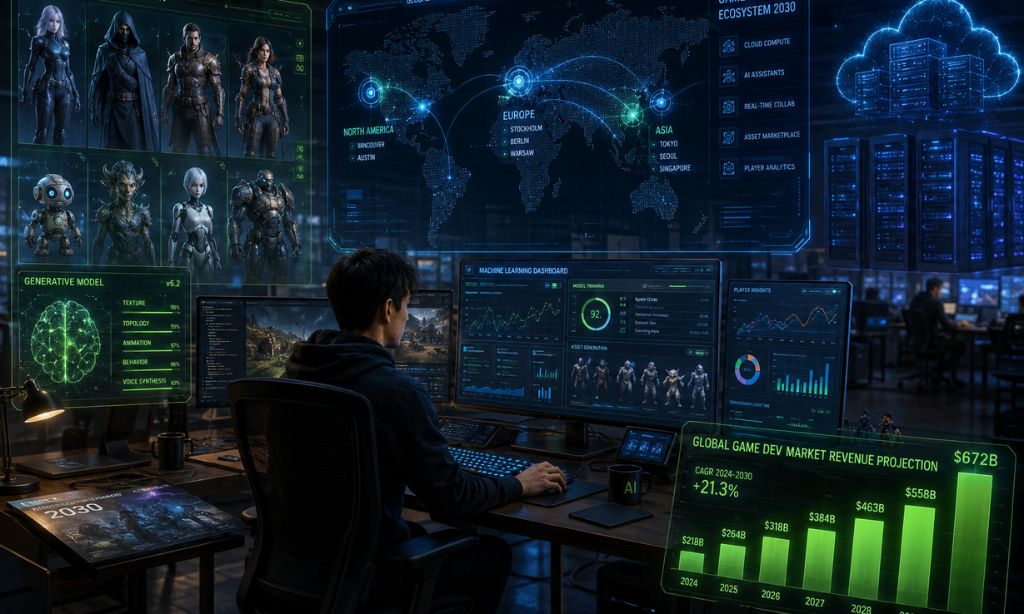
The gaming industry is one of the fastest-growing entertainment sectors in the world. According to data from Newzoo’s Global Games Market Report (2023), the market was valued at approximately $184 billion in 2023. Multiple analyst firms — including PwC and Mordor Intelligence — project the industry could reach between $300 billion and $500 billion by 2030, depending on adoption rates for cloud gaming, VR, and mobile expansion in emerging markets.
Key revenue drivers heading into 2030:
- Mobile gaming (free-to-play with in-app purchases)
- Live-service and subscription models
- Esports and streaming-related revenue
- VR/AR hardware and software sales
- In-game advertising, especially on mobile
These gaming industry predictions around revenue are conservative by some estimates. If VR adoption accelerates or a major new platform category emerges, the ceiling could be higher. For a deeper look at how platform choices affect spending, see this comparison of PlayStation vs Xbox vs PC gaming options.
What Are the Biggest Tech Trends Changing Video Games Right Now?
Three technologies are actively reshaping games in 2026: generative AI, real-time ray tracing, and cloud rendering. Each one changes a different layer of how games are built and experienced.
Generative AI is being used to create dialogue trees, NPC behavior, and even level geometry. Tools from companies like NVIDIA and various game-engine developers now let smaller studios produce content that previously required large teams.
Ray tracing has moved from a premium PC feature to a standard expectation on mid-range hardware, making lighting and reflections dramatically more realistic without requiring entirely new art pipelines.
Cloud rendering allows processing-heavy visuals to run on remote servers and stream to lower-powered devices — phones, smart TVs, even older laptops — which expands who can play demanding games.
Other notable trends:
- Cross-platform play becoming a baseline expectation, not a feature
- Haptic feedback and adaptive controllers improving accessibility
- Procedural generation used to build larger, more varied game worlds at lower cost
How Will AI Impact Game Development and Design?
AI is already changing game development, and by 2030 it will likely be standard in most studios’ workflows. The most direct impacts are on content creation speed, NPC intelligence, and quality assurance testing.
Where AI is making the biggest difference:
| Development Area | AI Application | Likely Outcome by 2030 |
|---|---|---|
| Art & asset creation | Generative image/3D tools | Faster prototyping, smaller art teams |
| Dialogue & narrative | Large language models | More branching, reactive storylines |
| QA testing | Automated bug detection | Fewer human QA hours needed |
| NPC behavior | Reinforcement learning | More believable, adaptive enemies/allies |
| Localization | AI translation + cultural review | Faster global releases |
Common mistake to avoid: Assuming AI will replace all game developers. The more accurate gaming industry prediction is that AI will shift developer roles — less repetitive asset work, more creative direction, system design, and AI supervision. Studios that treat AI as a tool rather than a replacement will have an advantage.
Will Cloud Gaming Finally Replace Traditional Console Gaming?
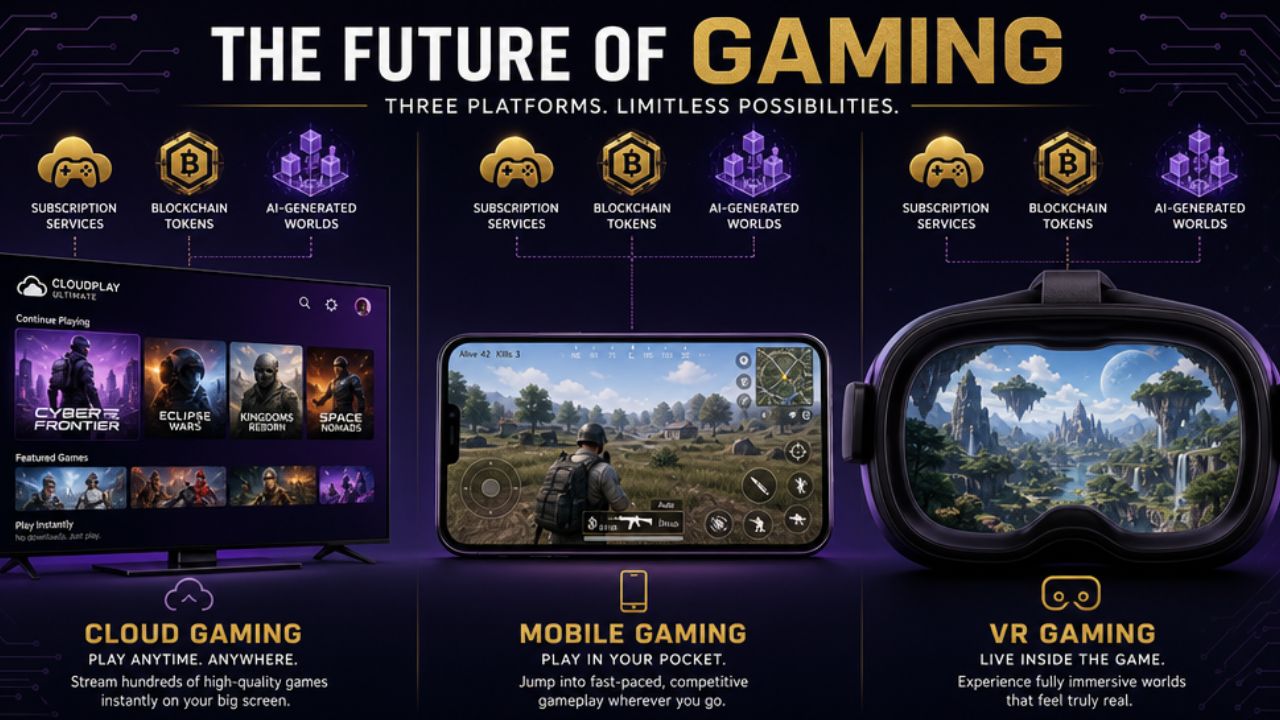
Cloud gaming won’t replace consoles before 2030, but it will take a meaningful share of the market — especially in regions where buying a $500 console is a significant barrier. Services like Xbox Cloud Gaming, NVIDIA GeForce NOW, and PlayStation’s cloud options are already functional, but consistent high-speed internet access remains uneven globally.
Choose cloud gaming if:
- You play on multiple devices and don’t want to buy hardware
- You live in an area with reliable low-latency broadband
- You prefer access to a library over owning individual games
Stick with a console or PC if:
- You play competitive games where input latency matters
- Your internet connection is inconsistent
- You prefer physical media or permanent game ownership
By 2030, the most likely outcome is a hybrid model: consoles and PCs handle local, high-performance play, while cloud handles casual, on-the-go sessions. The debate over which platform suits different players best is ongoing — this breakdown of PlayStation vs Xbox vs PC covers the current state well.
Which Gaming Platforms Are Most Likely to Grow in the Next 5 Years?
Mobile and PC are the two platforms with the strongest growth trajectories heading toward 2030. Console growth will be steadier but more modest, while VR/AR represents the highest-risk, highest-potential category.
Platform growth outlook:
- Mobile: Largest player base globally; growth driven by Southeast Asia, Africa, and Latin America. Monetization through ads and in-app purchases will keep revenue climbing.
- PC: Steady growth, especially in esports and high-end gaming. The PC gaming hardware market benefits from upgradeable components and a large modding community.
- Console: Nintendo, Sony, and Microsoft will all release new hardware iterations before 2030. Growth is solid but slower than mobile.
- VR/AR: Meta Quest and competitors are expanding the install base, but mass adoption depends on price drops and a stronger game library.
- Handheld hybrids: Devices like the Steam Deck and Nintendo’s portable lineup are carving out a distinct segment between mobile and console.
Will Mobile Gaming Continue to Dominate Global Gaming Markets?
Yes — mobile gaming is already the largest gaming segment by both player count and revenue share in many regions, and that position is unlikely to change before 2030. According to Newzoo (2023), mobile accounted for roughly 50% of global games revenue, and smartphone penetration in developing markets continues to rise.
The growth isn’t just about casual games. Mobile esports titles like PUBG Mobile and Mobile Legends: Bang Bang draw millions of competitive players, particularly in Asia. As 5G networks expand, mobile gaming experiences will improve further.
Edge case: Mobile dominance is strongest in Asia-Pacific and Latin America. In North America and Western Europe, PC and console still command higher per-player spending, even if mobile leads in raw user numbers.
Are Subscription Game Services Going to Replace Buying Individual Games?
Subscription services are growing fast, but they won’t fully replace individual game purchases before 2030. The model works well for players who want variety, but many gamers still prefer to own specific titles — especially major releases with long replay value.
Current major services (as of 2026):
- Xbox Game Pass (now Xbox Game Pass Ultimate)
- PlayStation Plus (Essential, Extra, Premium tiers)
- Apple Arcade
- EA Play
- Nintendo Switch Online
The risk for publishers is that subscription revenue per title is lower than direct sales, which could reduce budgets for big single-player games. The risk for players is that games can be removed from services without warning.
Prediction: By 2030, subscriptions will likely be the primary access method for casual and mid-tier games, while major AAA releases will still launch as paid titles first — possibly with a subscription window 6-12 months after release.
What New Game Genres Might Emerge With Virtual Reality Tech?
VR is finding its strongest footing in genres that benefit from physical presence: fitness games, social spaces, horror, and immersive simulations. Before 2030, expect a few new genre categories to solidify around VR’s unique strengths.
Emerging VR-native genres:
- Social VR worlds (persistent spaces for hanging out, not just gaming)
- Physical fitness games that double as workouts (already established with Beat Saber and similar titles)
- Narrative walk-through experiences closer to interactive film than traditional games
- VR esports with physical movement as a core mechanic
- Therapeutic and educational simulations (phobia treatment, surgical training, history exploration)
The challenge is that most existing genres (shooters, RPGs, strategy) don’t translate cleanly to VR without significant redesign. Studios that build for VR first — rather than porting flat-screen games — are the ones producing the most compelling experiences.
How Are Blockchain and NFT Technologies Changing Game Economics?
Blockchain gaming peaked in hype around 2021-2022 and has since settled into a smaller but more focused niche. The core promise — that players can truly own in-game assets and trade them freely — remains appealing, but execution has been inconsistent.
What’s actually working in 2026:
- Player-owned digital item marketplaces in specific titles
- Blockchain-verified tournament prize distribution
- Limited-edition digital collectibles with verifiable scarcity
What hasn’t worked as predicted:
- “Play-to-earn” models that sustained real income for most players
- Mainstream player adoption of crypto wallets as a gaming requirement
- Major publishers fully committing to on-chain economies
The gaming industry prediction most analysts agree on: blockchain will remain a niche tool rather than a universal standard before 2030. Players who enjoy collecting and trading digital assets will find dedicated platforms, but the average gamer won’t notice or care about the underlying technology.
What Countries Are Becoming Major Game Development Hubs?
Game development is spreading well beyond the US, Japan, and the UK. Several countries are investing heavily in their gaming sectors, and by 2030, the map of where games are made will look noticeably different.
Rising game development hubs:
- South Korea: Already a global leader in online and mobile games (Nexon, Krafton, NCsoft). Expanding into console and PC development.
- Brazil: Large domestic market, growing indie scene, and government incentives for tech startups.
- Poland: CD Projekt Red put Poland on the AAA map; a broader ecosystem of studios has followed.
- Vietnam and Indonesia: Low development costs, strong mobile gaming cultures, and increasing technical talent.
- UAE and Saudi Arabia: Active government investment in gaming infrastructure and esports as part of economic diversification.
For players curious about regional gaming platforms, Yandex Games offers a useful look at how Eastern European and Russian gaming ecosystems operate.
What Skills Do Game Developers Need to Stay Competitive in the Next Decade?
Developers who combine traditional craft skills with AI literacy and live-service knowledge will be most in demand before 2030. The industry is moving away from one-time releases toward ongoing, evolving games — which changes what studios need from their teams.
High-value skills for game developers heading into 2030:
- AI tool proficiency — knowing how to use generative tools for art, code, and narrative without losing creative control
- Live-service design — balancing content updates, player retention, and monetization ethically
- Cross-platform development — building games that work across mobile, console, PC, and cloud simultaneously
- Data analysis — reading player behavior data to inform design decisions
- Accessibility design — creating games that work for players with disabilities, which is increasingly a legal and ethical expectation
Common mistake: Focusing only on technical skills. Studios in 2026 are hiring for creative problem-solving, communication, and adaptability as much as for specific software knowledge.
What Challenges Might Stop Some Predicted Gaming Industry Changes?
Not every gaming industry prediction will come true on schedule. Several real obstacles could slow or redirect the changes analysts expect before 2030.
Key challenges:
- Infrastructure gaps: Cloud gaming and VR both require fast, reliable internet. Large portions of the world don’t have it, and rollout timelines are uncertain.
- Regulatory pressure: Loot boxes, in-game purchases targeting minors, and data privacy laws are under increasing scrutiny in the EU, UK, and parts of Asia. New rules could reshape monetization models quickly.
- Development cost inflation: AAA games already cost hundreds of millions to produce. If AI doesn’t reduce costs as expected, studios may consolidate further, reducing variety.
- Player fatigue: Subscription overload is real. If players feel they’re paying for too many services with too little time to use them, churn rates will rise.
- Economic downturns: Gaming is relatively recession-resistant, but a prolonged global economic slowdown would reduce discretionary spending on hardware and premium titles.
Final Thoughts
As we look ahead to 2030, it is clear that the gaming industry is on the edge of a major transformation. Technological advancements such as AI-driven game design, cloud gaming expansion, immersive VR/AR experiences, and more interconnected global gaming ecosystems will redefine how games are created and played. What once felt experimental is quickly becoming the new standard.
For players, this means richer, more personalized experiences that go beyond traditional gameplay. For developers and businesses, it opens new opportunities—but also brings increased competition and the need for constant innovation. Ultimately, the next few years will not just change games themselves, but the entire culture and economy surrounding gaming.
Frequently Asked Questions (FAQs): Gaming Industry Predictions Before 2030
Will physical game discs disappear before 2030?
Physical media is declining but won’t vanish entirely before 2030. Some console makers are already selling disc-free hardware, but collectors and players in areas with slow internet will keep physical formats alive in a smaller capacity.
Which gaming genre is growing the fastest right now?
Battle royale and open-world survival games remain strong, but social simulation games (like those in the Roblox ecosystem) are growing fastest by new player count, particularly among younger audiences. For more on Roblox’s appeal, see this guide to creating a new Roblox account.
Will esports become an Olympic sport before 2030?
Esports appeared at the 2024 Paris Olympics as a demonstration event, and the 2028 Los Angeles Olympics is expected to include it in some form. Full medal status before 2030 is possible but not confirmed.
Is PC gaming dying?
No. PC gaming is growing, not dying. The PC gaming hardware market continues to expand, and PC remains the dominant platform for esports, modding communities, and strategy games.
How will AI change the games players actually experience?
Players will notice more reactive NPCs, more personalized difficulty adjustments, and more dynamic game worlds. AI-generated side quests and dialogue are already appearing in some titles.
Will there be a new major console generation before 2030?
Yes. Sony, Microsoft, and Nintendo are all expected to release new hardware before 2030. The PlayStation 6 and next Xbox are widely anticipated in the 2027-2028 timeframe, though no official dates have been confirmed as of May 2026.