
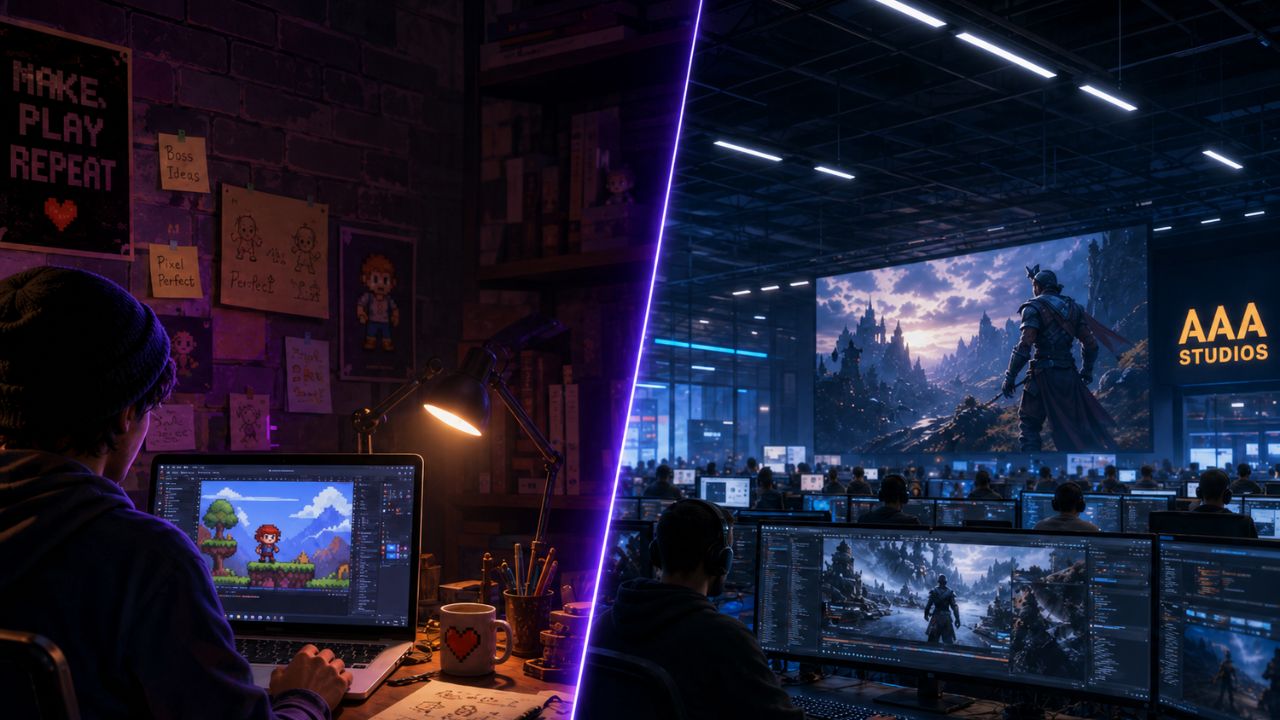
The gaming industry in 2026 is no longer dominated solely by massive studios with billion-dollar budgets. Today, indie games are competing directly with AAA titles by delivering innovative gameplay, unique storytelling, and highly engaged player communities. Thanks to accessible game development tools, crowdfunding platforms, AI-assisted design, and digital distribution services, independent developers now have the power to create experiences that rival even the biggest publishers. From viral multiplayer sensations to emotionally driven narrative adventures, indie games are reshaping the future of gaming and challenging traditional industry standards.
At the same time, many players are becoming more interested in creativity and originality rather than just high-end graphics or blockbuster marketing campaigns. While AAA games continue to offer cinematic experiences and large-scale productions, indie developers are winning audiences through experimentation, faster innovation, and closer community interaction. In this article, we will explore how indie games are competing with AAA titles in 2026, the strategies helping smaller studios succeed, and why the balance of power in the gaming industry is rapidly changing.
What Makes Indie Games Different From AAA Games Now
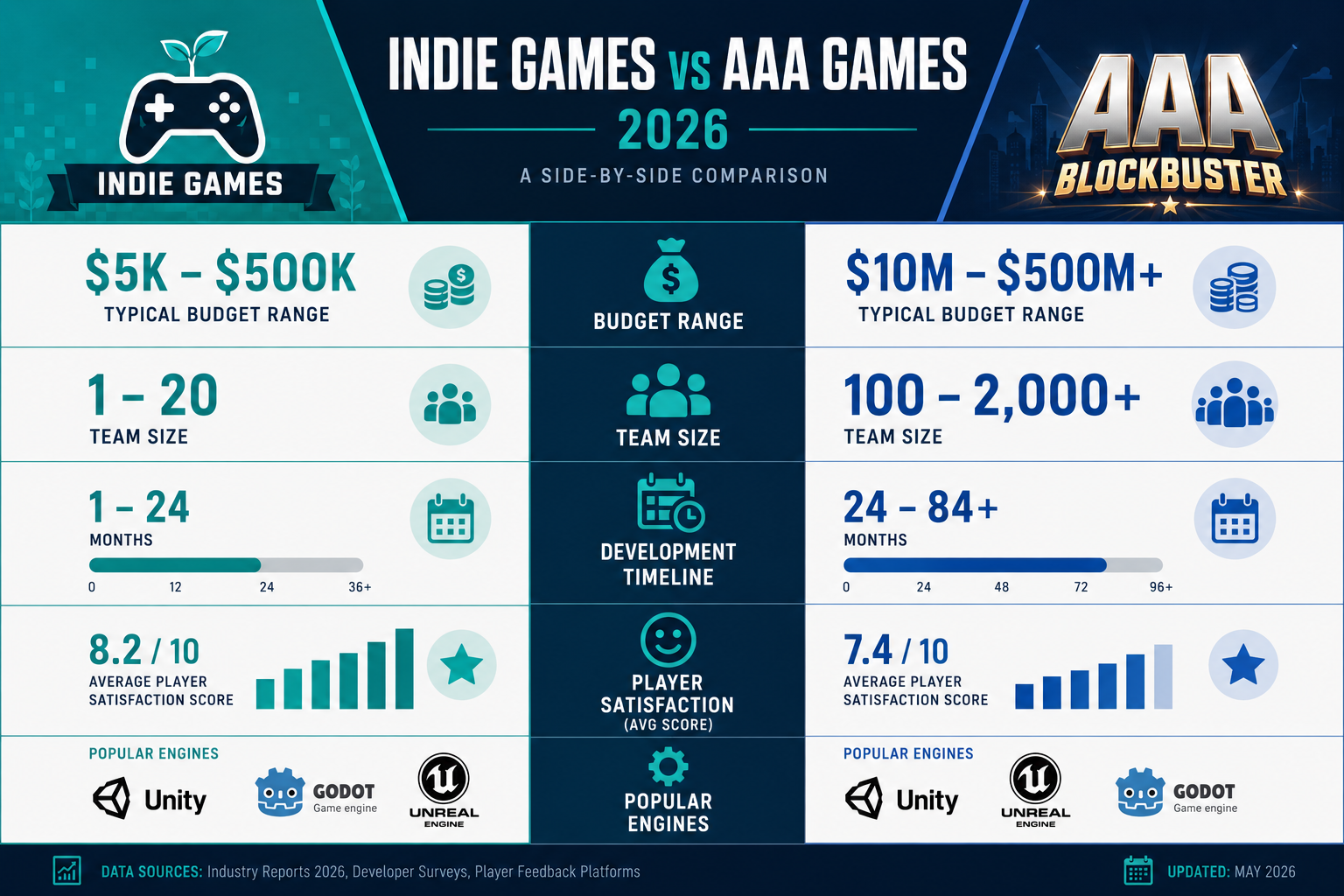
Indie games in 2026 are defined less by budget and more by creative autonomy. An indie studio typically operates without a major publisher controlling the creative direction, which means developers can take risks that a $200 million production simply cannot afford.
The practical differences are significant:
| Factor | Indie Games | AAA Games |
|---|---|---|
| Team size | 1–50 people | 200–5,000+ people |
| Budget range | $10K–$5M (estimated) | $50M–$300M+ |
| Dev cycle | 6 months–3 years | 3–8 years |
| Creative control | Full (developer-led) | Shared with publisher |
| Risk tolerance | High | Low |
| Monetization | Premium or small DLC | Often live-service, microtransactions |
The key shift in 2026 is that the quality gap has narrowed sharply. AI-assisted tools for animation, voice acting, and QA testing have given small teams capabilities that previously required entire departments. A two-person studio can now ship a game with professional-grade audio and polished UI — something that was nearly impossible five years ago.
How Are Small Game Studios Beating Big-Budget Titles
Small studios are beating big-budget titles by doing fewer things better. AAA publishers face pressure to appeal to the widest possible audience, which often results in safe, familiar design. Indie developers can target a specific niche and serve it exceptionally well.
Three core advantages indie studios hold in 2026:
- Speed. A small team can respond to player feedback and ship a patch within days. A large studio might take months to push a meaningful update through its approval chain.
- Authenticity. Games built by a handful of passionate developers often carry a distinct voice. Players notice — and they talk about it online, which drives organic discovery.
- Price. Most indie titles launch at $10–$25. At a time when AAA games regularly launch at $70–$80 (and more with editions and season passes), price alone is a meaningful differentiator.
Which Indie Games Have Outsold Major Studio Releases Recently
Several indie titles have outsold or outperformed major studio releases on a per-dollar-invested basis. Stardew Valley (developed by a single person, ConcernedApe) has sold over 30 million copies as of 2024, according to the developer’s public statements. Hades by Supergiant Games won multiple Game of the Year awards in 2020 and continued selling strongly through 2026. Hollow Knight by Team Cherry sold over 3 million copies with a team of three.
These aren’t outliers anymore — they’re a pattern. The best games of recent years have consistently included indie titles alongside major studio productions, and that trend has only strengthened in 2026.
What these breakout titles share:
- A clearly defined core loop that players can describe in one sentence
- Strong word-of-mouth potential (unusual art style, emotional story, or viral mechanics)
- Active developer communication on Discord, Reddit, and social platforms
- A launch price that feels like a no-brainer purchase
How Much Does It Cost to Develop an Indie Game in 2026
Developing an indie game in 2026 costs anywhere from $10,000 to $5 million, depending on scope, team size, and how much work is outsourced versus handled in-house. Most commercially successful indie games fall in the $50,000–$500,000 range (estimated based on publicly discussed budgets from developers on platforms like GDC Vault and indie dev forums).
Rough cost breakdown for a mid-tier indie game (estimated):
- Engine licensing: $0–$5,000/year (Godot is free; Unity and Unreal have revenue-share or subscription models)
- Art and animation: $15,000–$150,000 (varies widely based on style — pixel art is cheaper than 3D)
- Music and sound design: $5,000–$30,000
- QA and testing: $5,000–$20,000
- Marketing and launch: $10,000–$100,000+
- Platform fees: Steam charges a $100 listing fee; console certification has additional costs
AI tools have reduced art and audio costs noticeably in 2026, though the exact savings depend on the studio’s workflow and the tools used.
Choose this budget range if: You have a small team (2–5 people), a well-scoped concept, and 12–24 months to develop. Larger scopes need proportionally larger budgets and longer timelines.
Are Indie Games Cheaper Than AAA Games for Players
Yes — indie games are almost always cheaper than AAA titles for players, and that price gap has widened in 2026. Most AAA games now launch at $70–$80 on console and PC, with deluxe editions pushing past $100. Indie games typically launch at $5–$25, with many high-quality titles sitting at $15.
This price difference matters for a few reasons:
- Lower purchase risk. Players are more willing to try an unknown indie title at $12 than an unknown AAA game at $75.
- Better perceived value. A 20-hour indie RPG at $15 often feels like a better deal than a 60-hour AAA game padded with repetitive content.
- Sales and bundles. Indie games appear frequently in Humble Bundle and Steam sales, sometimes dropping to under $5, which drives volume.
For developers, this means pricing strategy is a real lever. Launching at $14.99 instead of $19.99 can meaningfully increase conversion rates, especially during the critical first-week discovery window.
What Game Engines Do Successful Indie Developers Use
The three dominant engines for indie development in 2026 are Unity, Godot, and Unreal Engine. Each has a different profile:
- Godot has grown dramatically since Unity’s controversial pricing changes in 2023. It’s free, open-source, and well-suited for 2D games. Many indie developers who left Unity migrated here.
- Unity remains widely used for both 2D and 3D indie projects, with a large asset store and strong community documentation.
- Unreal Engine 5 is increasingly accessible to small teams, especially for 3D games, though its learning curve and system requirements are steeper.
For developers building retro-style or pixel art games — a genre that continues to perform well — classic game design principles still inform how modern engines are used to recreate that feel authentically.
Choose Godot if: You’re building a 2D game, want zero licensing costs, and prefer an open-source ecosystem.
Choose Unity if: You need a large asset library, strong mobile support, and extensive tutorials.
Choose Unreal if: You’re building a 3D game and want cinematic-quality visuals with a revenue-share model.
How Are Indie Games Using AI and New Tech to Compete
AI tools have become a genuine equalizer for indie studios in 2026. Small teams are using AI for tasks that previously required dedicated specialists, including:
- Art generation and concept iteration (tools like Midjourney and Adobe Firefly for early concepting)
- Voice acting and localization (AI voice synthesis for non-critical dialogue, reducing localization costs)
- QA and bug detection (automated playtesting tools that flag common issues before human QA)
- Procedural content generation (AI-assisted level design for roguelikes and open-world games)
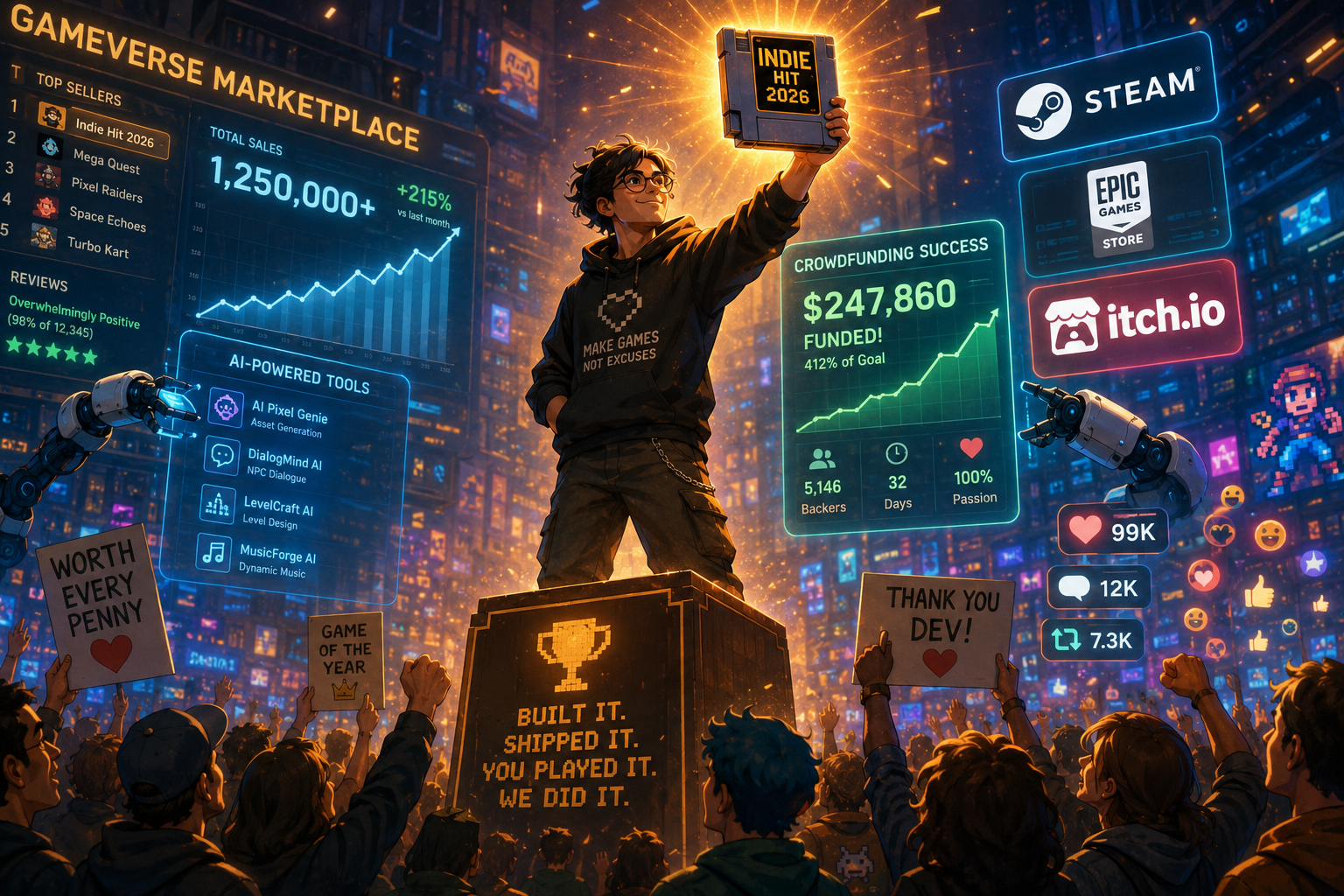
It’s worth noting that AI use in game development is still debated within the industry, particularly around art generation and its impact on human artists. Studios that use AI transparently and supplement (rather than replace) human creativity tend to receive better community reception.
Beyond AI, indie developers are also benefiting from:
- Better streaming software that makes it easier to connect with content creators (see best streaming software for gamers)
- Cross-platform tools that simplify porting to console without a separate codebase
- Community platforms like Discord for direct player feedback loops
Which Indie Game Genres Are Most Successful Right Now
The most commercially successful indie genres in 2026 are roguelikes, farming and life sims, narrative adventures, and precision platformers. These genres share a common trait: they reward replayability or emotional investment, which drives word-of-mouth.
Top-performing indie genres in 2026:
- Roguelikes/roguelites — High replayability, procedural generation keeps content costs manageable
- Farming and life sims — Strong, loyal player bases; offline farming games remain popular across all platforms
- Narrative adventures — Low art budget requirements if stylized; strong streaming appeal
- Precision platformers — Tight mechanics, speedrunning communities, high streamer visibility
- Cozy games — Broad demographic appeal, strong on Nintendo Switch and mobile
Genres that are harder for indie studios to compete in: Open-world action-RPGs, sports simulations, and military shooters — these categories are heavily dominated by AAA franchises with established brands and massive online player bases.
What Types of Gamers Prefer Indie Games Over AAA Titles
Gamers who prefer indie titles tend to prioritize originality, value, and a sense of connection to the developers. They’re not a niche group — in 2026, this segment represents a substantial portion of the PC gaming market.
Common characteristics of indie-first players:
- Value creative risk-taking over technical spectacle
- Active in gaming communities (Reddit, Discord, Twitch)
- More likely to follow developers directly on social media
- Comfortable with early access and beta participation
- Often fatigued by live-service monetization models in AAA games
This audience is also more likely to leave detailed reviews, share clips, and recommend games to friends — making them disproportionately valuable for organic growth. Indie studios that build genuine relationships with this community often see sustained sales long after launch.
Common Mistakes Indie Game Developers Make When Competing With Big Studios
The most common mistake indie developers make is building the game in isolation and only thinking about marketing after launch. Discoverability is the primary reason most indie games fail commercially — not quality.
Other frequent mistakes:
- Scope creep. Adding features that delay launch without meaningfully improving the core experience.
- Wrong platform choice. Launching exclusively on a platform where the target audience isn’t active.
- Ignoring wishlists. On Steam, wishlists before launch are a strong predictor of Day 1 sales. Building a wishlist campaign early is essential.
- Underpricing. Setting a price too low can signal low quality to potential buyers.
- Skipping a demo. Steam Next Fest and similar events reward studios that offer playable demos — they convert browsers into buyers.
Best Platforms for Indie Game Developers to Launch On
Steam remains the single most important platform for indie PC game launches in 2026, followed by Epic Games Store, itch.io, and GOG. For console, Nintendo Switch continues to be a strong market for indie titles, particularly in the cozy and platformer genres.
Platform comparison for indie developers:
| Platform | Revenue Share | Audience | Best For |
|---|---|---|---|
| Steam | 70/30 (up to 80/20 at scale) | Massive, global | Most genres |
| itch.io | Flexible (dev sets %) | Indie-focused | Experimental, jam games |
| Epic Games Store | 88/12 | Growing | Action, adventure |
| GOG | ~70/30 | DRM-free buyers | Retro, narrative |
| Nintendo eShop | ~70/30 | Family, cozy, platformer | Switch-optimized games |
Mobile (iOS/Android) remains viable for casual and puzzle games but is increasingly difficult for premium-priced titles due to the free-to-play dominance of the market.
How Crowdfunding Is Changing Indie Game Development
Crowdfunding has shifted from a funding mechanism to a community-building tool for indie developers. Kickstarter and similar platforms now serve as proof-of-concept validators — a successful campaign signals to press, platforms, and investors that an audience exists before a single line of code ships.
What crowdfunding does well for indie studios:
- Provides upfront capital without giving up equity or creative control
- Builds a core community of backers who become advocates at launch
- Creates accountability milestones that keep development on track
- Generates press coverage during the campaign period
What it doesn’t do: Replace a marketing strategy. Many developers assume a funded Kickstarter means the game will sell itself. It doesn’t. The campaign audience and the launch audience are often different groups, and reaching the second group requires a separate effort.
Crowdfunding works best for studios that already have a small following, a playable prototype, and a clear, visually compelling pitch. Cold campaigns with no existing community rarely hit their funding targets.
Frequently Asked Questions (FAQs)
Can a solo developer realistically compete with AAA studios?
Yes, in specific genres. Solo developers have shipped million-selling games (notably Stardew Valley). The key is choosing a scope that one person can execute well — typically 2D games with a strong core loop and a defined niche audience.
How long does it take to develop an indie game?
Most commercially released indie games take 1–4 years to develop. Smaller, well-scoped projects (jam games, short narrative titles) can ship in 3–6 months. Larger indie RPGs or open-world titles can take 5+ years.
Do indie games make money?
Some do, many don’t. The distribution of indie game revenue is heavily skewed — a small number of titles capture the majority of sales. Marketing strategy, genre choice, and platform timing all significantly affect outcomes.
Is early access a good strategy for indie games?
Early access works well for games with strong core loops that benefit from community feedback. It’s a poor fit for narrative games where story spoilers are a concern or for games that feel too unfinished at launch.
What’s the best way to get press coverage for an indie game?
Build relationships with gaming journalists and content creators before launch, not after. Send personalized pitches with a playable build at least 4–6 weeks before release. Participating in Steam Next Fest also generates significant organic press.
How important is a game trailer for indie launches?
Very important. A well-edited 60–90 second trailer is often the first and only thing a potential buyer sees. It should show actual gameplay within the first 10 seconds and convey the game’s tone clearly.
Are indie games better than AAA games?
“Better” depends on what the player values. Indie games often win on originality and value; AAA games often win on production scale and multiplayer infrastructure. Many players enjoy both.
Final Thoughts: Actionable Next Steps for Indie Developers and Industry Professionals
How indie games are competing with AAA titles in 2026 comes down to a clear formula: smaller scope, sharper focus, faster iteration, and smarter community building. The tools available to indie developers today — from free engines like Godot to AI-assisted production pipelines — have made it genuinely possible for a small team to build a game that resonates with millions of players.
If you’re an indie developer or studio founder, here’s where to focus:
- Define your niche before you write a line of code. Know exactly who your game is for and why they’ll care about it.
- Start building your audience at least 6 months before launch. Wishlists, devlogs, and community Discord servers all compound over time.
- Choose your engine based on your genre and team skills, not on what’s trending. Godot for 2D, Unity or Unreal for 3D.
- Set a realistic budget and scope. A finished small game beats an unfinished ambitious one every time.
- Treat your launch trailer as a product, not an afterthought. Hire a video editor if needed.
- Study what’s working in your genre. Look at recent releases on Steam, read their reviews, and understand what players loved and hated.
For AAA industry professionals watching this space: the indie sector isn’t a threat to ignore or a curiosity to admire from a distance. It’s a real-time signal about what players actually want — and in 2026, that signal is pointing toward originality, value, and genuine creative risk.