

Finding the best Elden Ring builds in 2026 is not just about picking the strongest weapon and rushing into battle. PvE and PvP play very differently, and the right build can decide whether you destroy bosses with confidence or lose every duel before your strategy even begins. Some builds are made for raw damage, some focus on bleed, magic, faith, poise, or fast pressure, while others give you safer survival in long fights.
This guide breaks down the best Elden Ring builds for both PvP and PvE, with practical options for different playstyles. Whether you want a beginner-friendly boss killer, a powerful New Game Plus setup, or a competitive build for invasions and duels, you will find clear choices here. We will look at weapons, stats, talismans, armor, and playstyle tips so you can build a Tarnished that actually fits the way you play.
What Makes a Build “Best” in Elden Ring?
The best Elden Ring builds are those that match your playstyle while meeting the stat thresholds that unlock a weapon or spell’s full potential. A build is strong when its stat investment pays off in damage, survivability, or both, without spreading points too thin.
Three core factors define build quality:
- Damage output: Does the build kill enemies fast enough to reduce risk?
- Survivability: Does it have enough Vigor and poise to survive mistakes?
- Flexibility: Can it handle multiple enemy types, bosses, and PvP scenarios?
Elden Ring uses soft caps, meaning stats become less efficient past certain thresholds. For damage stats (Strength, Dexterity, Intelligence, Faith, Arcane), the first soft cap is at 60 and the second is at 80. Vigor’s first soft cap is at 40, with a second at 60. In PvP, reaching 60 Vigor is effectively mandatory.
Best Elden Ring Builds for PvE in 2026
For PvE, the top builds prioritize fast boss kills, manageable learning curves, and enough health to survive late-game punishment. The five strongest PvE builds right now are Bleed Arcane, Intelligence Sorcery, Strength/Faith, pure Strength, and Dexterity/Faith.
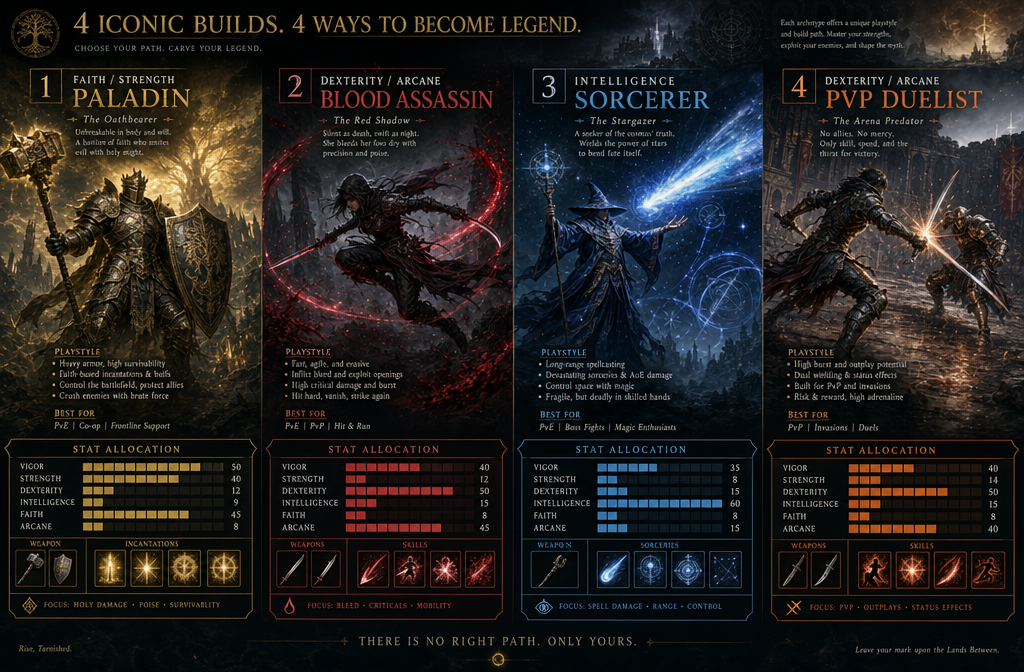
Bleed Arcane (Rivers of Blood / Mohgwyn’s Sacred Spear)
Why it works: Bleed (Hemorrhage) bypasses a large portion of enemy health in a single proc, making it devastating against bosses with high HP pools. Arcane scaling amplifies both the bleed buildup and the weapon’s base damage.
Recommended stats (Level 150):
- Vigor: 60
- Mind: 20
- Endurance: 25
- Strength: 14
- Dexterity: 18
- Arcane: 80
Best weapons: Rivers of Blood (Occult infusion), Mohgwyn’s Sacred Spear, Eleonora’s Poleblade
Key items: Lord of Blood’s Exultation talisman, Shard of Alexander, White Mask helm
Common mistake: Stacking too many bleed sources without hitting the Arcane soft cap first. Get Arcane to 60 before investing elsewhere.
Intelligence Sorcery (Lusat’s Glintstone Staff / Comet Azur)
Why it works: Sorcery builds deal the highest burst damage in the game against stationary or staggered targets. Comet Azur with Terra Magica and Cerulean Hidden Tear can delete most bosses in seconds.
Recommended stats (Level 150):
- Vigor: 55
- Mind: 35
- Intelligence: 80
- Everything else: minimum requirements
Best weapons: Lusat’s Glintstone Staff (damage), Carian Regal Scepter (FP efficiency), Dark Moon Greatsword (melee backup)
Limitation: This build punishes positional mistakes. If you’re caught mid-cast against an aggressive boss, you’ll take heavy damage. Pair with Cerulean Tear for FP recovery.
Strength/Faith (Golden Order / Dragon Communion)
This hybrid is one of the most flexible builds in the game. It combines high physical damage from Strength weapons with powerful healing and buff incantations, making it ideal for players who want options.
Recommended stats (Level 150):
- Vigor: 60
- Strength: 54 (two-handed = 81 effective)
- Faith: 50
- Mind: 25
Best weapons: Blasphemous Blade, Giant-Crusher, Marika’s Hammer (DLC)
Key incantations: Golden Vow, Flame, Grant Me Strength, Erdtree Heal
Choose this if: You want a build that handles every area of the game without needing to respec.
Best Elden Ring Builds for PvP in 2026
PvP in Elden Ring rewards players who understand spacing, roll-catching, and punish windows. The best Elden Ring builds for PvP are those with reliable damage, enough poise to trade hits, and weapons that are hard to predict.
Dexterity/Arcane Bleed (Duelist Meta)
Bleed is still strong in PvP, but opponents know how to dodge it. The key is mixing bleed procs with stance breaks using jump attacks and weapon arts.
Recommended stats (Level 125 for most PvP brackets):
- Vigor: 60
- Dexterity: 45
- Arcane: 45
- Endurance: 25
Best weapons: Eleonora’s Poleblade, Reduvia (off-hand), Nagakiba (Occult)
PvP tip: Don’t spam the weapon art. Use normal attacks to bait rolls, then proc bleed with a well-timed L2.
Pure Strength (Colossal Weapons)
Colossal weapons have hyperarmor on charged attacks, meaning they trade favorably against most lighter weapons. A well-timed charged R2 punishes aggressive opponents hard.
Recommended stats (Level 125):
- Vigor: 60
- Endurance: 30 (heavy armor + colossal weapon)
- Strength: 66 (two-handed = 99 effective)
Best weapons: Giant-Crusher, Greatsword, Starscourge Greatsword
Common mistake: Wearing too much armor and running out of stamina. Keep your equip load below 70% for medium roll.
Dexterity/Intelligence (Moonveil)
Moonveil’s Transient Moonlight weapon art is fast, has long range, and deals split physical/magic damage that’s harder to resist. It remains a top-tier PvP weapon despite being well-known.
Recommended stats (Level 125):
- Vigor: 60
- Dexterity: 40
- Intelligence: 60
- Mind: 25
Edge case: Against opponents with high Magic resistance (Haligdrake Talisman), swap to a physical backup weapon. Never rely on one damage type in PvP.
How to Choose Between PvP and PvE Builds
Most players don’t want to respec constantly. The good news is that several builds perform well in both modes. Bleed Arcane and Strength/Faith are the two best dual-purpose options.
| Build | PvE Rating | PvP Rating | Difficulty | Best For |
|---|---|---|---|---|
| Bleed Arcane | S | A | Medium | All-around players |
| Intelligence Sorcery | S | B | High | PvE specialists |
| Strength/Faith | A | A | Low | Beginners, hybrids |
| Pure Strength | B | A | Low | PvP beginners |
| Dex/Int (Moonveil) | A | S | Medium | PvP duelers |
| Dex/Arcane | A | S | Medium | Experienced PvP |
Choose Bleed Arcane if: You want one build that handles both PvE and PvP without major compromises.
Choose Intelligence Sorcery if: You primarily play PvE and want maximum boss damage.
Choose Strength/Faith if: You’re newer to the game and want a forgiving, versatile experience.
If you enjoy theorycrafting builds in other games, the same principles apply to titles like Baldur’s Gate 3, where class selection dramatically shapes your experience.
What Stats Should Every Build Prioritize First?
Regardless of build type, every character needs a baseline before specializing. Vigor is the most important stat in the game for survival, and neglecting it is the single biggest mistake new players make.
Universal priority order:
- Vigor to 40 (minimum for mid-game survival)
- Meet weapon requirements (Strength, Dexterity, Intelligence, etc.)
- Endurance to 25 (enough for armor + weapon stamina)
- Vigor to 60 (required for late-game and all PvP)
- Primary damage stat to 60 (first soft cap)
- Secondary stats as needed
Mind (FP) only needs investment if your build relies heavily on spells or weapon arts. Most Strength builds can keep Mind at 15-20.
Shadow of the Erdtree DLC: How It Changed the Best Builds
The Shadow of the Erdtree DLC added new weapons, incantations, and sorceries that shifted the build landscape. Several previously mid-tier builds became competitive, and some new weapons outperform base-game options.
Notable DLC additions that affect builds:
- Marika’s Hammer: Best-in-slot for Strength/Faith builds, with a powerful weapon art
- Euporia: A top-tier Faith weapon for aggressive melee playstyles
- Messmer’s Soldier Spear: Strong Dex/Faith option with fire damage
- Impenetrable Thorns: A new incantation that changed Faith PvP significantly
- Blacksteele Greatsword: Excellent for Quality (Strength/Dex) builds
The DLC also raised the effective level ceiling for endgame content, making Level 150 the new standard for fully optimized builds rather than the old Level 120-125 benchmark.
Common Build Mistakes to Avoid
Even experienced players fall into these traps when building characters in Elden Ring.
- Spreading stats too thin: Trying to use both sorceries and incantations requires 40+ in both Intelligence and Faith, which leaves little room for Vigor and damage stats. Pick one primary magic type.
- Ignoring poise: Poise determines whether you get staggered mid-attack. Colossal weapon users need enough poise to trade hits. Check the poise breakpoints for your weapon type.
- Skipping Vigor: A character with 80 Intelligence and 30 Vigor will die in two hits in late PvE and one combo in PvP.
- Over-investing in Mind: Most builds need 20-25 Mind at most. FP flasks cover the rest.
- Using the wrong infusion: A Strength weapon with a Keen infusion (Dex scaling) wastes your investment. Match infusions to your primary damage stat.
- Ignoring talismans: Talismans like Shard of Alexander (+15% weapon art damage), Erdtree’s Favor +2 (HP/Stamina/Equip Load), and Lord of Blood’s Exultation (+20% attack when bleed nearby) add significant damage without stat investment.
For players who enjoy optimizing loadouts across different games, the same min-max mindset applies to titles like competitive shooters. See our guide on best Warzone loadouts for a similar approach in a different genre.
How Does Elden Ring’s Multiplayer Level Range Affect Builds?
In Elden Ring, co-op and PvP matchmaking uses character level and weapon upgrade level to find opponents. Building at the wrong level can leave you with few opponents or place you against overleveled characters.
Current PvP brackets (2026, community standard):
- Level 125: Most popular dueling bracket, balanced for competitive play
- Level 150: Post-DLC endgame bracket, more common in invasion content
- Level 80: Niche early-game PvP, less active
Weapon upgrade level also matters. A +25 weapon (standard) or +10 (somber) matches against similarly upgraded characters. Don’t upgrade your weapon past the bracket’s accepted limit if you want fair duels.
For players comparing competitive experiences across titles, our CS2 settings guide covers a similar optimization mindset for a different competitive environment.
Final Thoughts
The best Elden Ring builds in 2026 reward players who commit to a clear stat path, respect soft caps, and match their build to their preferred playstyle. For most players, Bleed Arcane offers the best balance of PvE and PvP performance. Beginners should start with Strength or Strength/Faith for the most forgiving experience. Sorcery and Faith specialists can reach the highest damage ceilings in PvE, while Dexterity-based builds dominate competitive PvP dueling.
Actionable next steps:
- Decide your primary mode (PvE, PvP, or both) before allocating stats
- Get Vigor to 60 before investing heavily in damage stats
- Pick one build from the table above and commit to it through your first playthrough
- Use Larval Tears to respec once you understand what the build needs at endgame
- Check the Shadow of the Erdtree DLC weapon list to see if any new options fit your chosen archetype
- For PvP, practice in the Colosseum before invading to learn spacing and punish windows
If you enjoy deep character optimization across different genres, explore our Genshin Impact character tier list or the Apex Legends tier list for 2026 for similar build-focused analysis in other competitive games. For broader gaming platform decisions, the PlayStation vs Xbox vs PC comparison can help you decide where to run Elden Ring for the best experience.
Frequently Asked Questions (FAQs)
What is the best starting class for most builds in Elden Ring?
Wretch (level 1, all stats at 10) offers the most flexibility for any build. For beginners, Vagabond (high Vigor and Strength) or Astrologer (high Intelligence) are more practical starting points.
Can one build handle both PvE and PvP well?
Yes. Bleed Arcane and Strength/Faith are the two best dual-purpose builds. They perform at a high level in both modes without requiring a respec.
What level should I stop at for PvP?
Level 125 is the most active PvP bracket for duels. Level 150 is better for invasion content and post-DLC play.
Is Moonveil still good in 2026?
Yes, Moonveil remains a top-tier PvP weapon. It’s well-known by experienced players, but its speed and range still make it dangerous. Pair it with a physical backup for opponents who stack Magic resistance.
What is the best build for beginners?
Strength/Faith with the Blasphemous Blade is the most beginner-friendly strong build. It has self-healing on kill, high damage, and access to powerful buff incantations.
Do I need the Shadow of the Erdtree DLC for the best builds?
No, but several top-tier weapons (Marika’s Hammer, Euporia) are DLC-exclusive. Base game builds are fully competitive. The DLC expands options rather than making base builds obsolete.