For years, the Overwatch meta has evolved with every balance patch, hero release, and competitive season, but 2026 may be one of the most transformative years yet. New heroes, role passives, perk systems, and frequent balance updates have dramatically shifted the power rankings across Tank, Damage, and Support roles. Heroes that once dominated ranked play have fallen behind, while others have emerged as must-pick choices for climbing the competitive ladder. Recent updates have also placed a greater emphasis on mobility, utility, survivability, and team coordination, making hero selection more important than ever.
Whether you’re a seasoned Grandmaster player, a dedicated one-trick, or a newcomer looking to improve your win rate, understanding the current meta is essential. The strongest heroes in 2026 aren’t just those with the highest damage numbers—they’re the ones capable of consistently influencing team fights, controlling objectives, and adapting to multiple compositions. From dominant tanks that dictate the pace of engagements to DPS heroes that can carry games and supports that provide game-changing utility, every role has clear winners and underperformers in the current season.
In this comprehensive Overwatch 2 Tier List for 2026, we’ll rank every hero by role and overall meta strength, breaking down which characters belong in S-Tier, which are reliable competitive picks, and which heroes may struggle in the current environment. Whether you’re pushing ranked, preparing for tournaments, or simply looking for the best hero to main, this guide will help you stay ahead of the meta and make smarter hero choices throughout the season.
What Heroes Are Top Tier in Overwatch 2 Right Now
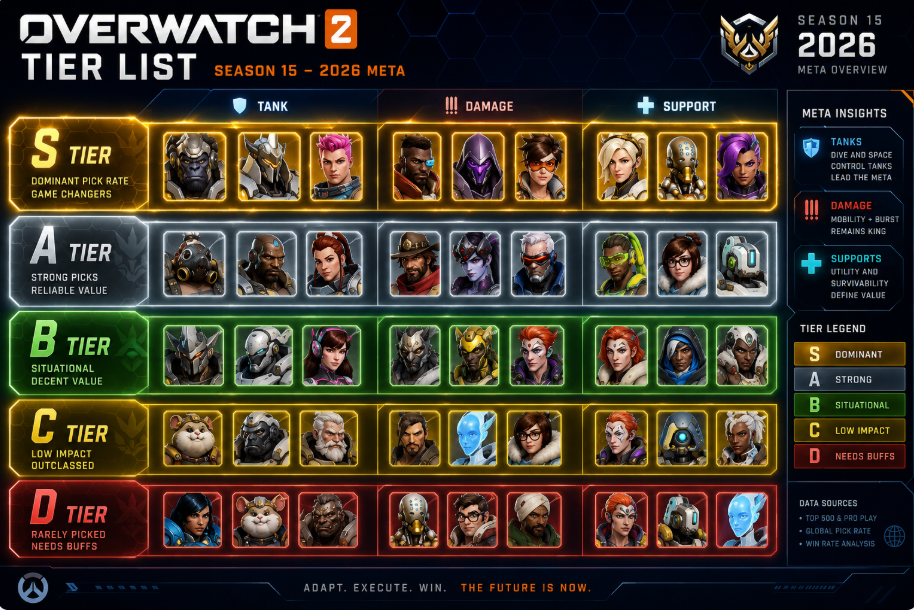
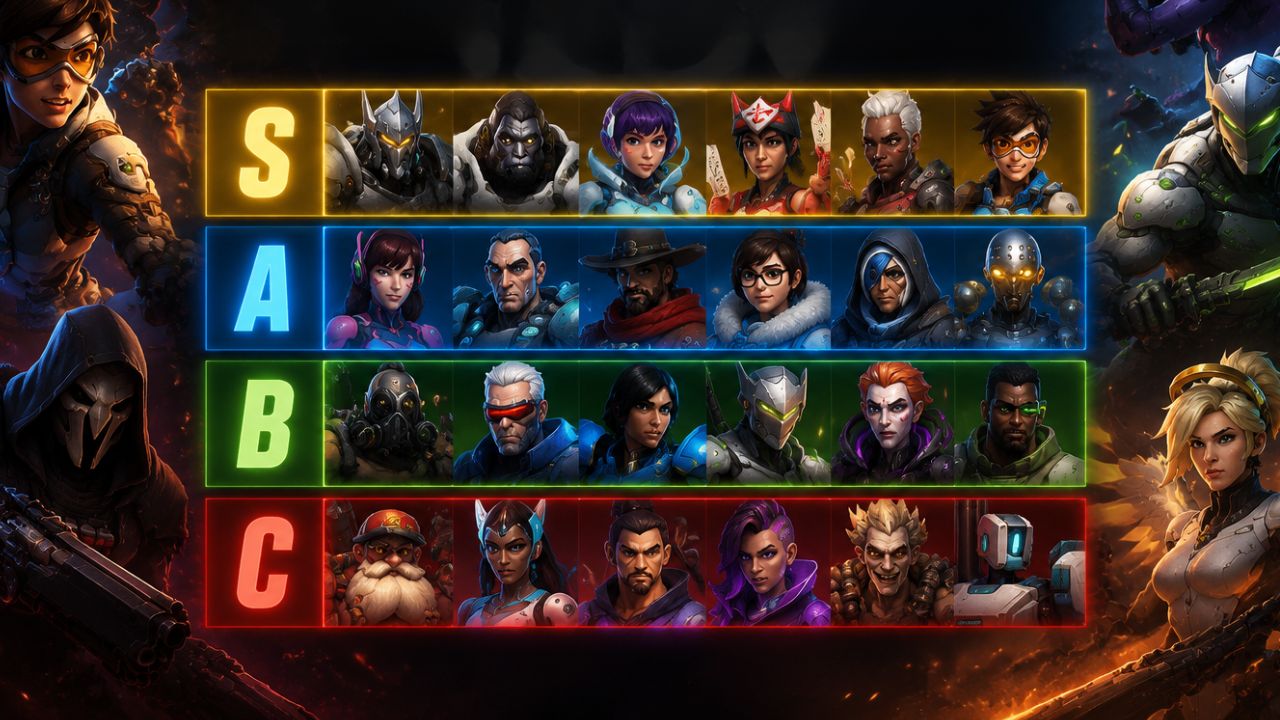
The S-tier heroes in the 2026 Overwatch 2 meta are Ana, Venture, Mauga, Illari, and Sojourn. These picks offer the best combination of damage, survivability, utility, and flexibility across most map types and game modes.
S-Tier Heroes (2026 Meta)
| Hero | Role | Why S-Tier |
|---|---|---|
| Ana | Support | Anti-heal grenade, burst heal, sleep dart |
| Venture | DPS | High mobility, burst damage, self-sustain |
| Mauga | Tank | Aggressive pressure, self-healing, high damage |
| Illari | Support | Strong healing output, Pylon sustain, reliable damage |
| Sojourn | DPS | Consistent railgun damage, high mobility |
A-Tier Heroes sit just below S-tier and are strong, reliable picks in most situations. These include Kiriko, Sigma, Tracer, Cassidy, and Lucio. They’re effective in the right hands but require more game sense to maximize.
The gap between S and A tier is meaningful in competitive play. S-tier heroes tend to carry games even when teammates underperform, while A-tier picks need more coordination to reach their ceiling.
Which Characters Are Broken in Competitive Play
“Broken” in Overwatch 2 typically means a hero’s kit is so strong that it warps how teams build compositions around countering it. In 2026, Mauga and Ana are the two heroes most commonly flagged as overtuned by the competitive community.
Mauga’s self-healing through his Cardiac Overdrive passive makes him extremely difficult to burst down without coordinated anti-heal. Teams without Ana often struggle to deal with a skilled Mauga player. Ana, meanwhile, counters Mauga directly with her Biotic Grenade, which creates a feedback loop where both heroes are mandatory in high-level play.
Venture also draws complaints at high ranks. The hero’s underground mobility makes tracking and targeting inconsistent, and the burst damage on emergence can delete squishy targets before they can react.
Blizzard has historically responded to these situations with targeted number adjustments rather than full reworks, so expect tuning patches rather than kit overhauls.
How Do Tank Heroes Rank in the Current Meta
Tanks in 2026 fall into two clear categories: aggressive dive-enablers and anchor tanks. The current meta rewards aggressive tanks that create pressure, which pushes Mauga and Orisa to the top of the Overwatch 2 tier list for the role.
Tank Tier Breakdown:
- S-Tier: Mauga, Orisa
- A-Tier: Sigma, Ramattra, Junker Queen
- B-Tier: Reinhardt, D.Va, Zarya
- C-Tier: Winston, Roadhog, Wrecking Ball
- D-Tier: Doomfist, Torbjorn (off-tank)
Orisa’s Fortify ability and spear throw make her one of the hardest tanks to punish when played correctly. She controls space effectively on payload and control maps. Sigma pairs well with aggressive DPS and offers strong long-range poke, keeping him firmly in A-tier.
Reinhardt has dropped to B-tier after recent shield health adjustments made him more vulnerable to sustained poke compositions. He’s still viable in coordinated play but struggles in solo queue where teammates don’t follow up on his charges.
Best DPS Characters for Climbing Ranked
For solo queue ranked climbing in 2026, Venture, Sojourn, and Tracer are the top three DPS picks. Each offers strong individual carry potential without relying heavily on team coordination.
Why these three stand out:
- Venture can disengage from bad fights, punish backline targets, and deal significant burst damage without needing peel from supports.
- Sojourn rewards mechanical skill with a high damage ceiling. Players who can land charged railgun shots consistently will find her one of the most efficient climbers in the game.
- Tracer remains one of the highest skill-ceiling heroes in Overwatch 2, but experienced players can use her to eliminate supports and create chaos that lower-ranked teams can’t respond to.
For players who prefer hitscan, Cassidy and Ashe are reliable A-tier options. Both deal consistent damage at medium range and have straightforward kits that don’t punish mechanical errors as harshly.
Avoid picking Symmetra or Torbjorn in solo queue unless you know the specific map and enemy composition will allow their turret setups to work. In most ranked games, the enemy team will simply walk around or destroy the turrets before they provide value. For a comparison of how other competitive games handle character rankings, the Valorant Agent Tier List for 2026 offers useful context on meta-driven hero selection.
Worst Heroes to Play in Overwatch 2 Competitive
The bottom of the 2026 Overwatch 2 tier list includes Symmetra, Torbjorn, Bastion, Pharah, and Doomfist. These heroes have either been outpaced by the meta or require such specific conditions to work that they’re not worth picking in most ranked games.
D-Tier Heroes and Why They Struggle:
- Symmetra: Turrets are easily destroyed, teleporter requires team coordination that solo queue rarely provides, and her damage output is too short-range for most maps.
- Torbjorn: Turret is a single point of failure. One flanker or a well-placed ultimate eliminates his entire kit contribution.
- Bastion: Despite rework attempts, Bastion remains a niche pick that strong teams counter by simply staying mobile and out of his line of sight.
- Pharah: The prevalence of hitscan heroes (Sojourn, Cassidy, Ashe) in the current meta makes Pharah extremely easy to punish. She needs a Mercy pocket to be viable, which is a two-hero investment for one damage dealer.
- Doomfist: His tank rework has left him in an awkward position where he’s neither a reliable anchor nor a consistent dive initiator.
These heroes can still work in casual play or with highly coordinated teams, but in solo ranked, they’re high-risk, low-reward choices.
How Much Do Pro Players Actually Use S-Tier Characters
Professional Overwatch 2 players heavily favor S-tier and high A-tier heroes, but the gap between pro and ranked play is significant. In the Overwatch League and major tournament circuits, pick rates for S-tier heroes like Ana and Mauga regularly exceed 60-70% across maps, based on community-tracked statistics from sites like Overbuff and Winston’s Lab.
At the GM and Top 500 level, players are more willing to deviate from the tier list when they have a hero they’ve mastered. A Top 500 Pharah player may outperform an average Sojourn player, even though Sojourn ranks higher on paper.
The practical takeaway: if you’re below Diamond rank, playing S-tier heroes correctly will produce better results than playing off-meta picks you’re more comfortable with. At Diamond and above, personal mastery starts to matter more than tier placement.
Are There Any Beginner-Friendly Heroes for New Players
New players should start with Lucio, Soldier: 76, Reinhardt, or Moira. These heroes have forgiving mechanics, clear roles, and kits that teach fundamental Overwatch 2 skills without requiring precise aim or deep game knowledge.
Best starter heroes by role:
- Tank: Reinhardt — straightforward shield and melee kit, teaches positioning and space control.
- DPS: Soldier: 76 — hitscan rifle with a sprint and self-heal, plays like a standard FPS character.
- Support: Moira — self-sustaining, short-range healing orbs are easy to land, and her fade ability gets new players out of bad situations.
- Alternative Support: Lucio — speed boost and healing aura provide team value even when the player isn’t actively doing much.
Which Heroes Counter the Current Meta Picks
Countering the 2026 meta means targeting Mauga, Ana, and Venture — the three heroes that define the current competitive environment.
Counter picks by target:
- Against Mauga: Ana (Biotic Grenade negates his healing), Sombra (hack prevents Cardiac Overdrive activation), Orisa (spear throw interrupts his momentum).
- Against Ana: Tracer and Genji can dive her backline quickly before she can land a sleep dart. Winston’s leap also works well for applying pressure.
- Against Venture: Cassidy’s Magnetic Grenade punishes the emergence animation. Pharah can poke from angles Venture can’t easily reach underground.
Counter-picking is most effective when you switch mid-match after identifying what the enemy team is building around. Locking in a counter before the match starts is less reliable because the enemy can adapt.
How Often Do Overwatch 2 Tier Lists Change
The Overwatch 2 tier list changes meaningfully every four to eight weeks, aligned with Blizzard’s seasonal balance patch schedule. Major patches — which typically arrive at the start of each new season — can shift the entire meta by buffing underplayed heroes or nerfing dominant ones.
Minor mid-season patches are more targeted, usually adjusting one or two heroes without reshaping the full tier list. The safest approach is to check a trusted community resource (such as Overbuff, Winston’s Lab, or content creators who track patch notes closely) within the first week of each new season.
Heroes that move most frequently between tiers are those in the A and B range. S-tier heroes tend to stay dominant until Blizzard specifically targets them, and D-tier heroes rarely climb without a significant rework. For a look at how patch-driven meta shifts work in another live-service game, the Fortnite Chapter 6 Latest Patch Notes Explained provides a useful parallel.
What Makes a Hero S-Tier Versus A-Tier
An S-tier hero in Overwatch 2 provides value that exceeds what most other heroes in the same role can offer, with fewer conditions attached. An A-tier hero is strong and reliable but requires either more skill, better team coordination, or a specific map type to reach the same impact.
The key differentiators:
- Unconditional value: S-tier heroes contribute meaningfully in almost every game state — whether ahead, behind, on attack, or on defense.
- Low counterpick vulnerability: S-tier picks don’t have hard counters that completely shut them down. A-tier heroes often have one or two specific counters that significantly reduce their effectiveness.
- Ultimate quality: S-tier ultimates tend to be either fight-winning on their own or provide massive utility (Ana’s Nano Boost, Mauga’s Cage Fight, Illari’s Captive Sun).
- Mechanical floor: S-tier heroes are effective even at average mechanical execution. A-tier heroes often require above-average aim or game sense to justify picking them.
Common Mistakes Players Make With Top-Tier Heroes
Playing S-tier heroes poorly is one of the most common reasons high-potential players stall in ranked. The heroes are strong, but they’re not foolproof.
Frequent mistakes by hero:
- Ana: Sleeping a target in the middle of the team instead of isolating them, or using Biotic Grenade offensively when the team needs the healing boost defensively.
- Mauga: Activating Cardiac Overdrive too early in a fight before taking enough damage to benefit from it, or pushing too deep without support follow-up.
- Venture: Using the underground dash without a clear exit route, getting trapped by barriers or terrain when emerging.
- Sojourn: Holding the charged railgun shot too long while trying for a perfect opportunity, losing windows to deal significant damage.
- Illari: Placing the Pylon in an exposed position where the enemy team can easily destroy it in the first ten seconds of a fight.
The pattern across all these mistakes is the same: players pick S-tier heroes expecting the kit to carry them, then use abilities reactively instead of proactively. Mastering the timing of each ability is what separates a good S-tier player from a great one.
How Hero Changes Impact Tier Rankings
A single balance patch can move a hero two full tiers in either direction. Blizzard’s patch notes typically adjust damage values, cooldown timers, healing output, or ultimate costs — any one of these can fundamentally change how a hero fits into the meta.
For example, when Sojourn’s railgun charge rate was reduced in a previous season, she dropped from a dominant S-tier pick to a fringe A-tier option almost overnight. When Illari’s Pylon healing was increased, she jumped from B-tier to S-tier within two weeks of the patch going live.
The most reliable way to track these shifts is to read the official patch notes on release day and then check community tier list updates three to five days later, after high-rank players have had time to test the changes in live competitive matches.
Which Heroes Are Good for Solo Queue Versus Team Play
Solo queue and coordinated team play reward different hero traits, and the Overwatch 2 tier list shifts depending on which context you’re playing in.
Solo queue favors:
- High self-sufficiency (Venture, Sojourn, Moira)
- Heroes that don’t rely on teammates to peel for them
- Ultimates that can be used independently (Sojourn’s Overclock, Tracer’s Pulse Bomb)
Coordinated team play favors:
- Combo ultimates (Zenyatta’s Transcendence paired with a dive, Lucio’s Sound Barrier with a rush composition)
- Heroes that require specific follow-up (Zarya’s Graviton Surge needs a secondary AoE ultimate to be effective)
- Niche picks that counter specific enemy compositions (Sombra, Symmetra in the right setup)
If you’re playing with a full five-stack, Zenyatta and Lucio climb from B-tier to A-tier or higher because their team-dependent value gets fully realized. In solo queue, Ana and Illari are safer support choices because they can contribute even when teammates don’t coordinate.
For similar breakdowns in other competitive games, the Genshin Impact Best Characters Tier List 2026 and Best LoL Champions for Beginners in 2026 both cover how character strength varies by team context.
Final Thoughts
The 2026 Overwatch 2 tier list rewards players who understand the meta well enough to pick heroes that match the current patch, their rank, and their play style. Ana, Venture, Mauga, Illari, and Sojourn sit at the top of the competitive hierarchy for good reasons — their kits provide consistent, high-impact value without requiring perfect team coordination.
Actionable next steps:
- If you’re below Diamond, pick one S-tier or A-tier hero per role and focus on mastering their ability timing rather than switching frequently.
- Check the official Blizzard patch notes at the start of each new season and cross-reference with community tier lists three to five days after the patch drops.
- In solo queue, prioritize self-sufficient heroes. In coordinated play, expand your pool to include combo-dependent picks like Zenyatta or Zarya.
- Use counter-pick knowledge as a mid-match tool. Identify what the enemy team is building around and switch accordingly after the first lost team fight.
- New players should start with Soldier: 76, Reinhardt, or Moira before moving to higher-skill-ceiling picks.
For players who enjoy competitive tier list analysis across other games, the Marvel Rivals Tier List Season 2 and Apex Legends Tier List for 2026 follow similar frameworks and are worth reading alongside this guide.
Frequently Asked Questions (FAQs)
What is the best hero in Overwatch 2 right now?
Ana is widely considered the single best hero in the 2026 meta. Her anti-heal grenade, sleep dart, and burst healing make her the most impactful support in both solo queue and professional play.
Is Overwatch 2 still worth playing in 2026?
Yes. The game remains one of the most-played hero shooters on PC and console, with an active competitive scene and regular seasonal content updates from Blizzard.
How often should I update my hero pool based on the tier list?
Check the tier list at the start of each new season (roughly every eight weeks) and after any major mid-season patch. Minor patches rarely require a full hero pool change.
Can you climb ranked with B-tier heroes?
Yes, especially if you have significant hours on a B-tier hero. Personal mastery matters more than tier placement below Diamond rank. Above Diamond, the gap between S-tier and B-tier becomes more pronounced.
What is the easiest S-tier hero to learn?
Illari is generally considered the most accessible S-tier hero in 2026. Her Pylon provides passive healing, her damage is straightforward, and her ultimate is powerful without requiring complex timing.
Which hero has the highest skill ceiling in Overwatch 2?
Tracer and Genji are widely regarded as the highest skill-ceiling heroes in the game. Both require precise aim, excellent positioning, and deep game sense to play effectively at high ranks.