
For new players, choosing the right champion can make the difference between enjoying your first matches and feeling overwhelmed by League of Legends. With more than 160 champions available in 2026, each featuring unique abilities, playstyles, and mechanics, finding a beginner-friendly option is often the first challenge every summoner faces.
The best champions for beginners combine simple abilities, forgiving gameplay, and strong effectiveness across different skill levels. They help new players learn essential fundamentals such as farming, positioning, map awareness, and team fighting without requiring advanced mechanics or extensive game knowledge. Whether you prefer dealing damage, protecting teammates, or leading the charge in battles, there are beginner-friendly champions designed for every role.
In this complete guide, we rank the best LoL champions for beginners in 2026, highlighting easy-to-learn picks for top lane, jungle, mid lane, ADC, and support. These champions offer a smooth learning curve while remaining powerful enough to help you climb the ranks as your skills improve. If you’re just starting your League of Legends journey, these are the champions that will set you up for success from your very first match.
What Are the Easiest League of Legends Champions to Learn
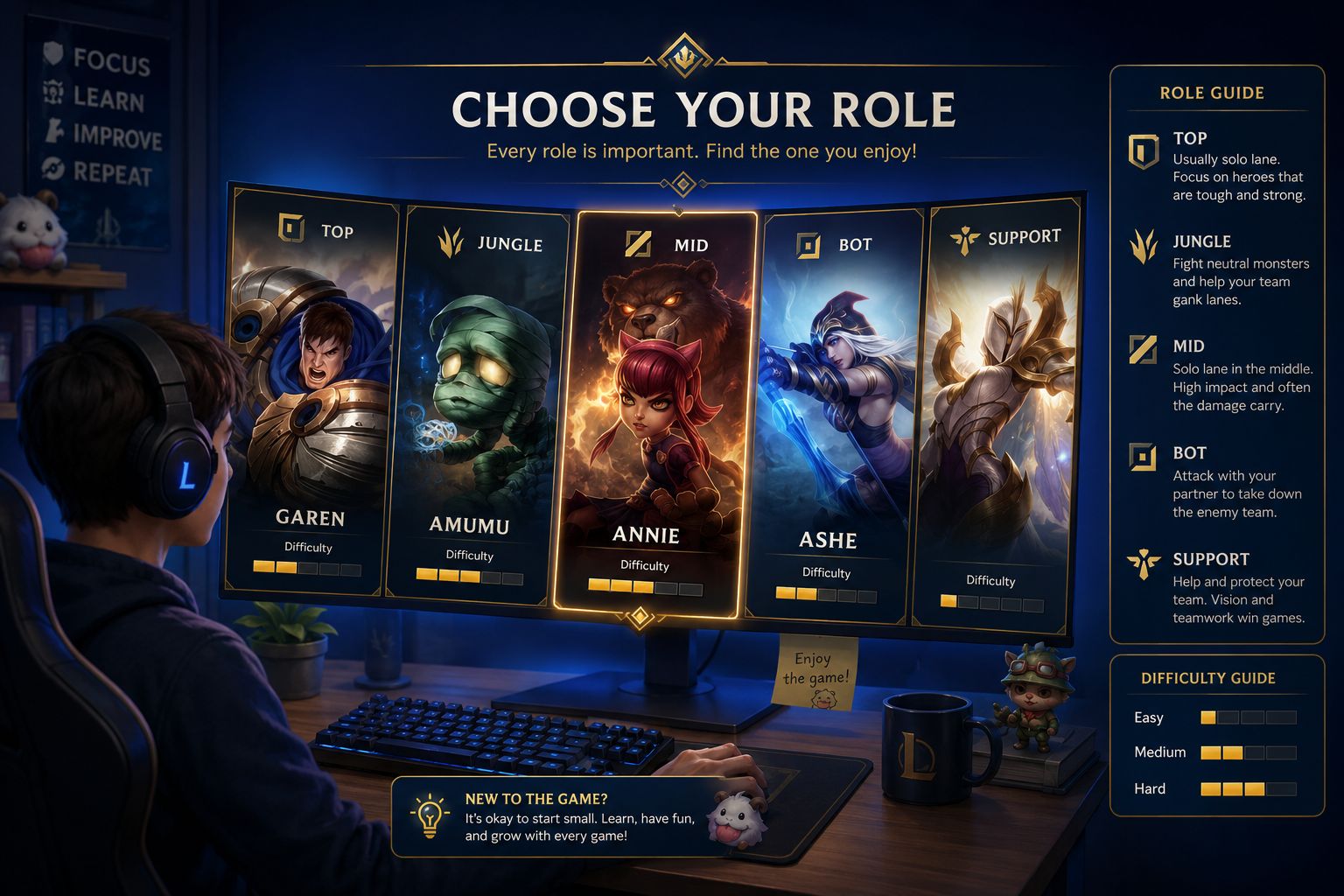
The easiest League of Legends champions to learn are those with three or fewer active abilities, no complex resource management, and clear visual feedback on their skills. Garen, Ashe, Annie, Amumu, and Nasus consistently appear on beginner lists because their kits require minimal mechanical skill to produce results.
Here is a quick breakdown of the top starter picks by role in 2026:
| Champion | Role | Difficulty | Key Strength |
|---|---|---|---|
| Garen | Top Lane | 1/5 | Tanky, self-healing, no mana |
| Ashe | Bot Lane (ADC) | 1/5 | Long range, built-in CC, utility |
| Annie | Mid Lane | 1/5 | High burst, simple stun mechanic |
| Amumu | Jungle | 2/5 | Strong teamfight ultimate, easy clear |
| Malphite | Top/Support | 2/5 | One-button teamfight ultimate |
| Nasus | Top Lane | 1/5 | Simple farming loop, scales hard |
| Soraka | Support | 1/5 | Pure healing, low-pressure role |
Choose Garen if you want a champion that punishes mistakes less and lets you focus entirely on learning lane fundamentals. Choose Ashe if you want to play the marksman role and need a champion that teaches positioning without demanding pixel-perfect aim.
Which Champions Are Good for New Players in Ranked
For new players entering ranked in 2026, Garen, Malphite, and Ashe are the safest picks. These champions are consistent across most match-ups, do not rely on team coordination to be effective, and have kits simple enough to execute under the pressure of a ranked environment.
Ranked introduces stress that normal games do not replicate. A champion that feels manageable in a casual match can feel overwhelming when teammates are calling for specific plays. The best ranked starter champions share three traits:
- Low execution ceiling: Their power does not depend on hitting complex combos
- Clear role in teamfights: They have an obvious job (engage, peel, or deal damage) that does not require improvisation
- Consistent performance: They do not have high-variance games where one mistake ends the match
Avoid taking a champion into ranked before playing at least 20 to 30 normal games on them. Even the simplest champions have matchup-specific decisions that take time to internalize.
How Hard Is Garen to Play Compared to Other Champions
Garen is one of the least mechanically demanding champions in the game. He has no mana, a self-heal built into his passive, a silence on his Q ability, a spin on his E, and a single-target ultimate. There are no skill shots to land, no resource bars to track, and no ability chains that require precise timing.
Compared to other top laners:
- Garen vs. Fiora: Fiora requires parrying directional vitals, split-push decision-making, and dueling mechanics. Garen requires none of this.
- Garen vs. Darius: Darius is slightly harder because his Q has a sweet-spot mechanic (the outer edge deals more damage) and his passive stack management matters more.
- Garen vs. Nasus: Both are beginner-friendly, but Nasus demands disciplined last-hitting to stack his Q over time. Garen is more straightforward in lane.
The main challenge with Garen is knowing when to engage and when to back off, which is a game-sense issue rather than a mechanical one. New players can focus entirely on learning map awareness and wave management because Garen’s kit demands almost nothing mechanically.
Which Champions Are Most Forgiving for New Players
The most forgiving champions for new players are those that can absorb mistakes through high base durability, self-sustain, or simple escape tools. Garen, Malphite, Soraka, and Nasus lead this category in 2026.
Forgiving champion traits to look for:
- High base health or armor so early positioning errors do not result in instant death
- A self-heal or shield that buys time to correct mistakes
- An escape ability (dash, speed boost, or blink) that helps when caught out of position
- Abilities that do not punish missed casts heavily
Soraka is particularly forgiving for support players because her healing keeps allies alive even when she makes positional errors, and her kit does not require landing skill shots to contribute meaningfully. For a comparison of how champion accessibility works in other games, the Baldur’s Gate 3 Best Class for Beginners guide covers similar “low floor, high ceiling” design thinking.
Common mistake: New players often confuse “easy to play” with “easy to win with.” Forgiving champions still require learning macro decisions like when to group, when to split push, and when to take objectives.
What Champions Should Beginners Avoid
Beginners should avoid mechanically complex champions, assassins with short windows to execute combos, and champions whose power depends entirely on landing a single skill shot. These picks punish new players disproportionately.
Avoid these champion categories early on:
- High-skill-floor assassins: Zed, Katarina, Akali, and Qiyana require precise combo execution and deep matchup knowledge to function
- Global ultimate champions: Twisted Fate and Shen demand strong map awareness that beginners have not yet developed
- Ability-sequence-dependent picks: Champions like Lee Sin require specific input chains (ability, ward jump, ability, kick) that take months to execute consistently
- Hyper-carries with low base stats: Champions like Kalista and Aphelios have extremely low base durability and punish positioning errors instantly
The general rule: if a champion’s tutorial video runs longer than five minutes and still does not cover all the nuances, it is not a beginner pick.
How Much Do the Best Starter Champions Cost in Blue Essence
Most of the best starter champions for beginners cost between 450 and 1,350 Blue Essence, making them among the cheapest options in the game. Riot Games deliberately prices beginner-friendly champions at low Blue Essence costs to reduce the barrier for new players.
2026 Blue Essence costs for top beginner picks:
| Champion | Blue Essence Cost |
|---|---|
| Garen | 450 BE |
| Ashe | 450 BE |
| Annie | 450 BE |
| Nasus | 450 BE |
| Amumu | 450 BE |
| Soraka | 450 BE |
| Malphite | 450 BE |
All seven of the champions listed above cost 450 Blue Essence each, which is the lowest price tier in the game. New players earn Blue Essence by leveling up and disenchanting champion shards from loot capsules. Reaching level 5 to 10 typically generates enough Blue Essence to purchase two or three of these champions without any additional grinding.
The free champion rotation (updated weekly by Riot Games) also includes beginner-friendly picks regularly, so new players can test these champions before spending anything.
What Role Should a Beginner Pick in League of Legends
Support is generally the most beginner-friendly role in League of Legends because it removes last-hitting pressure entirely and lets new players focus on positioning, map awareness, and learning how fights develop. Top lane is the second-best starting role because it is isolated, one-on-one for most of the early game, and forgiving of macro mistakes.
Role difficulty overview for beginners:
- Support (easiest): No last-hitting required, clear job in fights, champions like Soraka and Lux are straightforward
- Top Lane: Isolated lane, simple 1v1 dynamics, champions like Garen and Malphite are very accessible
- Jungle (moderate): Requires learning camp clear routes and pathing, but Amumu makes it manageable
- Mid Lane: High pressure role with frequent roaming decisions, Annie simplifies it significantly
- Bot Lane/ADC (hardest for beginners): Requires last-hitting under pressure, positioning in fights, and coordination with a support
Beginners who want to understand the full competitive landscape of other games may find the Apex Legends Tier List for 2026 useful for seeing how role-based thinking applies across different titles.
Are There Champions That Work Well in Multiple Lanes
Yes, several beginner-friendly champions work across multiple lanes, which makes them especially efficient for new players who want flexibility without learning an entirely new champion. Malphite, Lux, and Amumu are the best multi-lane options for beginners in 2026.
- Malphite plays effectively in Top Lane and Support. His ultimate (Unstoppable Force) is impactful in both roles, and his tankiness scales with armor items regardless of lane.
- Lux works in Mid Lane and Support. Her kit is the same in both positions, and her skill shots teach fundamentals that transfer across the game.
- Amumu is primarily a jungler but can also function in Support in certain team compositions.
Learning a flex pick early gives beginners more options in champion select and reduces the pressure of being locked into a single role before they know which one they enjoy most.
What Common Mistakes Do New Players Make With Starter Champions
The most common mistake new players make with starter champions is treating champion simplicity as a substitute for game knowledge. A simple kit does not win games on its own. New players still need to learn wave management, objective timing, and when to group with their team.
Top five mistakes beginners make with starter champions:
- Over-extending in lane after winning a trade, which leads to getting caught by roaming enemies
- Ignoring the minimap and missing enemy positions entirely, leading to avoidable deaths
- Skipping ability upgrades or leveling abilities in the wrong order (always prioritize your primary damage ability first unless a guide specifies otherwise)
- Building items without a plan, often copying random builds seen in streams rather than following recommended item paths
- Forcing fights at full health when the enemy team has stronger champions at that stage of the game
For players who enjoy learning through structured guides in other games, the approach used in the Marvel Rivals Tier List Season 2 shows how role-based thinking and tier awareness can accelerate the learning curve in competitive titles.
How Do Beginner Champions Scale Into Late Game
Most beginner-friendly champions scale adequately into late game at lower skill levels but become easier to counter in higher-ranked environments. Nasus is the strongest late-game scaler among beginner picks, as his Q ability (Siphoning Strike) gains permanent damage with every stack, making him a genuine threat in extended games.
Late-game scaling by champion:
- Nasus: Excellent late-game scaling, becomes very strong with 200+ Q stacks
- Malphite: Strong late game because his ultimate remains impactful regardless of the game stage
- Amumu: Scales well with tank items and continues to provide teamfight value late
- Garen: Falls off slightly in very late games against fed carries but remains durable
- Ashe: Scales with items like other marksmen, strong utility through her ultimate stays relevant
The key insight for beginners: do not worry about late-game scaling until you can consistently survive the early and mid game. Most beginner-level matches end before true late-game scaling becomes a deciding factor.
Which Champions Have the Simplest Mechanics and What Champions Are Good for Learning Different Roles
The champions with the simplest mechanics in 2026 are Garen, Nasus, Soraka, Amumu, and Ashe. Each of these champions uses straightforward ability patterns with minimal combo requirements, no resource management beyond mana (or no mana at all), and clear visual indicators for ability ranges.
For players who want to use champion selection as a way to learn each role properly:
- Learning Top Lane: Start with Garen, then progress to Malphite, then Darius
- Learning Jungle: Start with Amumu, then try Warwick, then Hecarim
- Learning Mid Lane: Start with Annie, then try Lux, then Veigar
- Learning Bot Lane (ADC): Start with Ashe, then try Miss Fortune, then Caitlyn
- Learning Support: Start with Soraka, then try Lux Support, then Blitzcrank
This progression works because each step adds one new mechanical concept without overwhelming the player. For example, moving from Soraka to Lux Support introduces skill shot aiming. Moving from Lux to Blitzcrank adds the challenge of landing a high-impact, game-changing hook. If you enjoy progression-based learning in games, the Genshin Impact Best Characters Tier List 2026 follows a similar structured approach to character selection for newer players.
Players who want to see how competitive settings affect performance in other titles might also check the Best CS2 Settings for Pro Players guide for a sense of how technical preparation supports skill development across competitive games.
Final Thoughts
The best LoL champions for beginners in 2026 are Garen, Ashe, Annie, Amumu, and Malphite. All five cost 450 Blue Essence, have simple kits, and teach core game fundamentals without demanding advanced mechanics. Support and Top Lane are the easiest roles to start with, and the free champion rotation lets new players test these picks before committing Blue Essence.
Actionable next steps for new players:
- Download the game and complete the tutorial to earn starter Blue Essence
- Pick one champion from the beginner list above and play 20 to 30 normal games on that champion only
- Focus on one improvement per session: last-hitting one session, minimap awareness the next
- Watch one replay of a lost game to identify the single biggest mistake, not all mistakes at once
- Expand to a second champion only after feeling comfortable with the first
The fastest path to improvement in League of Legends is not finding the strongest champion. It is finding the simplest champion and learning the game through them. Once the fundamentals are solid, the champion pool can grow naturally.
Frequently Asked Questions (FAQs)
What is the single best champion for a complete beginner in League of Legends?
Garen is the single best champion for a complete beginner. He has no mana, a passive self-heal, and no skill shots, which lets new players focus entirely on learning game fundamentals rather than mechanical execution.
Can beginners climb ranked with starter champions?
Yes. Garen, Malphite, and Ashe are viable in ranked play at lower skill levels. Their simplicity becomes a strength because players can focus on decision-making rather than mechanics.
How long does it take to learn a beginner champion?
Most players feel comfortable with a beginner champion after 20 to 30 games. Basic competency with positioning and ability usage typically comes within 10 games for the simplest picks like Garen or Soraka.
Is jungle a good role for beginners?
Jungle is moderately difficult for beginners because it requires learning camp clear routes and when to gank lanes. Amumu makes it more accessible than most junglers, but support or top lane is still easier to start with.
Do beginner champions become useless at higher ranks?
Not entirely. Malphite, Amumu, and Ashe remain relevant at higher ranks because their utility (crowd control, teamfight ultimates) scales with team coordination. Garen and Nasus become less viable but are still playable.
What is the cheapest way to get beginner champions?
All top beginner champions cost 450 Blue Essence each. New players can earn enough Blue Essence to buy two or three of them simply by leveling up through the first 10 account levels.
Should beginners buy skins for starter champions?
Skins have no gameplay impact. New players should focus on Blue Essence for champion unlocks rather than spending Riot Points on cosmetics until they are certain which champion they enjoy most.