
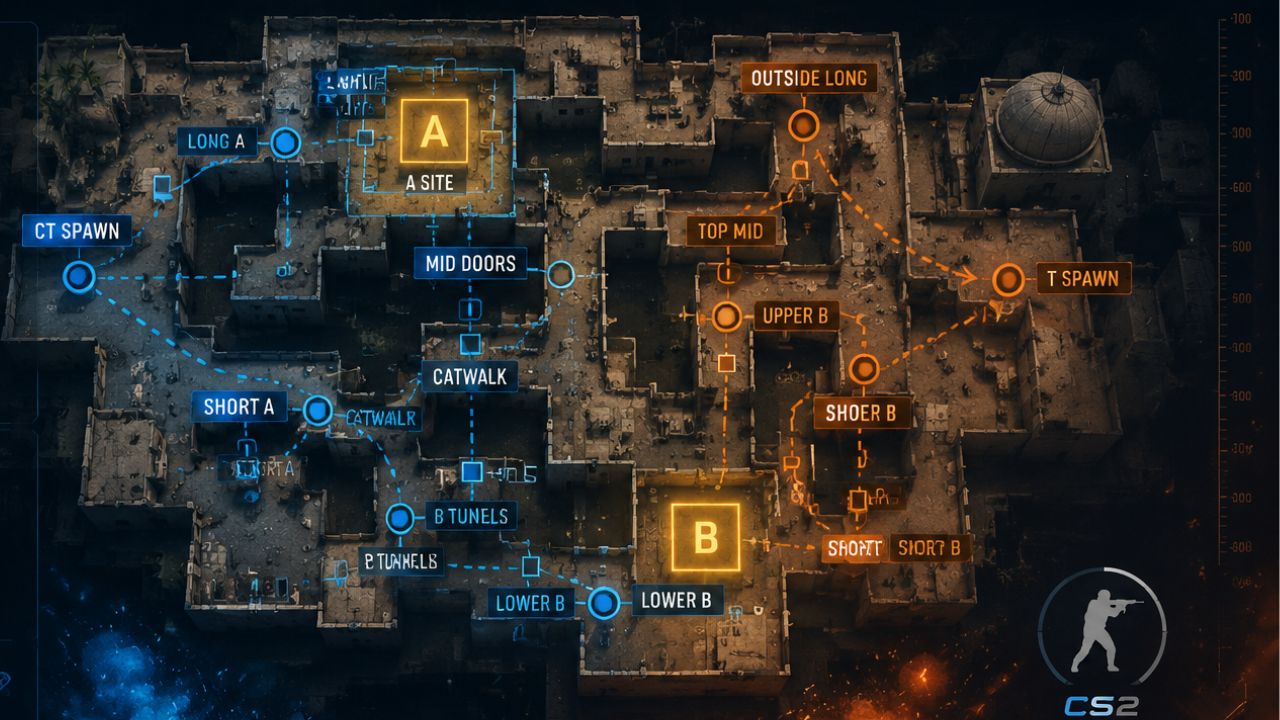
What Are the Most Important Map Callouts in Counter-Strike 2
Callouts are the short location names players use to communicate enemy positions during a round. Without them, teammates cannot rotate or trade effectively. Every map in the CS2 competitive pool has a set of community-standard callouts that pro players and ranked players alike rely on.
High-priority callouts to learn first, by map:
| Map | Critical Callouts |
|---|---|
| Dust2 | Long A, Short, B Tunnels, Mid, Cat, Xbox |
| Mirage | A Ramp, CT, Jungle, Mid, B Apartments, Van |
| Inferno | Banana, Arch, Library, Second Mid, Pit |
| Nuke | Ramp, Heaven, Hell, Lobby, Outside, Hut |
| Ancient | Mid, Cave, Donut, A Main, B River |
| Anubis | Mid, Palace, Connector, B Alley, A Site |
| Vertigo | A Ramp, B Ramp, Mid, CT, Scaffold |
Common mistake: New players often use vague descriptions like “he’s on the right” instead of named callouts. This delays rotations by several seconds, which is enough time for a plant or a kill. Memorize at least the five or six most-used callouts per map before queuing competitive.
For players also working on their in-game setup, pairing callout knowledge with the right configuration helps. See this full guide to the best CS2 settings for pro players for crosshair, resolution, and sensitivity recommendations that complement map awareness.
How Do Pro Players Learn Map Strategies for Dust2
Pro players approach Dust2 as a geometry problem: every angle is fixed, so preparation beats reaction. They study demo footage, memorize grenade lineups for specific positions, and drill default executes until the movement is automatic.
The standard pro approach to learning Dust2:
- Watch professional demos with a focus on T-side default setups (not just the final execute)
- Load the map in a private server and walk every route to internalize distances
- Practice three to five grenade lineups per site until they can be thrown from memory
- Run 10-man scrimmages or use FACEIT to get structured feedback on positioning
- Review personal demos after losses, specifically looking at where rotations broke down
Dust2 T-side fundamentals pros use:
- Early Long A control forces CT to commit resources, opening B for a split
- Mid-to-Short control with a smoke on CT spawn is the most reliable A-site execute
- B Tunnels rush with a flash over the top of B doors is still effective when timed correctly
Edge case: At the professional level, Dust2 is considered somewhat CT-sided on the first few rounds because Long A is very difficult to take without utility. Beginners often over-commit to Long early and lose the round before the execute even starts.
Which CS2 Maps Are Best for Competitive Play
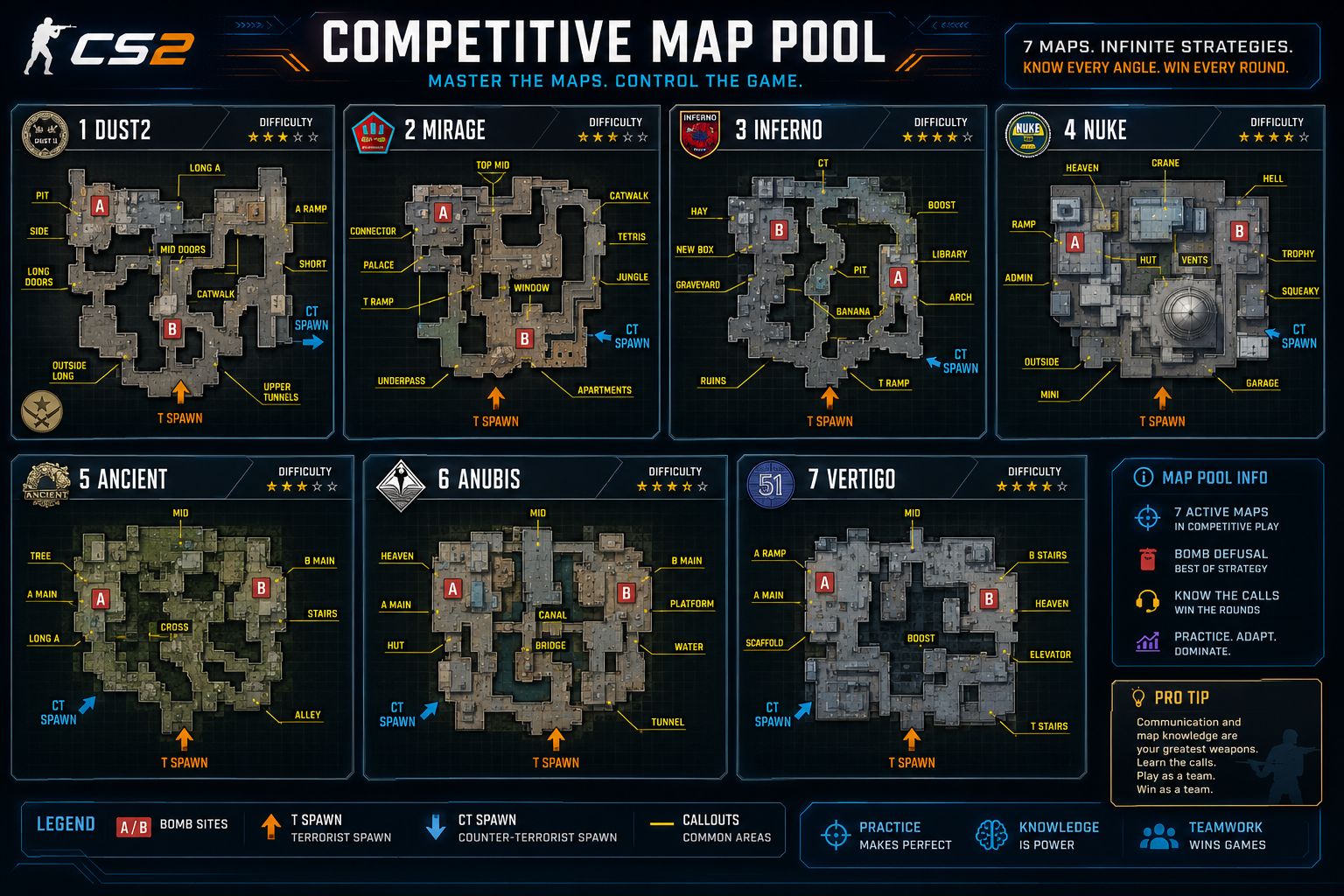
The best CS2 maps for competitive play in 2026 are Mirage, Dust2, and Inferno, based on their consistent presence in the active duty pool and balanced win-rate data across rank brackets. Nuke and Ancient reward deep map knowledge and tend to favor prepared teams.
Active duty map pool (2026): Dust2, Mirage, Inferno, Nuke, Ancient, Anubis, Vertigo
Most balanced for competitive design:
- Mirage has near-equal T and CT win rates across most rank brackets and offers multiple viable strategies on both sides
- Inferno rewards coordinated play and punishes solo-queue aggression, making it a strong competitive map
- Anubis has grown in competitive viability since its rework and offers cleaner site geometry than Vertigo
Choose a map based on your playstyle:
- Choose Mirage if you want a map that rewards both individual skill and team coordination
- Choose Inferno if your team communicates well and can execute slow defaults
- Avoid Vertigo if you are new to competitive play, as vertical angles create confusion that punishes inexperienced positioning
What Are Common Beginner Mistakes on Mirage Map
The most common beginner mistake on Mirage is playing B Apartments without utility, walking directly into a Van or CT player holding the angle. The second most frequent error is pushing Mid without a smoke on the window, which exposes the player to a free AWP shot.
Top five beginner mistakes on Mirage:
- Going B Apartments dry: Always use a flash before pushing out of Apartments onto the site
- Skipping Mid control: Mid-to-Short is one of the strongest A-site executes; ignoring Mid gives CT full information
- Rotating too early as CT: Leaving A site before confirming a B execute gives T-side a free retake situation
- Not smoking Jungle: Jungle is a critical information position; leaving it open costs rounds
- Peeking CT with no support: The CT position on A site has a massive angle advantage; solo peeks without a flash almost always lose
Quick example: A T-side player pushes A Ramp, sees no one, and immediately rotates to B. The CT holding short then walks onto A site for free. The correct play is to smoke CT, throw a flash, and wait for a teammate to confirm before rotating.
Are Some Maps Better for AWPers Versus Riflers
Yes, map geometry directly determines how effective an AWP is relative to rifles. Long sightlines favor AWPers, while close-quarters maps with tight corners and multiple entry points favor riflers.
AWP-favored maps: Dust2 (Long A, Mid, B doors), Mirage (Mid window, A site), Nuke (Outside, Ramp)
Rifler-favored maps: Inferno (Banana, Library, Apartments), Ancient (Cave, B River), Anubis (B Alley, A Main)
Vertigo sits in the middle: the A ramp and scaffold areas reward AWP play, but the tight B site heavily favors rifles.
Decision rule: If your team has a strong AWPer, prioritize map picks that include Dust2 or Mirage. If your team runs a five-rifler setup, Inferno and Ancient give you the best structural advantage.
How Map Strategies Change Between Casual and Competitive Modes
In casual mode, respawning removes the economy system and the penalty for dying, so players take far more aggressive, uncoordinated risks. Competitive mode introduces a buy system, round economy, and permanent death per round, which forces players to value positioning and utility much more carefully.
Key differences:
| Factor | Casual Mode | Competitive Mode |
|---|---|---|
| Death penalty | Respawn available | Round over for that player |
| Economy | No buy system | Full economy management |
| Utility use | Rare, uncoordinated | Central to round strategy |
| Rotation timing | Irrelevant | Critical for CT side |
| Map control | Ignored | Contested every round |
Practical impact: A strategy that works in casual (rushing B every round) fails in competitive because opponents adapt after round two. Competitive requires varying strategies, reading the economy, and adjusting based on what the opposing team has shown.
What Map Strategies Work Differently at High Versus Low Ranks
At low ranks (Silver to Gold Nova), default setups and basic site executes win the majority of rounds because opponents rarely play coordinated defense. At high ranks (Supreme and above), defaults are read quickly, so teams need layered fakes, utility-heavy executes, and mid-round adjustments.
Low rank priorities:
- Run a default every round to gather information before committing
- Smoke the most dangerous CT angle on each site and execute as a group
- Do not split the team into groups of one or two without a plan
High rank adjustments:
- Fake one site with noise and utility, then rotate to the real execute
- Use mid-round calls based on CT positioning rather than pre-planned executes
- Time rotations to bait out CT movement before committing
Common mistake at high rank: Teams that run the same execute every round get read by experienced CTs who pre-aim the entry point. Varying the timing by five to ten seconds, or using a different entry angle, breaks the CT’s preparation.
How Can I Improve My Map Positioning in Counter-Strike 2
Better map positioning comes from understanding two things: where the most common enemy angles are, and how to hold those angles with the least exposure. Most positioning errors in CS2 come from standing in predictable spots or over-extending without information.
Steps to improve positioning:
- Watch a professional demo on the map you want to improve on and note where CTs hold at round start
- Identify the two or three most dangerous angles on each site and practice holding them in deathmatch
- Use cover rather than standing in the open, even when holding a wide angle
- Avoid peeking multiple angles at once; clear one before moving to the next
- After each death, ask whether the position was readable or whether the opponent made an exceptional play
Pull quote: “The player who dies to the same angle three rounds in a row is not unlucky. They are predictable.”
Positioning also connects directly to crosshair placement. Players who pre-aim head height at common angles win far more duels than those who drag their crosshair up from the ground. For crosshair and settings optimization across tactical shooters, the best Valorant crosshair settings guide covers transferable aiming principles that apply in CS2 as well.
Which Maps Are Hardest for New Players to Learn
Nuke and Vertigo are consistently the hardest maps for new players because both use vertical gameplay that does not exist on any other map in the pool. Players must track enemies above and below them simultaneously, which requires a mental model of the map that takes significant time to build.
Difficulty ranking for new players (hardest to easiest):
- Nuke (two-floor layout, outside rotations, Ramp/Heaven/Hell positioning)
- Vertigo (rooftop setting, scaffold angles, vertical B site)
- Ancient (cave system, multiple connector routes)
- Anubis (newer map, less community learning content available)
- Inferno (tight but learnable, one main entry per site)
- Mirage (well-documented, most community guides available)
- Dust2 (simplest geometry, best starting map)
Recommendation: New players should start with Dust2 and Mirage exclusively until they reach Gold Nova rank. The geometry is simpler, community resources are extensive, and the skills transfer to harder maps later.
What Equipment Do I Need to Practice Map Rotations Effectively
Practicing map rotations requires no special hardware beyond a PC that runs CS2 at a stable frame rate. The most useful tools are free workshop maps and a private server where movement can be practiced without opponents.
Recommended practice setup:
- Hardware: A PC capable of running CS2 at 60 fps minimum (144 fps recommended for competitive play)
- Workshop maps: Aim Botz, Yprac Map Strats, and individual map training maps available on the Steam Workshop at no cost
- Private server: Launch CS2 with bot difficulty set to hard for rotation timing practice
- Third-party platform: FACEIT offers structured 128-tick competitive matches for free at the base tier
Cost breakdown:
- CS2 itself: Free to play (Steam, as of 2026)
- Workshop maps: Free
- FACEIT basic tier: Free
- FACEIT premium (advanced stats, better matchmaking): Approximately $7 to $12 per month depending on region
No paid map training program is necessary for most players. The free tools available through Steam Workshop cover the majority of what structured programs offer.
Are There Map Differences Between Valve Servers and Third-Party Platforms
Yes. The most significant difference is tick rate. Valve’s official servers run at 64 tick, while third-party platforms like FACEIT run at 128 tick. A higher tick rate means the server registers player positions and actions more frequently, which affects the reliability of spray control, movement, and peeking duels.
Practical differences:
| Feature | Valve Servers | FACEIT (Third-Party) |
|---|---|---|
| Tick rate | 64 tick | 128 tick |
| Anti-cheat | VAC | FACEIT AC (kernel-level) |
| Match quality | Variable | Generally higher |
| Cost | Free with CS2 | Free basic / paid premium |
| Map pool | Full Valve pool | Active duty only |
Note: Valve introduced sub-tick architecture with CS2’s launch in 2023, which is designed to reduce the practical gap between 64 and 128 tick. However, as of 2026, many competitive players still report that FACEIT matches feel more consistent for spray patterns and peeking.
Edge case: If you practice sprays extensively on FACEIT and then play Valve matchmaking, expect slight differences in spray registration. The core strategy remains the same, but the mechanical feel differs.
What CS2 Maps Have the Most Balanced Competitive Design
Mirage and Inferno are widely considered the most balanced maps in the CS2 active duty pool, based on consistent T and CT win rates across professional play and ranked matchmaking. Both maps have been refined over many years and have well-established counterplay for every strategy.
Balance indicators to look for in a map:
- Neither side wins more than 55% of rounds on average across all ranks
- Multiple viable strategies exist for both T and CT sides
- No single position dominates all rounds without counterplay
- Rotations are possible without sacrificing the entire opposite site
Anubis has shown improving balance data since its competitive introduction and is considered the most balanced of the newer maps. Vertigo remains the most debated map for balance, with CT-side considered significantly stronger in lower ranks due to the difficulty of A-site executes.
Final Thoughts
A strong CS2 map guide is only useful if the knowledge gets applied consistently in real matches. Start by picking one or two maps from the active duty pool and learning their callouts, default setups, and three to five key grenade lineups. Do not spread attention across seven maps at once.
Actionable next steps:
- Pick Dust2 or Mirage as your primary map and play 20 competitive matches focused only on that map
- Load the map in a private server and walk every callout zone at least twice
- Learn one smoke, one flash, and one molotov lineup per site before your next session
- Review one personal demo per week looking specifically at positioning errors
- Move to a second map only after you feel confident calling rotations on the first
For players looking to round out their competitive setup, the best CS2 settings for pro players is the logical next step after locking in map knowledge. Competitive players who also enjoy other tactical and strategic games may find value in guides like the Apex Legends tier list for 2026 or the best Warzone loadouts for cross-genre strategic thinking.
Map knowledge compounds over time. Every match on a familiar map adds a new data point about how opponents play, where rotations break, and which strategies hold up under pressure. The players who climb fastest are not the ones with the best aim. They are the ones who know exactly where to be before the round starts.
Frequently Asked Questions (FAQs)
What is the best CS2 map for beginners?
Dust2 is the best starting map. Its layout is straightforward, community guides are extensive, and the skills learned there transfer to every other map in the pool.
How long does it take to learn a CS2 map properly?
Most players develop functional map knowledge after 50 to 100 competitive matches on a single map. Deep strategic understanding, including grenade lineups and rotation timing, takes several hundred hours.
Do grenade lineups change between updates?
Yes. Valve periodically adjusts map geometry, which can break existing smoke lineups. Always verify lineups after a major update using a private server before relying on them in ranked play.
Is Nuke worth learning for solo queue players?
Nuke rewards coordinated team play more than any other map. Solo queue players can learn it, but the payoff is lower than on Mirage or Dust2 without reliable teammates who understand the layout.
What is the fastest way to learn callouts?
Load the map in a private server, walk every area, and say the callout name aloud as you enter each zone. Repeat this two or three times. Then play deathmatch on that map and use callouts in chat even when playing alone.
Does map strategy change with different weapon loadouts?
Yes. An AWP-heavy CT setup on Mirage holds Mid and A site differently than a rifle-heavy setup. T-side should adapt by using utility to block sightlines rather than peeking them directly.
Are workshop aim maps useful for learning map rotations?
Aim maps improve mechanical skill but do not teach rotations. Use Yprac or map-specific strategy maps on the Steam Workshop for rotation practice.