
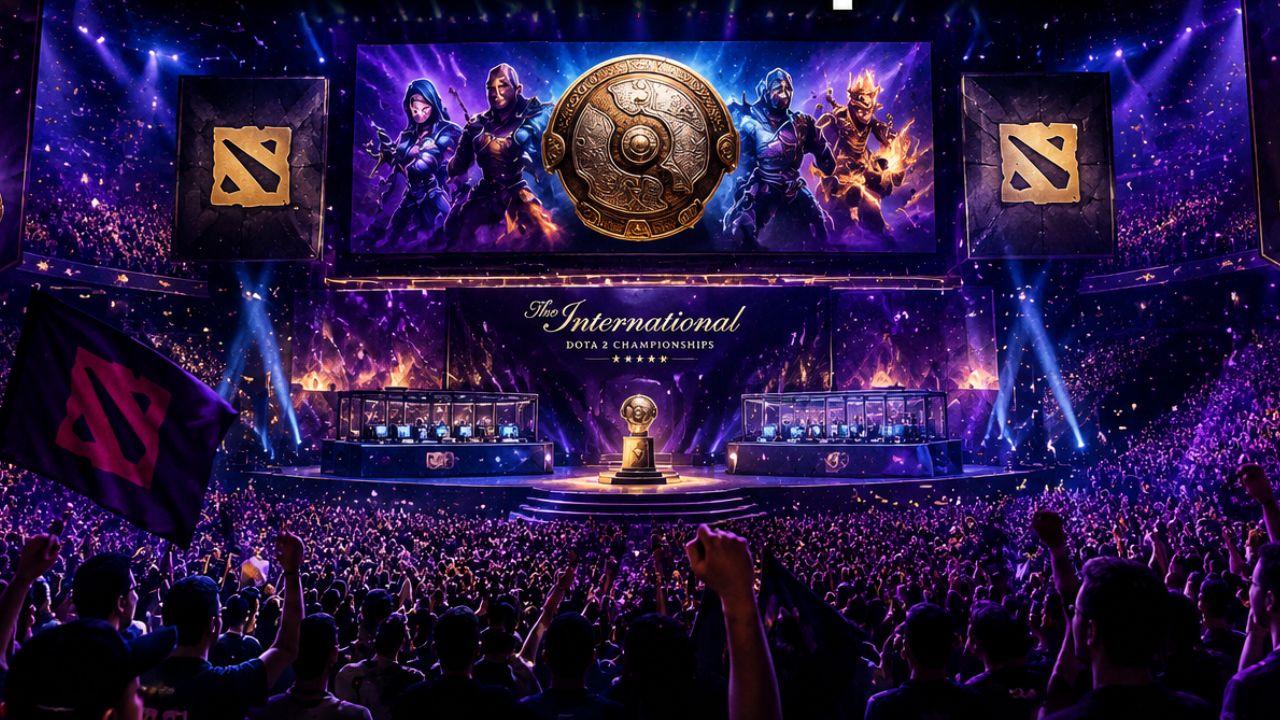
The International remains the pinnacle of competitive Dota 2, and the 2026 edition is shaping up to be one of the most exciting tournaments in the event’s history. Returning to Shanghai, China, for the first time in years, TI 2026 will bring together 16 of the world’s strongest teams as they battle for the prestigious Aegis of Champions and a share of the tournament’s multimillion-dollar prize pool. The event marks the fifteenth edition of Dota 2’s premier championship, adding even more significance to an already legendary competition.
Running from August 13 to August 23, 2026, The International will feature a revamped format that includes a Swiss-style group stage followed by an intense playoff bracket. With only seven teams receiving direct invitations and the remaining spots determined through fiercely contested regional qualifiers, every participant will have earned their place on the biggest stage in esports.
Fans can expect plenty of storylines heading into the tournament. Defending champions Team Falcons will look to retain their crown, while elite contenders such as Team Liquid, Tundra Esports, Aurora Gaming, Xtreme Gaming, Team Yandex, and BoomBoys enter the event as some of the strongest favorites. Meanwhile, qualifier teams from Europe, China, Southeast Asia, and the Americas will be eager to prove they belong among Dota 2’s elite.
In this guide, we’ll break down the complete TI 2026 schedule, explain the tournament format, highlight the top teams to watch, and cover everything fans need to know before the world’s best Dota 2 players clash in Shanghai for esports immortality.
What Is Dota 2 The International 2026?
Dota 2 The International 2026 is the fourteenth edition of Valve’s annual world championship for the game Dota 2. It brings together the best professional teams from across the globe to compete for the Aegis of Champions and a share of a multi-million dollar prize pool.
The International began in 2011 at Gamescom in Cologne, Germany, where Valve surprised the community by announcing a $1.6 million prize pool, which was unprecedented at the time (Valve, 2011). Since then, the event has grown into one of the defining moments of the esports calendar each year. TI 2026 continues that tradition, with Valve expected to announce the official host city and venue through its usual pre-event reveal cycle.
Why it matters: For casual fans and competitive players alike, TI is the one tournament where every match carries maximum stakes. Careers are made or ended here, and the winning organization earns a year-long claim to the title of world’s best Dota 2 team.
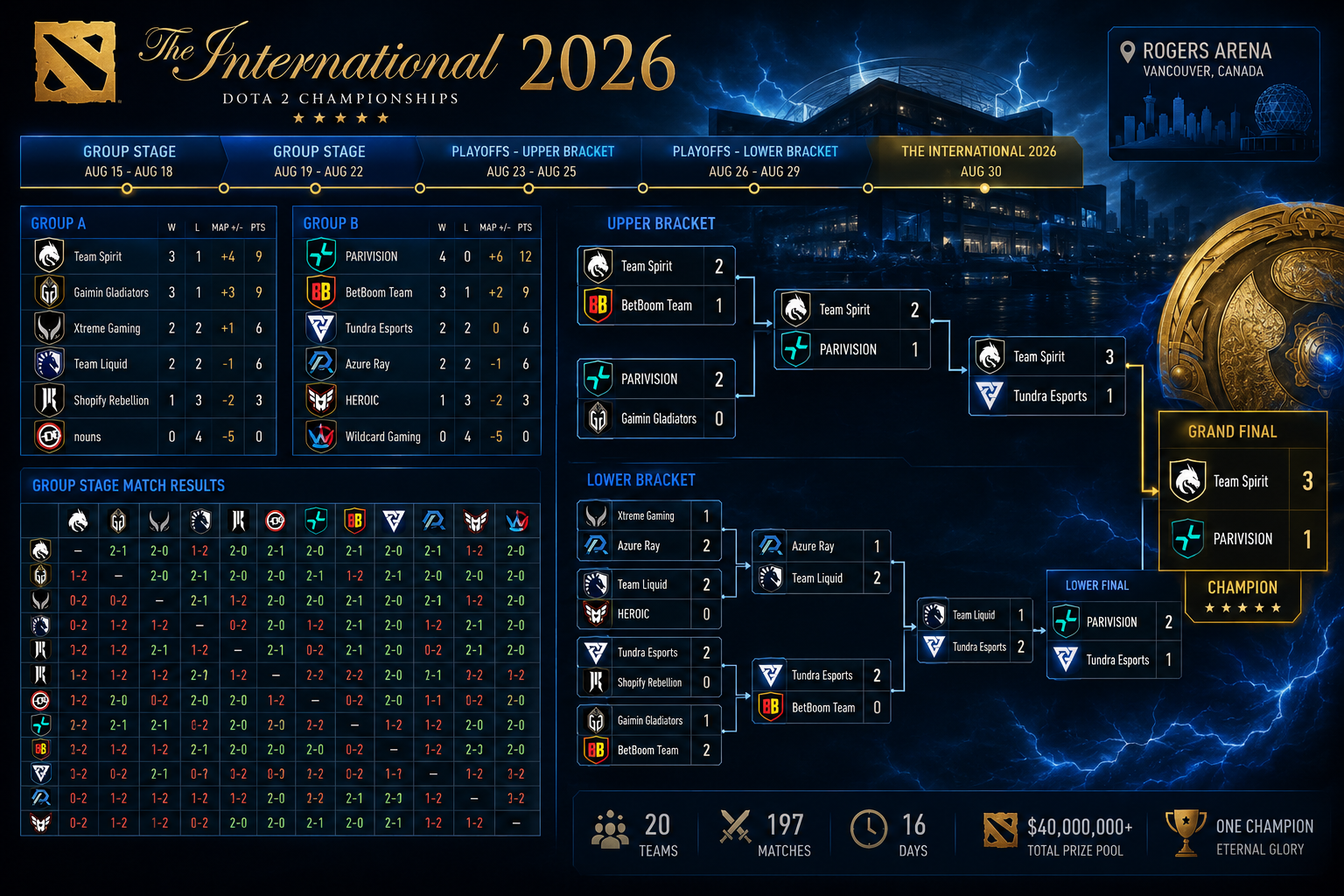
Dota 2 The International 2026: Schedule and Top Teams Overview
The full official schedule for TI 2026 has not been confirmed by Valve at the time of publication, but based on the established DPC calendar and prior years, the expected structure is as follows:
Expected Tournament Timeline
| Phase | Estimated Dates | Format |
|---|---|---|
| DPC Regional Finals | June – July 2026 | Regional leagues |
| Last Chance Qualifier | Late July 2026 | Open bracket |
| Group Stage | Late August 2026 | Round-robin |
| Main Event (Playoffs) | Early September 2026 | Double elimination |
| Grand Finals | Mid-September 2026 | Best of 5 |
Important note: These dates are estimates based on Valve’s historical scheduling patterns. Always check the official Dota 2 website or Liquipedia for confirmed dates once Valve announces them.
The group stage typically runs over four to five days, with 20 teams split into two groups of 10. Teams play every other team in their group once. The bottom two teams from each group are eliminated, while the rest advance to the main event bracket.
How Do Teams Qualify for TI 2026?
Teams earn spots at TI 2026 through the Dota Pro Circuit system and Valve’s direct invitation process. There are two main qualification paths.
Path 1: DPC Points
Teams accumulate DPC points throughout the season by finishing well in regional leagues and attending Valve-sanctioned Major tournaments. The teams with the highest point totals at the end of the season receive direct invitations to TI.
Path 2: Last Chance Qualifier (LCQ)
Teams that narrowly missed direct qualification compete in a regional LCQ. Each region sends a set number of teams to this open bracket, and the winners earn the final spots at TI.
Regional allocations at recent TI events have generally followed this breakdown (approximate, based on prior seasons):
- China: 3-4 direct spots
- Western Europe: 3-4 direct spots
- Eastern Europe / CIS: 2-3 direct spots
- Southeast Asia: 2-3 direct spots
- North America: 1-2 direct spots
- South America: 1 direct spot
Valve adjusts these numbers based on regional performance across the season, so the exact breakdown for 2026 may differ slightly.
Who Are the Top Teams at Dota 2 The International 2026?
Several organizations have established themselves as consistent TI contenders based on their DPC season performance heading into mid-2026. Full rosters shift frequently due to player transfers and roster shuffles, so treat this as a form guide rather than a definitive list.
Tier 1 Contenders
Team Spirit (Eastern Europe/CIS) – Winners of TI10, Spirit have maintained a strong roster and continue to be a threat at every Major they attend. Their aggressive draft style and mechanical execution make them dangerous in any bracket position.
Team Liquid (Western Europe) – A historically strong TI performer, Liquid’s structured teamplay and experienced roster make them a consistent top-four threat. Their coaching staff is among the best in the scene.
PSG.LGD (China) – China’s most decorated TI finalist organization, LGD has come agonizingly close to winning TI multiple times. Their disciplined, macro-focused playstyle remains effective at the highest level.
Gaimin Gladiators (Western Europe) – One of the most exciting rosters in the current meta, Gladiators play a fast-paced, high-kill style that punishes slower opponents.
Xtreme Gaming (China) – A newer powerhouse from the Chinese region, Xtreme Gaming has shown TI-winning potential with dominant DPC performances.
Teams to Watch
- Tundra Esports (Western Europe) – TI11 champions with a history of performing when it matters most
- nouns esports (North America) – Consistently the best NA squad, though the region faces a talent gap against top international competition
- Talon Esports (Southeast Asia) – Known for unconventional drafts and high-risk plays that can upset any team on a given day
What Format Does TI 2026 Use?
TI 2026 uses the same two-phase format that Valve has refined over several years: a round-robin group stage followed by a double-elimination main event.
Group Stage Rules:
- 20 teams split into two groups of 10
- Each team plays every other team in their group once (best of 2)
- Win = 2 points, Draw = 1 point, Loss = 0 points
- Top 8 from each group advance to the upper bracket; bottom 2 from each group are eliminated
Main Event Rules:
- 16 teams in a double-elimination bracket
- Upper bracket matches are best of 3; lower bracket matches are best of 3 until the lower bracket final (best of 3) and grand final (best of 5)
- Teams that lose in the upper bracket drop to the lower bracket and get a second chance
This format rewards consistency in the group stage while giving every team a safety net in the main event. A team can lose their first main event match and still win the championship, as Team Spirit demonstrated at TI10.
Where and How to Watch TI 2026
TI 2026 will be broadcast across multiple platforms simultaneously. Valve has historically partnered with major streaming services to maximize viewership.
Primary platforms:
- Twitch (twitch.tv/dota2ti) – English main stream with professional talent
- Steam TV – Integrated directly into the Steam client, allowing in-client viewing
- YouTube – Official Dota 2 channel with VOD availability after each match
Multi-language coverage:
Valve supports broadcasts in Russian, Chinese (Mandarin), Spanish, Portuguese, and several other languages through official and partner channels. This makes TI one of the most accessible esports events for global audiences.
For tracking scores and brackets:
Liquipedia’s Dota 2 section (liquipedia.net/dota2) is the most reliable community resource for live bracket updates, match histories, and team statistics.
If you enjoy competitive gaming coverage beyond Dota 2, the League of Legends Patch Tier List 2026 and Valorant Agent Tier List for 2026 offer similar deep-dive analysis for other major esports titles.
What Is the TI 2026 Prize Pool?
The TI prize pool is one of the most discussed topics in esports each year. Valve funds it primarily through the Battle Pass (also called the Compendium in earlier years), where a percentage of every Battle Pass purchase is added to the pool.
Historical prize pool milestones:
- TI3 (2013): $2.87 million (first crowd-funded pool)
- TI5 (2015): $18.4 million (record at the time)
- TI10 (2021): $40.0 million (all-time record as of publication)
The TI 2026 prize pool will depend on Battle Pass sales, which typically run for several months before the event. Based on recent trends, estimates for TI 2026 range from $20 million to $40 million, though the actual figure will only be confirmed once the Battle Pass closes.
Prize distribution follows a top-heavy model. The first-place team typically receives around 45% of the total pool, with sharply decreasing amounts for lower placements. Even teams eliminated in the group stage receive a meaningful payout relative to most esports tournaments.
How Does TI 2026 Compare to Other Major Esports Events?
TI is widely considered the single most prestigious tournament in esports, measured by prize pool size, production quality, and the cultural weight it carries within the Dota 2 community.
| Tournament | Game | Approx. Prize Pool (recent editions) |
|---|---|---|
| The International | Dota 2 | $20M – $40M |
| League of Legends Worlds | League of Legends | $2.2M (Riot-funded) |
| CS2 Major | Counter-Strike 2 | $1.25M |
| Fortnite World Cup | Fortnite | $30M (2019 only) |
The gap between TI and other esports events in terms of prize money is significant. However, tournaments like the League of Legends World Championship and CS2 Majors are considered equally prestigious within their own communities due to their competitive histories and viewership numbers.
For fans interested in other competitive gaming scenes, the CS2 Map Guide: Best Strategies for Every Map 2026 provides useful context on Counter-Strike’s competitive landscape, and the Apex Legends Tier List for 2026 covers another major battle royale esports scene.
Tips for New Fans Watching TI 2026
TI can feel overwhelming for first-time viewers. Dota 2 has over 120 heroes, complex item systems, and match durations that can exceed an hour. Here are practical ways to get more out of watching.
Start with the basics:
- Focus on the minimap and gold/experience graphs shown on screen to understand which team is winning
- The “net worth” bar at the top of the broadcast screen shows the overall gold advantage for each team
- Announcers (casters) explain key plays in real time, so listening closely helps
Choose a team to follow:
Picking a team to root for makes the group stage much more engaging. Consider following a team from your region or one with a player whose story interests you.
Use second-screen resources:
The Dota 2 wiki and Liquipedia both offer hero ability descriptions and match history that help contextualize what you’re seeing on screen.
Final Thoughts
Dota 2 The International 2026 is shaping up to be another landmark event in competitive gaming. With a stacked field of regional champions, a crowd-funded prize pool that dwarfs most other esports tournaments, and production quality that rivals traditional sports broadcasts, TI 2026 deserves attention from both hardcore fans and curious newcomers.
Actionable next steps for fans:
- Bookmark the official Dota 2 website and Liquipedia’s TI 2026 page for schedule confirmations and bracket updates
- Follow your preferred team’s social media accounts for roster news before the event
- Set a reminder to check Battle Pass sales progress, which signals how large the prize pool will grow
- Watch at least one group stage match to get a feel for the format before the higher-stakes main event begins
- Use Twitch’s clip and VOD features to catch up on matches you miss during the live broadcast window
Whether the goal is to watch the world’s best players compete for tens of millions of dollars or simply to understand why Dota 2 has sustained one of esports’ most passionate communities for over a decade, TI 2026 is the right place to start.
Frequently Asked Questions (FAQs)
When does TI 2026 start?
Based on Valve’s historical scheduling, the group stage is expected to begin in late August 2026. Valve typically announces the official dates 60 to 90 days before the event. Check the official Dota 2 website for confirmed dates.
Where is TI 2026 being held?
The host city for TI 2026 has not been officially confirmed at the time of publication. Valve selects a new city each year; past locations have included Seattle, Vancouver, Stockholm, Singapore, and Bali.
How many teams compete at TI 2026?
TI traditionally features 20 teams: 12 to 14 direct invites based on DPC points and 6 to 8 spots filled through regional Last Chance Qualifiers.
How can fans attend TI 2026 in person?
Tickets go on sale through the official Dota 2 website, usually 4 to 8 weeks before the event. Main event tickets sell out quickly. Group stage tickets are generally easier to obtain.
What is the Aegis of Champions?
The Aegis of Champions is the physical trophy awarded to the TI-winning team. Each year, the previous year’s Aegis is “Etched” with the winning team’s names and a new one is created. It is the most iconic trophy in esports.
Can you watch TI 2026 for free?
Yes. The main English stream on Twitch and YouTube is free to watch. Steam TV is also free for all Steam users.
Which region has won TI the most times?
China has the most TI victories of any single region, with teams like Invictus Gaming, LGD-adjacent organizations, and others claiming multiple titles. Western Europe and Eastern Europe have also produced multiple champions.