Marvel Rivals continues to dominate the hero-shooter scene in 2026, with new heroes, balance updates, and shifting team compositions constantly reshaping the competitive meta. A hero who was considered unstoppable a few months ago may now struggle against emerging strategies, while previously overlooked characters have risen to become game-changing picks. With Season 8.5 introducing fresh balance adjustments and new heroes such as Cyclops, players are once again reevaluating which characters offer the best value in ranked and casual play.
Whether you’re climbing the competitive ladder, building the perfect team composition, or simply looking for a strong main character, understanding the current meta is essential. In this Marvel Rivals Hero Tier List for 2026, we’ll rank every major hero from S-Tier powerhouses to situational picks, breaking down their strengths, weaknesses, and overall impact on the battlefield. From dominant tanks and deadly duelists to game-changing strategists, this guide will help you identify the heroes that can give you the biggest advantage in the latest season.
What Is a Tier List and How Do You Read It
A tier list ranks every playable hero from strongest to weakest based on their current in-game performance. In Marvel Rivals, tiers are labeled S, A, B, and C, where S-tier heroes are the most effective in the current meta and C-tier heroes are either outclassed or require too much effort for too little reward.
Reading a tier list correctly means understanding context. A hero ranked B-tier in solo queue might be A-tier in a coordinated five-stack because team communication changes how their abilities land. Tier lists also assume average-to-good play, not perfect execution, so a hero’s ceiling matters less than their floor.
How to apply a tier list:
- S-tier: Strong in almost every match, safe to pick without overthinking team composition
- A-tier: Reliable and effective, good for most players and most situations
- B-tier: Situationally strong or require specific team setups to perform well
- C-tier: Currently underperforming; avoid unless you have significant experience with the hero
Best Heroes in Marvel Rivals Right Now in 2026
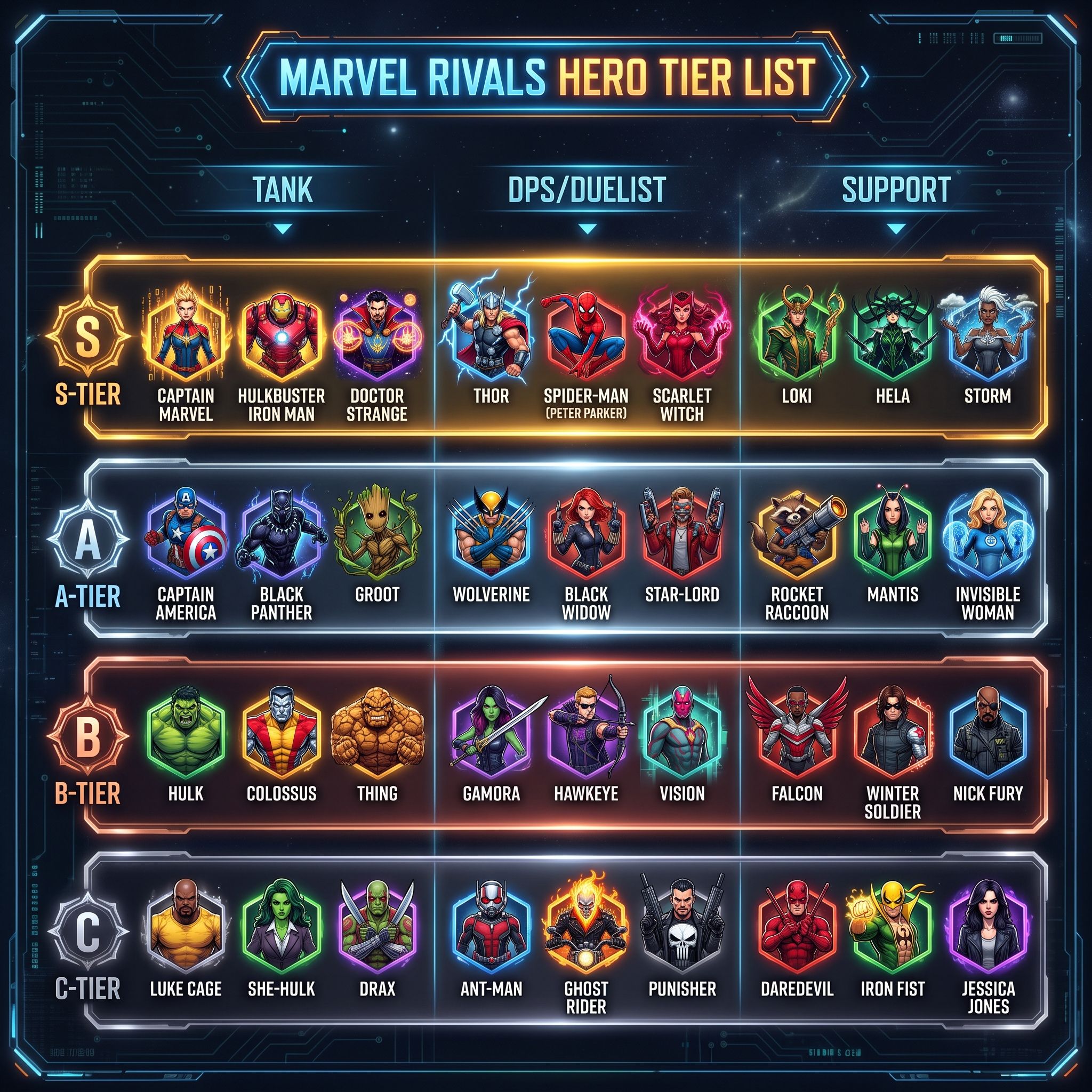
The strongest heroes in Marvel Rivals as of mid-2026 are Hela, Magneto, Luna Snow, Thor, and Iron Man. These picks consistently appear in high-rank lobbies and competitive play because their kits offer strong output with reasonable counterplay.
S-Tier (Current Patch)
| Hero | Role | Why They’re S-Tier |
|---|---|---|
| Hela | DPS | High burst damage, strong aerial mobility, difficult to pin down |
| Magneto | Tank | Exceptional zone control, team shielding, high survivability |
| Luna Snow | Support | Best healing throughput in the game, strong ultimate uptime |
| Spider-Man | DPS | Elite mobility and pick potential in skilled hands |
A-Tier (Strong and Reliable)
| Hero | Role | Notes |
|---|---|---|
| Thor | Tank/DPS | Versatile kit, good in both solo and team play |
| Iron Man | DPS | Strong ranged pressure, good ultimate damage |
| Mantis | Support | Consistent healing, solid damage boost utility |
| Groot | Tank | Excellent crowd control, strong in organized play |
For a deeper breakdown of Season 2 rankings, the Marvel Rivals Tier List Season 2: Best Heroes Ranked 2026 guide covers patch-specific changes in full detail.
Marvel Rivals Tier List by Role: Tank, DPS, and Support
Ranking heroes by role gives a more accurate picture than a single combined list. A support hero cannot be fairly compared to a tank using the same criteria.
Best Tanks: Magneto leads the tank category because his barrier mechanics protect the entire team while he deals consistent damage. Groot follows closely for his crowd control in tight corridors. Doctor Strange remains a strong pick for teams that need portal-based repositioning.
Best DPS (Duelists): Hela is the top DPS pick in 2026 due to her ranged burst and aerial superiority. Black Panther offers strong flanking potential but punishes mechanical errors. Hawkeye is effective at long range but struggles in close-quarters maps.
Best Supports: Luna Snow is the clear top support pick. Her healing output is the highest in the game, and her ultimate ability can turn lost team fights. Mantis and Cloak and Dagger round out the A-tier support options.
Which Marvel Rivals Heroes Are Overpowered This Patch
As of the mid-2026 patch cycle, Hela and Luna Snow are the two heroes most commonly flagged as overpowered by the competitive community. Hela’s damage output at range exceeds what most tanks can absorb before their supports can respond. Luna Snow’s healing numbers allow her team to sustain through fights that should otherwise be losses.
Spider-Man is also drawing attention in high-rank lobbies, though his power is gated behind mechanical skill. In average lobbies, he performs like a B-tier pick. In the hands of experienced players, he functions like a second S-tier DPS.
Common mistake: Players often label a hero overpowered because they lost to one. A hero is genuinely overpowered when their win rate is significantly above average across a wide sample of matches, not just in single games.
Marvel Rivals Heroes Ranked Worst to Best
The bottom of the Marvel Rivals Hero Tier List in 2026 includes heroes who either have kits that do not fit the current meta or who were hit hard by recent nerfs.
C-Tier Heroes (Currently Underperforming):
- Rocket Raccoon: Support output too low for current healing demands
- Black Widow: High skill ceiling with underwhelming payoff compared to other DPS options
- Venom: Survivability reduced in the last two patches; struggles against the current S-tier picks
B-Tier Heroes (Situationally Viable):
- Scarlet Witch: Strong in specific team comps but inconsistent across maps
- Wolverine: Good in close-range brawls, weak against ranged-heavy compositions
- Storm: High damage potential but fragile and easy to focus down
The full ranking from worst to best runs: C-tier (Rocket Raccoon, Black Widow, Venom), B-tier (Scarlet Witch, Wolverine, Storm, Hawkeye), A-tier (Thor, Iron Man, Mantis, Groot), S-tier (Hela, Magneto, Luna Snow, Spider-Man).
If you enjoy comparing hero rankings across different games, the Overwatch 2 Tier List 2026: Best Heroes Ranked by Role offers a useful parallel for players coming from that game.
Should You Main This Hero or Pick a Better One
Main the hero that matches your playstyle, but avoid investing hundreds of hours into a C-tier pick if climbing rank is a priority. The best hero to main is one that sits in A-tier or higher and aligns with how you naturally want to play.
Decision rules:
- Choose a hero to main if they are A-tier or above and you enjoy their playstyle
- Avoid maining a C-tier hero if your primary goal is ranked progression
- If you already have strong mechanics on a B-tier hero, the skill advantage often outweighs the tier gap
- Switch heroes if you are consistently losing fights you should be winning, not just because a tier list says to
For players still building their hero pool, the Best Marvel Rivals Heroes for Beginners 2026 Guide breaks down which heroes teach good habits without punishing new players too harshly.
Marvel Rivals Tier List for Beginners vs Competitive Players
Beginners and competitive players need different things from a tier list. A beginner benefits most from heroes with simple, forgiving kits that do not require precise timing or advanced game sense. Competitive players prioritize heroes with high impact ceilings and strong team synergy.
Best heroes for beginners:
- Thor: Straightforward kit, durable, and useful in almost every team composition
- Mantis: Easy to understand healing loop, good for learning support fundamentals
- Groot: Forgiving tank with strong crowd control that helps even when played imperfectly
Best heroes for competitive play:
- Hela: Rewards precise aim and positioning with top-tier damage output
- Luna Snow: Requires game sense to maximize ultimate timing but offers the highest support ceiling
- Magneto: Demands map knowledge and barrier placement awareness
How Often Does the Marvel Rivals Tier List Change
The Marvel Rivals Hero Tier List shifts meaningfully every four to six weeks on average, following each balance patch. Major seasonal updates, which arrive roughly every three months, tend to cause larger shifts because they often introduce new heroes or rework existing ones.
Small patches adjust numbers (damage, healing, cooldowns) without changing a hero’s fundamental role. Large patches can move a hero two full tiers in either direction. After any patch, allow one to two weeks for the community to settle on updated rankings before treating a new tier list as authoritative.
Tip: Follow official Marvel Rivals patch notes directly and cross-reference with high-rank player feedback rather than relying on a single tier list source that may not update immediately after patches.
Is This Hero Worth Learning or Is It Trash Tier
A hero is worth learning if they are B-tier or above, or if they are currently C-tier but have confirmed buffs coming in the next patch. Investing time in a hero with no upward trajectory wastes practice hours that could go toward more viable picks.
Heroes worth learning despite current tier placement:
- Wolverine: Expected buffs in the next patch cycle make him worth picking up now
- Scarlet Witch: Her high skill ceiling means she performs above her tier in skilled hands
- Storm: Niche but strong on open-sky maps; worth knowing as a situational pick
Heroes not worth investing in right now:
- Black Widow: No confirmed buffs and her kit does not fit the current close-range meta
- Rocket Raccoon: Outclassed in every support metric by Luna Snow and Mantis
Marvel Rivals Meta Heroes vs Fun Heroes to Play
The meta and fun are not mutually exclusive, but they often pull in different directions. Meta heroes are the ones that win the most matches at the highest level. Fun heroes are the ones that feel satisfying to play regardless of their win rate.
At ranks below Diamond, the gap between a meta pick and a fun pick is smaller than most players assume. Mechanical comfort and game sense matter more than tier placement in casual and mid-rank lobbies.
Choose meta heroes if: You are pushing for top-rank placement or playing in organized competitive matches.
Choose fun heroes if: You are in casual modes, learning the game, or playing with friends who are not focused on climbing.
Players who enjoy comparing meta vs. fun dynamics across different games might find the Valorant Agent Tier List for 2026: Every Agent Ranked a useful read for perspective on how other tactical games handle this balance.
What Makes a Hero Top Tier in Marvel Rivals
A hero reaches top-tier status in Marvel Rivals when they combine high output (damage or healing), strong survivability or mobility, and team utility that works across multiple map types and compositions.
The four factors that define top-tier status:
- Output efficiency: How much damage or healing they produce per second relative to their resource costs
- Survivability: Ability to stay alive through a fight without requiring constant support
- Utility: Crowd control, shields, buffs, or debuffs that benefit the whole team
- Map versatility: Performing well on both open and enclosed maps rather than only one type
Heroes that score high on all four factors consistently appear at the top of the Marvel Rivals Hero Tier List regardless of patch changes.
Upcoming Buffs and Nerfs: Marvel Rivals Tier List Changes to Expect
Based on developer patch previews and community datamining as of mid-2026, several heroes are expected to shift in the next major update.
Expected buffs (heroes moving up):
- Wolverine: Regeneration scaling improvements expected
- Scarlet Witch: Cooldown reductions on her primary chaos bolt ability
- Storm: Mobility improvements to address her fragility
Expected nerfs (heroes moving down):
- Hela: Damage falloff at range likely to be increased
- Luna Snow: Ultimate charge rate expected to be slowed
- Spider-Man: Web mobility cooldowns under review at high-rank levels
These changes are based on official developer communications and should be confirmed against the actual patch notes when released. Tier lists will need reassessment after each update lands.
How to Counter Top Tier Heroes in Marvel Rivals
Countering S-tier heroes is more reliable than trying to out-pick them, and it does not require switching to a hero you are unfamiliar with. Most top-tier heroes have specific weaknesses that consistent play can exploit.
Counter strategies for current S-tier picks:
- Against Hela: Use heroes with strong vertical mobility or long-range pressure to deny her aerial positioning. Black Panther and Thor can close distance quickly.
- Against Magneto: His barriers have cooldowns. Burst damage during barrier downtime is the most effective approach.
- Against Luna Snow: Prioritize her in team fights. Supports are always the highest-value elimination target. Heroes with dive potential like Spider-Man work well.
General counter principle: Every S-tier hero has a window of vulnerability. Learning those windows is more valuable than picking a specific counter hero you cannot play well.
For players who enjoy the strategic layer of counter-picking across different competitive games, the Apex Legends Tier List for 2026: Every Legend Ranked covers similar meta dynamics in a different genre.
Final Thoughts
The Marvel Rivals Hero Tier List for 2026 gives players a clear starting point for hero selection, but it works best as a guide rather than a rulebook. S-tier picks like Hela, Magneto, and Luna Snow are strong in most situations, but the right hero is always the one that fits the team composition, the map, and the player’s own skill set.
Actionable next steps:
- Start with A-tier heroes if you are new or returning to Marvel Rivals after a break
- Check patch notes after every major update and reassess your main hero’s tier placement
- Focus on learning counter strategies for S-tier heroes rather than always trying to mirror them
- Use role-specific tier lists when building a team composition, not just the overall combined ranking
- Revisit the Marvel Rivals Tier List Season 2: Best Heroes Ranked 2026 after the next major patch drops for updated rankings
Players who understand why a hero is strong, not just that they are strong, will adapt faster when the meta shifts. That knowledge is more durable than any single tier list.
Frequently Asked Questions (FAQs)
What is the best hero in Marvel Rivals in 2026?
Hela is widely considered the strongest DPS hero in Marvel Rivals as of mid-2026 due to her burst damage, aerial mobility, and consistent high win rate in ranked play.
Is Luna Snow overpowered right now?
Luna Snow’s healing throughput is the highest in the game and her ultimate uptime is strong enough that many competitive players consider her overpowered in the current patch. Nerfs are expected in the next update.
Which hero should a beginner pick in Marvel Rivals?
Thor and Mantis are the best starting points for beginners. Both have straightforward kits, are forgiving of mechanical errors, and teach core game sense without punishing new players too harshly.
How do I know when the tier list has been updated?
Check official Marvel Rivals patch notes after each update and cross-reference with high-rank community sources. Tier lists that have not been updated within two weeks of a major patch may be outdated.
Can I climb ranked with a B-tier hero?
Yes. Mechanical skill and game sense outweigh tier placement in most rank brackets below Diamond. A B-tier hero played with strong fundamentals will outperform an S-tier hero played poorly.
Is Wolverine worth learning right now?
Wolverine is currently B-tier but expected buffs in the upcoming patch make him worth learning now. Players who invest time before the buffs land will have an advantage when he moves up the rankings.