
Climbing the ranked ladder in Marvel Rivals takes more than mechanical skill—it requires the right team composition. Even the strongest individual heroes can struggle when paired with teammates who lack synergy, while a well-balanced lineup can consistently outperform teams filled with meta picks. As the 2026 competitive season continues to evolve, successful players are focusing on coordinated team structures that maximize damage, survivability, crowd control, and objective pressure. Current high-level play heavily favors balanced compositions, with traditional 2-2-2 setups (two Vanguards, two Duelists, and two Strategists) remaining among the most reliable options for ranked climbing, while specialized dive, brawl, and triple-support variants can dominate in coordinated squads.
In this guide, we’ll break down the best Marvel Rivals team comps for ranked play in 2026, explaining why each lineup works, which heroes provide the strongest synergies, and when to use them based on the current meta. Whether you’re grinding through Gold, pushing for Diamond, or aiming for the highest competitive tiers, these team compositions can help you win more matches and climb faster.
What Are Marvel Rivals Team Comps and Why Do They Matter for Ranked?
A team composition in Marvel Rivals is the specific combination of six heroes your squad selects before a match. In ranked play, team comps determine whether your group has enough healing, frontline durability, and damage output to win sustained fights.
Unlike casual modes, ranked matches in Marvel Rivals reward coordinated drafting. A random collection of popular heroes will lose to a structured lineup that covers all three roles and activates synergy bonuses. According to NetEase’s Season 2 patch notes (2025), synergy bonuses can provide meaningful stat increases — ranging from passive healing to damage amplification — making intentional drafting a competitive necessity rather than a preference.
The three core roles:
- Vanguard: Frontline tanks who absorb damage, create space, and enable teammates to deal damage safely.
- Duelist: Primary damage dealers who eliminate targets and apply pressure.
- Strategist: Healers and support heroes who sustain the team and provide utility.
A well-built Marvel Rivals team comp for ranked balances all three roles while stacking synergy bonuses where possible.
The Best Marvel Rivals Team Comps for Ranked in 2026
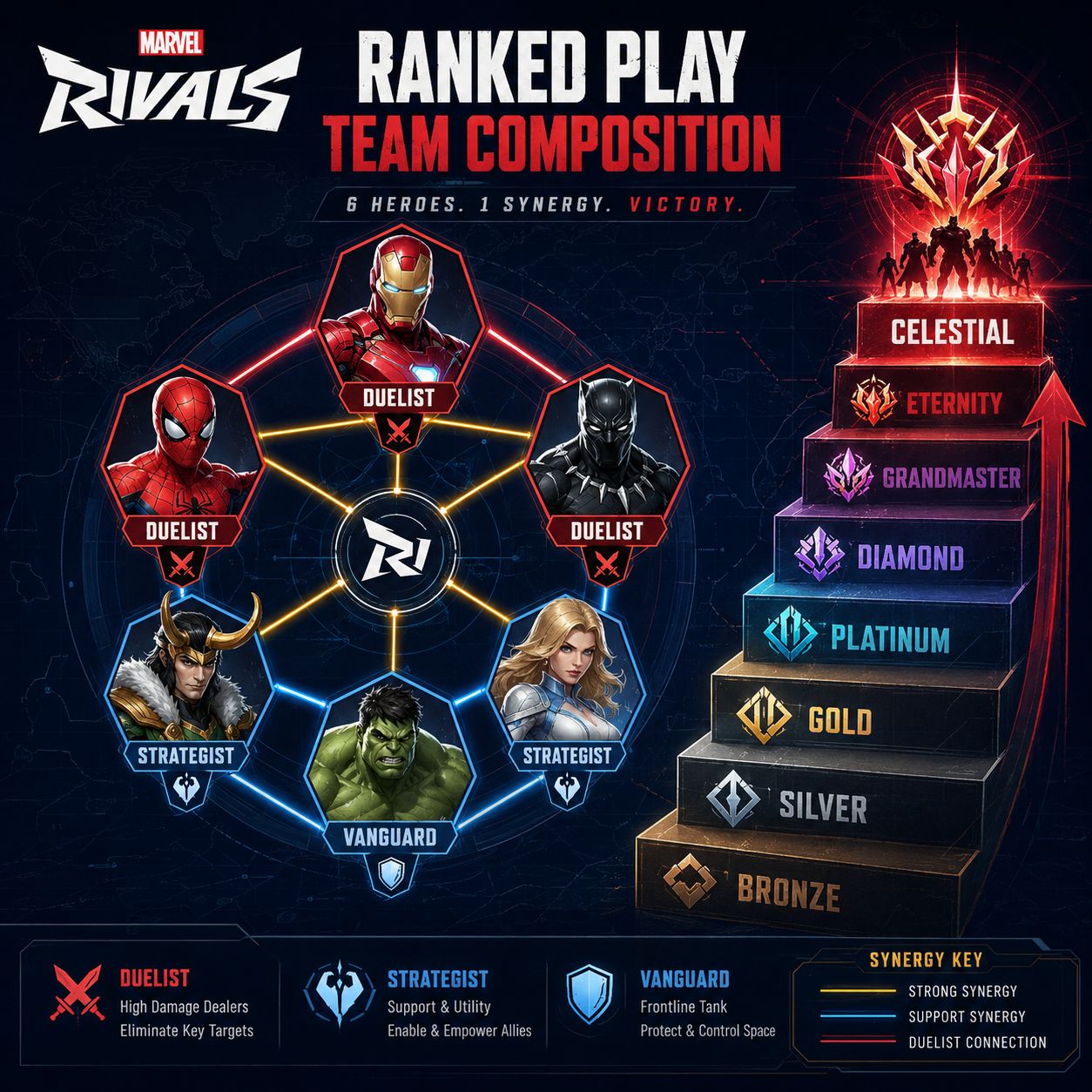
The top-performing ranked compositions in 2026 fall into four main archetypes: sustain, dive, poke, and rush. Each has a different playstyle and works better on certain map types.
For a full breakdown of which heroes perform best individually, see the Marvel Rivals Tier List Season 2: Best Heroes Ranked 2026.
Sustain Composition (Best All-Around)
This is the safest pick for most rank brackets, from Gold through Diamond.
| Role | Hero | Why They Fit |
|---|---|---|
| Vanguard | Magneto | Magnetic shield, area denial, synergy with Storm |
| Vanguard | Doctor Strange | Portal utility, high HP, frontline control |
| Duelist | Hawkeye | Long-range burst, consistent damage output |
| Duelist | Black Widow | Mobile flanker, distracts backline |
| Strategist | Luna Snow | High sustained healing, freeze ultimate |
| Strategist | Mantis | Burst heal, sleep dart for peel |
Why it works: This lineup covers every role, activates the Magneto/Storm synergy if Storm is subbed in, and has two reliable ultimates (Luna Snow’s freeze and Doctor Strange’s portal) that can swing teamfights. The backline is protected by Mantis’s sleep dart, which stops dives cold.
Common mistake: Running this comp passively. Sustain comps win by forcing prolonged fights, not by sitting back. Push with your Vanguards and let Hawkeye farm damage from behind the frontline.
Dive Composition (High Aggression)
Dive comps punish teams running a single Vanguard or slow, stationary Strategists.
| Role | Hero | Why They Fit |
|---|---|---|
| Vanguard | Thor | Dive-capable tank, high mobility |
| Vanguard | Hulk | Anchor frontline while Thor dives |
| Duelist | Spider-Man | Fastest mobility in the roster |
| Duelist | Black Panther | Burst damage, hard to track |
| Strategist | Adam Warlock | Resurrection ultimate, mobile healing |
| Strategist | Cloak and Dagger | Damage mitigation, area healing |
Choose dive if: The enemy team has slow, immobile Strategists (like Loki or Rocket Raccoon) who cannot escape gap-closers. Avoid dive if the enemy runs Mantis (sleep dart counters every diver) or a double-shield Vanguard setup.
How Synergy Bonuses Change Marvel Rivals Team Comps for Ranked
Synergy bonuses are passive buffs that activate when specific hero combinations are on the same team. They are one of the most underused tools in ranked play below Grandmaster rank.
Top synergy pairings to build around in 2026:
- Magneto + Storm (X-Men): Magneto gains a magnetic shield boost; Storm gains increased storm duration. This pairing alone makes Magneto the default Vanguard pick.
- Spider-Man + Black Cat (Spider-Verse): Both heroes gain increased movement speed and reduced ultimate cost.
- Luna Snow + Jeff the Land Shark (Vanguard of the Stars): Luna Snow’s healing radius increases, making her even more effective in grouped teamfights.
- Rocket Raccoon + Groot (Guardians): Groot’s walls gain additional HP; Rocket gains a passive ammo refund.
Decision rule: If two heroes you already want to run share a synergy bonus, always prioritize activating it. If you have to sacrifice a better hero to activate a weak synergy, skip it.
If you’re newer to the game and still learning which heroes suit your playstyle, the Best Marvel Rivals Heroes for Beginners 2026 Guide is a strong starting point before committing to ranked compositions.
What Role Structure Works Best in Ranked Play?
The 2-2-2 structure (two Vanguards, two Duelists, two Strategists) is the most reliable format for ranked climbing in 2026. It provides enough healing to sustain fights, enough frontline to contest objectives, and enough damage to close out kills.
Alternative structures and when they work:
- 1-3-2 (one Vanguard, three Duelists, two Strategists): Works in lower ranks where coordinated dives are rare, but falls apart at Platinum and above when enemies focus the solo tank.
- 2-1-3 (two Vanguards, one Duelist, three Strategists): An extreme sustain setup that can stall indefinitely but struggles to close kills. Use this only if your team has very high individual skill on Duelists.
- 3-2-1 (three Vanguards, two Duelists, one Strategist): Almost never works in ranked. One Strategist cannot sustain six players through extended fights.
Edge case: In Convoy defense maps, a 2-1-3 setup can stall the payload effectively, but you need your single Duelist to be on a high-burst hero like Hela or Iron Man.
How to Counter Common Marvel Rivals Team Comps in Ranked
Knowing how to counter opposing lineups is just as important as building your own. At Diamond rank and above, players actively draft to beat what they see on the enemy team.
Counter-picking guide:
| Enemy Comp | Counter Strategy | Key Hero Swaps |
|---|---|---|
| Double shield (Magneto + Doctor Strange) | High-burst Duelists who pierce shields | Hela, Hawkeye, Iron Man |
| Dive (Spider-Man + Black Panther) | Peel-heavy Strategists and CC Vanguards | Mantis, Scarlet Witch, Thor |
| Poke (Hawkeye + Hela) | Aggressive dive to close distance fast | Spider-Man, Black Panther, Thor |
| Sustain stack (triple Strategist) | Burst damage to kill before heals land | Punisher, Black Panther, Wolverine |
Common mistake: Waiting until the second round to counter-pick. In ranked, you can adjust your lineup between rounds. If the enemy comp is beating you, swap one or two heroes rather than sticking with a losing draft out of comfort.
For comparison, games like Overwatch 2 use a similar counter-drafting system — if you want to see how role meta works in another hero shooter, the Overwatch 2 Tier List 2026: Best Heroes Ranked by Role covers those dynamics in detail.
Map-Specific Marvel Rivals Team Comps for Ranked
Not every composition works on every map. Map geometry heavily influences which heroes provide value.
Long sightline maps (Wakanda Outskirts, Asgard Bridge):
- Favor poke comps with Hawkeye, Hela, and Iron Man.
- Avoid melee-heavy Duelists like Wolverine or Black Panther, who cannot reach enemies safely.
Close-quarters maps (Sanctum Sanctorum, Hydra Lab):
- Favor dive and brawl comps with Thor, Hulk, Spider-Man, and Wolverine.
- Avoid long-range poke heroes who lose value at close range.
Convoy and Escort maps:
- Sustain comps with high healing output perform best because fights last longer around the payload.
- Luna Snow’s freeze ultimate is especially powerful on Escort, as it can stall the payload push entirely.
Decision rule: Before locking in your comp, check the map. If the map is a close-range brawl environment, switch at least one long-range Duelist for a mobile melee hero.
Ranked Climbing Tips Beyond Team Comps
Even the best Marvel Rivals team comps for ranked will underperform without good communication and game sense. Composition is the foundation, but execution wins matches.
Practical tips for ranked climbing in 2026:
- Coordinate ultimates. Chaining Luna Snow’s freeze into Hawkeye’s charged shot or Doctor Strange’s portal into a team collapse creates fight-winning moments that individual ultimates cannot.
- Call out enemy ultimate status. Knowing when the enemy Strategist has their ultimate ready changes how aggressively you should fight.
- Avoid hero duplication. Running two of the same hero wastes synergy slots and creates role gaps.
- Swap when losing. If your comp is 0-2 in a best-of-three, one or two hero swaps can completely change the matchup.
- Prioritize Strategist protection. Most ranked games are lost because Strategists die to unchecked divers. Your Vanguards should always know where the enemy Spider-Man is.
Final Thoughts
Building the right Marvel Rivals team comps for ranked in 2026 comes down to three things: role balance, synergy activation, and adaptability. Start with the 2-2-2 sustain structure if you’re still learning the meta, then layer in synergy bonuses as you become more familiar with the roster. At higher ranks, counter-drafting and map awareness separate good players from great ones.
Actionable next steps:
- Learn at least two heroes in each role so you can always fill what your team needs.
- Memorize the top five synergy pairings and build your drafts around them.
- Study the map before locking in — adjust at least one hero pick based on the geometry.
- Coordinate ultimates with your team through voice or text chat before teamfights start.
- Check the current tier list regularly, because balance patches shift the meta every few weeks.
For a deeper look at individual hero strength, the Marvel Rivals Tier List Season 2: Best Heroes Ranked 2026 breaks down every character by role and current patch standing. If you’re coming from another hero shooter and want to compare meta approaches, the Valorant Agent Tier List for 2026: Every Agent Ranked offers useful context on how competitive drafting works across different games.
Frequently Asked Questions (FAQs)
What is the best team comp for beginners in Marvel Rivals ranked?
The sustain 2-2-2 comp with Magneto, Doctor Strange, Hawkeye, Black Widow, Luna Snow, and Mantis is the most forgiving for new ranked players. It covers all roles and does not require advanced mechanical skills to function.
How many Strategists should a ranked team run?
Two Strategists is the standard for ranked play. One Strategist cannot sustain a full team through extended fights, and three Strategists leave too little damage output to close kills.
Do synergy bonuses make a big difference in ranked?
Yes. Synergy bonuses provide passive stat increases that compound over a full match. Activating even one strong synergy pairing (like Magneto and Storm) gives a measurable advantage in sustained teamfights.
What is the strongest Vanguard pairing in 2026?
Magneto and Doctor Strange. Magneto provides area denial and the X-Men synergy, while Doctor Strange offers portal utility and high durability. Together they create strong frontline presence without sacrificing mobility.
Is dive or sustain better for climbing ranked?
Sustain comps are more consistent across all rank brackets. Dive comps have a higher ceiling but require coordinated communication to execute correctly. Below Diamond, sustain is the safer choice.
Can you run a one-tank composition in ranked?
Technically yes, but it is not recommended above Gold rank. Single-tank setups are easily punished by dive compositions and burst damage heroes that focus the solo Vanguard.
Which Strategist has the best ultimate for ranked?
Luna Snow’s freeze ultimate is widely considered the strongest Strategist ultimate in ranked because it both heals teammates and stops enemy pushes simultaneously.