
The video game industry continues to face one of its most challenging periods, with 2026 bringing another wave of layoffs, studio closures, project cancellations, and major restructuring across developers and publishers of every size. From indie teams fighting to survive to global companies cutting hundreds of jobs, thousands of talented developers, artists, designers, writers, and engineers have been affected as studios adapt to rising development costs, changing player demand, consolidation, and increasing investment in AI and live-service strategies. Industry trackers estimate that several thousand gaming professionals have already lost their jobs this year, with new announcements arriving almost every week.
This Game Industry Layoffs in 2026: Complete Tracker is continuously updated to document every confirmed layoff, studio shutdown, workforce reduction, and restructuring announcement throughout the year. Whether you’re a developer following industry trends, a journalist researching the latest cuts, or a gamer wanting to understand how these changes could affect upcoming titles, this tracker provides a comprehensive timeline of the companies involved, the number of employees impacted, and the broader context behind each decision. As the industry continues to evolve, we’ll keep this page updated with the latest confirmed developments and their impact on the future of game development.
Why Are Game Studios Laying Off Employees in 2026
Game studios are laying off employees in 2026 primarily because of three converging pressures: unsustainable headcount growth during the 2020-2022 pandemic boom, sharply higher costs to ship AAA titles, and a slower-than-expected recovery in consumer spending on premium games.
During the pandemic, publishers hired aggressively to meet surging demand. By 2024 and into 2026, that demand normalized while costs did not. A major AAA game now routinely costs $200 million or more to develop and market (industry estimates cited by Game Developer magazine, 2024). When a title underperforms at launch, publishers cut staff to protect margins.
Additional factors driving 2026 cuts include:
- AI tool adoption: Automated asset generation, QA testing scripts, and AI-assisted localization have reduced the need for certain junior and mid-level roles.
- Live-service fatigue: Several studios shut down live-service titles that failed to retain players, eliminating entire teams overnight.
- Rising interest rates: Parent companies and private equity-backed studios face higher borrowing costs, making large payrolls harder to justify.
- Consolidation: Post-merger integration (especially following Microsoft’s Activision Blizzard acquisition) has led to redundant teams being eliminated.
For a broader look at where the industry is heading, see this analysis of gaming industry predictions before 2030.
Which Game Companies Have Had Layoffs Recently
The most active layoff announcements in 2026 have come from Microsoft Gaming, Electronic Arts, Ubisoft, and several mid-tier studios. Confirmed cuts through June 2026 include companies across North America, Europe, and Australia.
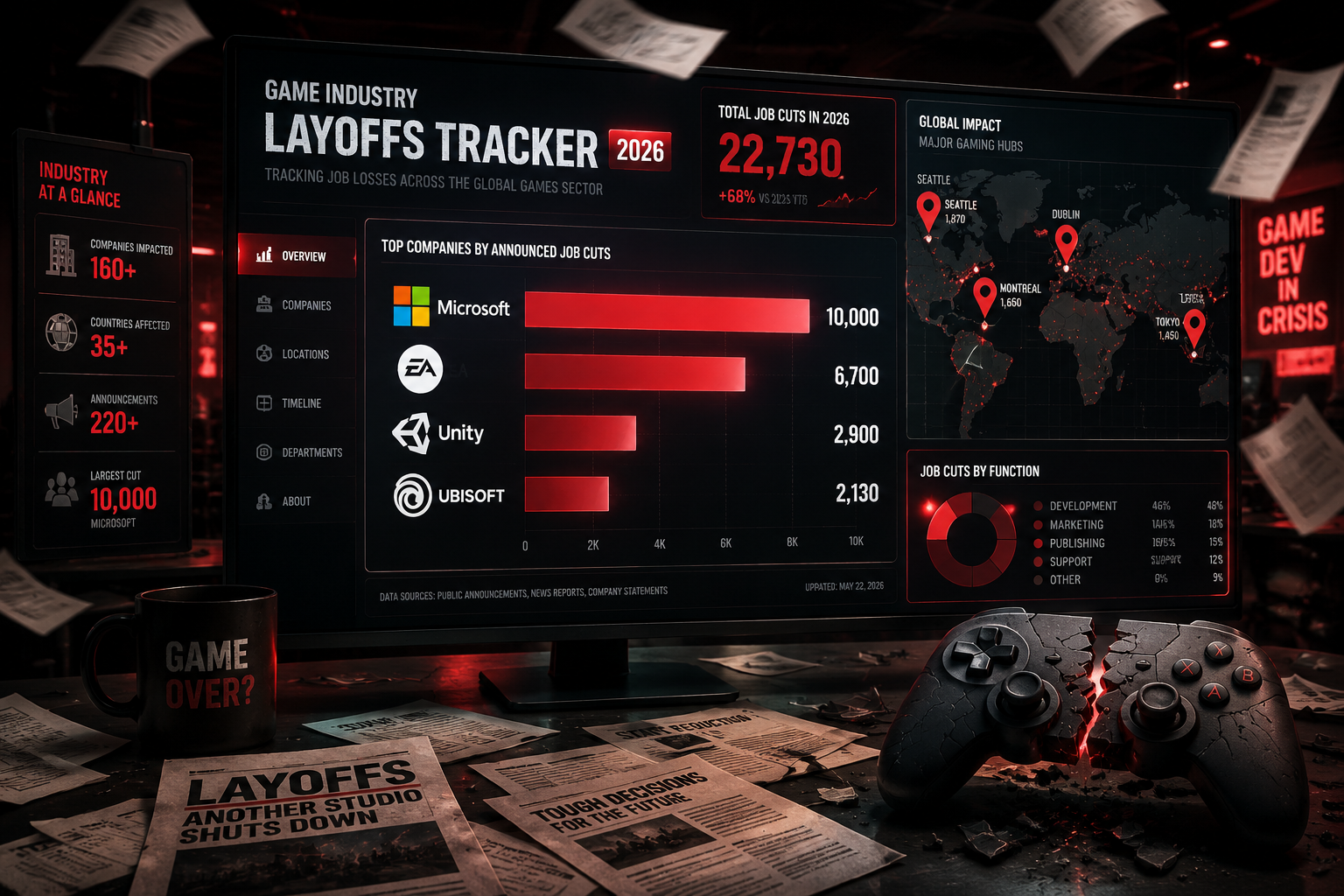
Confirmed 2026 Layoff Events (through June 30, 2026):
| Company | Estimated Cuts | Division Affected | Month |
|---|---|---|---|
| Microsoft Gaming | 650+ | Xbox Game Studios, Activision support | January |
| Electronic Arts | 400+ | EA Sports, Maxis | February |
| Ubisoft | 300+ | Montreal, Paris studios | March |
| Unity Technologies | 250+ | Engine support, professional services | February |
| Embracer Group (subsidiaries) | 500+ | Multiple studios across EU | January-April |
| Take-Two Interactive | 200+ | 2K support teams | April |
| Riot Games | 150+ | Publishing and esports operations | May |
| Bungie | 100+ | Destiny 2 live team | March |
Note: These figures are based on publicly reported announcements and filings. Actual totals may be higher due to unreported small-team cuts.
Game Developer Layoff Statistics 2026
An estimated 8,000 to 12,000 game industry jobs have been cut globally in the first half of 2026, based on aggregated public announcements tracked by industry outlets including Game Developer and IGN. This follows approximately 10,500 confirmed cuts in 2023 and over 8,000 in 2024 (Game Developer, 2024).
Key data points for 2026:
- North America accounts for roughly 55% of announced cuts, with the U.S. Pacific Northwest (Seattle, Redmond) and California most affected.
- Europe represents about 30% of cuts, concentrated in France, the UK, and Sweden.
- QA and localization roles have seen disproportionately high cut rates compared to core engineering positions.
- Senior engineers and technical directors have largely been retained or quickly rehired.
- The median time to find a new role for a laid-off game developer in 2026 is estimated at 3 to 6 months, based on LinkedIn workforce data trends cited in industry reporting.
The scale of these cuts has also affected what games are getting made. For a look at what’s still coming despite the turbulence, check the most anticipated games of June 2026.
What Causes Video Game Studio Layoffs
Video game studio layoffs are caused by a combination of financial underperformance, structural overhiring, and strategic pivots. Understanding the root causes helps workers and players anticipate where cuts are most likely to happen next.
The most common triggers:
- Game launch failures – A title that misses sales targets can eliminate an entire studio within weeks of launch.
- Project cancellations – When a game in development is cancelled, the team built to make it is often dissolved.
- Post-acquisition restructuring – Mergers routinely create duplicate roles across HR, marketing, finance, and QA.
- Platform shifts – Studios that built primarily for one platform (e.g., dedicated VR) face cuts when that platform loses market traction.
- Subscription model pressure – Games added to Game Pass or PS Plus generate less direct revenue, squeezing studio budgets.
Common mistake: Many workers assume that working on a successful franchise protects them. In reality, post-launch support teams are often the first cut once a game ships and player counts stabilize.
The rise of indie studios as a counterweight to AAA instability is worth noting. See how indie games are competing with AAA titles in 2026 for context on where the industry’s creative energy is shifting.
Which Game Studios Are Still Hiring in 2026
Despite widespread game industry layoffs, several studios and sectors are actively hiring in 2026. Mobile game companies, live-service titles with growing player bases, and studios in emerging markets have maintained or expanded headcount.
Studios and sectors with active hiring (as of mid-2026):
- Supercell (Helsinki) – Mobile strategy games, engineering and design roles
- Scopely (Los Angeles) – Mobile RPG and sports game development
- Grinding Gear Games (Auckland) – Path of Exile 2 ongoing development
- CD Projekt Red (Warsaw) – New IP pre-production, engine team expansion
- Larian Studios (Ghent/Dublin) – Post-Baldur’s Gate 3 new project staffing
- Niantic (San Francisco) – AR game development
- Roblox Corporation – Platform infrastructure and creator tools
- NetEase Games (China, with global studios) – Multiple open-world and mobile titles
Choose a job search strategy based on your role:
- If you are a programmer or engineer: Target engine-side roles at mid-size studios and platform companies (Roblox, Unity’s remaining teams, Epic).
- If you are a designer or artist: Mobile studios and indie publishers are more open to contract and remote work.
- If you are in QA or localization: Consider adjacent industries such as software testing or language services while the game market stabilizes.
Remote Game Development Jobs After Layoffs
Remote game development jobs are available in 2026, though competition is high and many studios have pulled back from fully remote models. The best remote opportunities are in programming, technical art, narrative design, and QA automation.
Key facts about remote game jobs in 2026:
- Many European studios (particularly in Poland, Romania, and Portugal) offer fully remote roles to attract global talent.
- Mobile game companies tend to be more remote-friendly than AAA console studios.
- Contract and freelance work through platforms like Xolo, Toptal, and direct studio portals has increased as studios reduce permanent headcount but still need project-based talent.
- Time zone overlap remains a common hiring filter — most studios prefer candidates within 3 to 5 hours of their core team’s time zone.
Edge case: Candidates in the U.S. applying to European remote roles should verify tax and contractor classification rules, as some studios cannot legally hire U.S. residents as remote employees without a local entity.
How to Find a Job After a Game Industry Layoff
Laid-off game workers can find new roles faster by targeting their search strategically, updating their portfolio immediately, and expanding into adjacent industries if needed. The average job search after a game industry layoff takes 3 to 6 months in 2026, but workers with strong public portfolios and transferable skills often land faster.
Step-by-step job search after a layoff:
- Update your portfolio within the first week. Add shipped titles, personal projects, and any work you can legally share. Use ArtStation, GitHub, or a personal site.
- Announce your availability on LinkedIn. The “Open to Work” feature increases recruiter contact rates significantly, according to LinkedIn’s own published data.
- Contact your network directly. Most game industry hires still happen through referrals, not job boards.
- Apply to studios outside your previous genre. A designer from a shooter studio can work in mobile, simulation, or educational games.
- Consider adjacent industries. Simulation, defense tech, film VFX, and enterprise training software all hire game engine skills.
- Attend GDC, PAX, and regional game dev meetups. In-person networking remains one of the fastest paths to a referral.
- Track your applications in a spreadsheet. Volume matters, but organized follow-up matters more.
Game Industry Layoff Severance Packages
Severance packages after game industry layoffs typically range from two to eight weeks of pay per year of service, with larger publishers offering more structured packages than smaller studios. Health insurance continuation (COBRA in the U.S.) and outplacement services are common at major companies.
What to expect by company size:
- Large publishers (Microsoft, EA, Take-Two): 4 to 8 weeks per year of service, extended health benefits for 30 to 90 days, and access to career counseling services.
- Mid-size studios (100-500 employees): 2 to 4 weeks per year of service, sometimes with a fixed minimum (e.g., 8 weeks regardless of tenure).
- Small studios (under 100 employees): Severance is less consistent and sometimes limited to final paycheck plus accrued vacation.
Important: Severance agreements almost always include a release of legal claims. Workers should read the full agreement and, if the amount is substantial, consult an employment attorney before signing. In the U.S., workers over 40 have 21 days to consider a severance offer under the Older Workers Benefit Protection Act.
What Skills Help Game Developers After Layoffs
Game developers with skills in real-time rendering, AI-assisted pipeline tools, cross-platform development, and live-service systems engineering are finding new roles most quickly after layoffs in 2026.
High-demand skills in 2026:
- Unreal Engine 5 and Nanite/Lumen systems – Demand is strong across AAA, film, and architectural visualization.
- AI tool integration – Developers who can work with generative AI in art pipelines or NPC behavior systems are actively recruited.
- Gameplay programming in C++ and C# – Core engineering skills remain evergreen.
- Live-service backend development – Studios running ongoing titles need engineers who understand player retention systems.
- Mobile optimization – Unity and Unreal mobile pipelines are in demand at growing mobile studios.
- Technical art – Shader writing, procedural generation, and rigging remain hard to automate fully.
Workers in roles most affected by automation (manual QA, basic localization, asset tagging) should invest in learning adjacent technical skills. Online courses through GDC Vault, Coursera, and Udemy offer structured paths into programming and technical art.
How to Prepare for Potential Game Studio Layoffs
The best preparation for a potential game studio layoff is to maintain an active external portfolio, keep your network warm before you need it, and build financial runway. Workers who wait until a layoff announcement to start these steps face a harder transition.
Proactive preparation checklist:
- Build and maintain a public portfolio continuously, not just when job hunting.
- Save 3 to 6 months of living expenses as a financial buffer.
- Keep your LinkedIn profile current and connect with recruiters in your specialty before you need them.
- Document your contributions to shipped projects clearly (metrics, scope, your specific role).
- Learn one adjacent skill per quarter — even small expansions in your skill set open new doors.
- Know your studio’s financial health: watch for missed earnings reports, cancelled projects, or leadership departures, which often precede layoffs.
Warning sign: If your studio has cancelled a major project and not announced a replacement, a layoff within 60 to 90 days is historically common.
Game Industry Job Market Outlook for the Rest of 2026
The game industry job market in 2026 is stabilizing but has not fully recovered. The second half of 2026 is expected to see fewer mass layoffs than the first half, as most large publishers have already completed their restructuring cycles. However, hiring volumes remain below 2021 and 2022 levels.
Positive signals for the second half of 2026:
- Several major titles are in late-stage development, which typically triggers hiring for live-service support teams post-launch.
- The upcoming PS5 exclusive games roadmap suggests Sony’s first-party studios are in active production, which supports hiring at partner studios.
- Cloud gaming growth is creating new roles in streaming infrastructure and platform optimization. For more on this trend, see how cloud gaming is changing PC gaming in 2026.
- Esports and competitive gaming infrastructure continues to expand, with titles like Dota 2 The International 2026 drawing investment into tournament operations and broadcast roles.
The most realistic outlook: workers with specialized technical skills will find opportunities, while generalist roles in large studios remain competitive and uncertain through at least early 2027.
Final Thoughts
Game industry layoffs in 2026 are real, widespread, and not yet fully resolved. The industry is in a structural adjustment, not a temporary dip. Large publishers over-hired during the pandemic, and the correction is playing out across nearly every major company.
For workers caught in these cuts, the path forward is concrete: update your portfolio now, keep your network active before you need it, and expand your skills into areas that AI cannot easily replace. For players and enthusiasts, the layoffs are reshaping which games get made and by whom, with indie studios gaining ground as AAA teams shrink.
Actionable next steps:
- If you are a game developer: audit your current skill set against the high-demand list above and start one new learning track this month.
- If you are job hunting: prioritize studios with active projects and public hiring pages over cold applications to companies in restructuring.
- If you are a player or industry observer: follow gamedeveloper.com and gamesindustry.biz for the most current layoff announcements.
- If you are planning a career in games: focus on technical skills, build a public portfolio from day one, and treat every project as a portfolio piece.
The game industry has survived downturns before and will again. The studios that emerge strongest from 2026 will be leaner, more technically focused, and more reliant on workers who can adapt quickly.
Frequently Asked Questions (FAQs)
How many game industry jobs have been lost in 2026?
Based on publicly announced cuts through June 2026, an estimated 8,000 to 12,000 game industry jobs have been eliminated globally. The actual number is likely higher due to unreported small-studio cuts.
Which company has cut the most game jobs in 2026?
Embracer Group subsidiaries and Microsoft Gaming have announced the largest combined cuts in 2026, continuing a trend that began with Embracer’s restructuring in 2023.
Are game industry layoffs slowing down in 2026?
The pace of layoffs appears to be slowing compared to the peak in early 2024, but cuts are still occurring regularly. Most major publishers have completed their primary restructuring, though project cancellations continue to trigger smaller cuts.
What should I do the first week after a game industry layoff?
File for unemployment benefits immediately, update your portfolio and LinkedIn profile, and reach out to your professional network. Do not sign a severance agreement without reading it fully.
Do game companies offer outplacement services after layoffs?
Larger publishers like Microsoft and EA typically include outplacement services (resume help, career coaching) in their severance packages. Smaller studios rarely offer this.
Is remote work still available for game developers in 2026?
Yes, but it is more competitive than in 2021 and 2022. European mid-size studios and mobile game companies offer the most remote-friendly roles.
What game development skills are most future-proof?
Core programming (C++, C#), Unreal Engine 5 expertise, technical art, and AI pipeline integration are the most resilient skills in the current market.