
Solo queue in League of Legends has never been more competitive than it is in 2026. With frequent balance updates, evolving champion metas, smarter matchmaking, and players constantly refining their strategies, climbing the ranked ladder requires much more than mechanical skill alone. Whether your goal is to escape Bronze, break into Emerald, or finally reach Master, consistent improvement comes from making better decisions, maintaining a strong mindset, and adapting to every patch.
This guide covers everything you need to climb solo queue in 2026, from choosing the best roles and champions to improving your macro play, communication, and mental resilience. You’ll also learn the habits that separate consistently high-ranked players from those who remain stuck in the same division season after season. If you’re ready to win more games, reduce avoidable mistakes, and maximize every ranked session, these proven tips will help you climb faster and play at your best.
What Rank Should You Main One Champion to Climb
Maining one champion is most effective from Iron through Platinum. In those ranks, the mechanical and decision-making gaps between players are large enough that deep champion mastery consistently outweighs team composition or meta knowledge. Above Emerald, champion pool flexibility becomes more important because opponents can identify and counter a single-champion specialist.
The practical rule: play one primary champion and one backup in the same role. Your backup exists for ban situations or hard counters, not as a second main. For players new to ranked, check our Best LoL Champions for Beginners in 2026 guide before committing to a pool.
Common mistake: Switching champions every patch because a new champion is “broken.” Patch-to-patch power shifts rarely outweigh the winrate boost from 100+ games of experience on a familiar pick.
Best Champions for Solo Queue 2026
The best solo queue champions in 2026 are those with low mechanical ceilings, strong independent carry potential, and minimal reliance on team coordination. Riot’s current design philosophy continues to reward self-sufficient picks that can win lanes and translate that lead into objectives without needing five-man coordination.
Strong solo queue archetypes by role in 2026:
- Top lane: Split-push bruisers and tanks with strong 1v1 potential (Darius, Garen, Malphite)
- Jungle: Objective-focused junglers with reliable ganks (Vi, Warwick, Hecarim)
- Mid lane: Roam-heavy assassins and mages with wave clear (Vex, Zed, Lux)
- Bot lane (ADC): Hypercarries with safe laning phases (Jinx, Caitlyn, Jhin)
- Support: Engage supports who can create plays without ADC cooperation (Leona, Nautilus, Blitzcrank)
For a full breakdown of current patch power rankings, see the League of Legends Patch Tier List 2026.
Choose a champion if: it has a clear win condition you can execute alone, it punishes mistakes in lower elos, and it doesn’t require teammates to follow up perfectly.
How to Improve CS and Farm Better
Improving CS is the single most impactful mechanical habit for players below Diamond. A player hitting 8 CS per minute at 20 minutes has roughly 40 more gold than one hitting 6 per minute, which translates to a full item component advantage.
Steps to improve farming:
- Last-hit practice in custom games for 15 minutes daily, focusing on cannon minions first
- Track your CS at 10-minute intervals in replays to identify where you fall off
- Prioritize wave management over trading when you’re behind in lane
- Recall only when the wave is crashing into the enemy tower, never mid-wave
- Use your champion’s abilities to secure cannon minions under tower pressure
A realistic target by rank: 6 CS/min for Bronze-Silver, 7 CS/min for Gold-Platinum, 8+ CS/min for Emerald and above. Missing fewer than 20 CS in the first 10 minutes is a reliable benchmark for any rank.
What Is the Difference Between Solo Queue and Ranked Flex
Solo queue (Solo/Duo) is a two-player maximum ranked mode, while Ranked Flex allows groups of one, two, three, or five players. For climbing purposes, Solo/Duo is the more accurate measure of individual skill because it limits premade coordination advantages.
Key differences:
| Feature | Solo/Duo Queue | Ranked Flex |
|---|---|---|
| Max party size | 2 | 5 |
| Rank accuracy | High (individual skill) | Lower (team-dependent) |
| LP gains | Standard | Often lower with premades |
| Meta relevance | High | Moderate |
| Best for climbing | Yes | No (use for practice) |
Flex queue is useful for practicing new champions or roles without risking Solo/Duo LP. It should not be used as a primary climbing ladder because premade five-stacks distort the matchmaking pool.
How to Deal With Toxic Teammates While Climbing
Muting toxic players immediately and redirecting attention to your own gameplay is the only reliable strategy. Engaging with toxicity costs mental focus, which directly reduces decision-making quality in the next few minutes of the game.
Practical steps:
- Mute all chat at the start of the game if you’re on a tilt streak
- Use the /mute all command during champion select if the lobby is already hostile
- Ping-only communication is sufficient for 90% of in-game callouts
- After a loss caused by a teammate, review your own replay before blaming others
- Report players after the game and move on; the report system is most effective when used consistently
Edge case: If a teammate is intentionally feeding, do not waste time arguing. Focus on farming safely, avoid risky fights, and try to extend the game long enough to find a winning play. Surrendering early is often correct when the game is genuinely unwinnable.
Is Macro Play or Mechanics More Important for Climbing
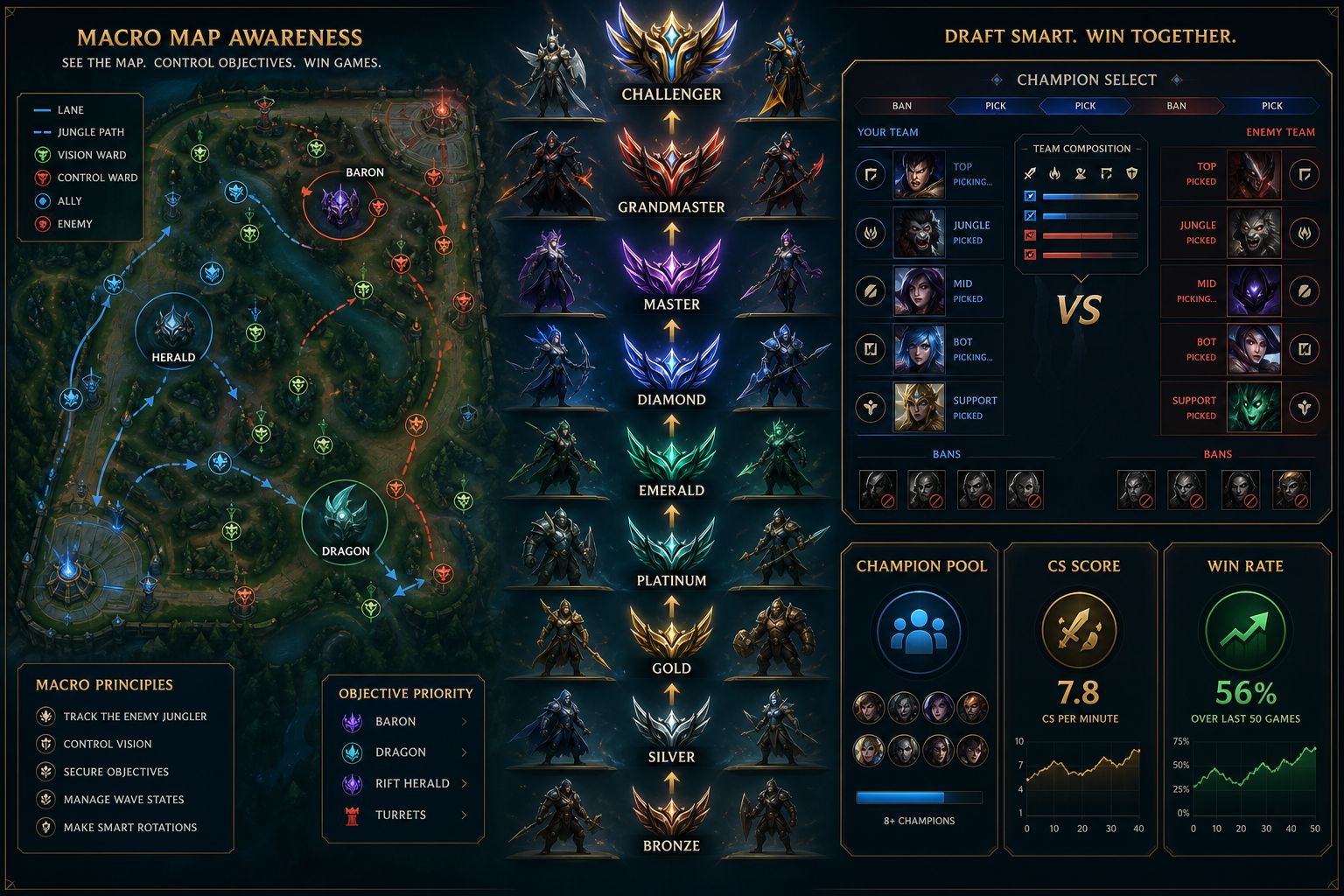
Macro play is more important for climbing in ranks below Diamond; mechanics become the primary differentiator from Diamond upward. This is because most games below high Emerald are decided by objective control, rotation timing, and wave management rather than mechanical outplays.
Macro fundamentals that directly increase win rate:
- Rotate to Dragon and Baron within 30 seconds of a kill advantage
- Freeze waves near your tower when ahead to deny enemy CS and invite dives you can punish
- Track the enemy jungler’s position using ward timers and camp clear patterns
- Push your wave before rotating to avoid losing CS while helping teammates
- Identify the win condition in champion select and play toward it from minute one
A useful self-check: if you win lane but still lose games, the problem is macro, not mechanics. If you lose lane consistently, the problem is mechanics or matchup knowledge.
How Many Games Does It Take to Climb From Bronze to Gold
Climbing from Bronze to Gold typically takes 150 to 300 games for a player actively working on improvement. The range depends on starting MMR, champion pool consistency, and how quickly fixable habits are corrected.
Rough game estimates by transition:
- Bronze to Silver: 50 to 100 games
- Silver to Gold: 80 to 150 games
- Total Bronze to Gold: 150 to 300 games
These are estimates based on community-reported data from platforms like OP.GG and League of Graphs, not official Riot figures. Players who review replays and track specific mistakes tend to land at the lower end of these ranges.
Important constraint: These estimates assume consistent play on a focused champion pool. Players who switch roles or champions frequently can expect the higher end of each range.
What Mistakes Hold Players Back From Climbing
The most common mistakes that prevent climbing are: dying too often, playing too many champions, and not converting leads into objectives. Each of these is fixable with targeted practice.
Top mistakes ranked by frequency:
- Overextending after winning a fight instead of taking the nearby objective
- Playing 10+ champions across multiple roles with no mastery depth
- Ignoring wave state before roaming or fighting
- Not warding the river before lane trades or all-ins
- Playing ranked when tilted after two or more consecutive losses
- Copying pro builds without understanding why each item is chosen
- Blaming teammates instead of identifying personal errors in replays
For players who want to apply similar discipline to other competitive games, the habit-building principles in guides like How to Improve Aim in CS2 in 2026 translate well across titles.
Should You Play Support or ADC for Faster Climbing
Support is generally faster for climbing in lower elos because it offers direct control over vision, engage, and peel without depending on ADC cooperation. ADC climbing is slower because it requires consistent farm, positioning, and a support who enables the role.
Choose Support if:
- You want to influence fights through engage or disengage
- You prefer vision control and map awareness over mechanical execution
- You’re comfortable making calls and leading rotations
Choose ADC if:
- You have strong mechanical fundamentals and consistent CS
- You play with a reliable duo partner in the support role
- You prefer a carry role that scales into late-game power spikes
Jungle is the third strong option for players who want full map influence. A jungler who tracks objectives and applies pressure across all three lanes can single-handedly shift game outcomes in Bronze through Platinum.
How to Climb When You Are Stuck at Your Rank
Hardstuck players are almost always repeating one or two specific mistakes that a replay review will reveal within three to five games. The fix is identifying the pattern, not grinding more games with the same habits.
A structured approach to breaking a hardstuck plateau:
- Review your last five losses and note the minute and cause of each death
- Identify whether deaths cluster in laning phase, mid-game fights, or late-game sieges
- Pick one specific habit to fix (for example: “I will not fight without vision of the enemy jungler”)
- Play 20 games focusing only on that habit before adding another
- Use external tools like OP.GG, U.GG, or Mobafire to compare your item builds and rune choices against high-elo players on the same champion
This same focused improvement loop applies to other competitive games. For reference, see how structured practice is applied in the How to Solo Helldive Difficulty in Helldivers 2 guide.
What Is the Best Time of Day to Play Ranked
Evening hours between 7 PM and 11 PM local time generally produce the most balanced matchmaking because the player pool is largest. Larger pools allow the matchmaking system to find closer skill matches, which produces fairer games and more accurate LP gains.
Times to avoid:
- Very late night (after 1 AM): smaller pool, higher variance in match quality
- Early morning on weekdays: low population, more smurfs and boosted accounts
- Right after a major patch drops: player behavior is erratic while the meta settles
Regional note: This applies to NA and EUW servers. Korean and Chinese servers have different peak windows due to time zone distribution. Check your server’s population data on third-party tools if unsure.
Do You Need a Duo Partner to Climb Efficiently
A duo partner is helpful but not necessary. Solo queue is designed to be climbed alone, and most high-elo players reached their peaks without consistent duo partners. That said, a reliable duo in a synergistic role can reduce variance and improve communication.
Best duo combinations:
- Jungle + Mid (fast roam synergy)
- Support + ADC (direct lane control)
- Jungle + Top (dive and split-push coordination)
Avoid duoing with players more than one full tier below your rank. The MMR averaging can place you in games where the enemy team has a significant skill advantage over your duo partner, creating a structural disadvantage.
How to Shotcall and Win More Games as a Team
Effective shotcalling in solo queue is about simple, clear pings rather than complex voice-chat-style coordination. Most players respond to objective pings and danger signals better than typed instructions mid-fight.
Core shotcalling habits:
- Ping Dragon or Baron 30 seconds before it spawns to signal grouping
- Use the “On My Way” ping when rotating, not after you arrive
- Ping “Retreat” immediately when you see the enemy jungler on the minimap near a teammate
- Avoid typing strategy mid-fight; use pings exclusively during active combat
- After a teamfight win, immediately ping the nearest objective rather than waiting for consensus
For players interested in how coordination translates to other competitive titles, the Dota 2 The International 2026 coverage offers useful context on high-level macro decision-making.
What Should You Do If You Are Hardstuck at Your Current Elo
If you have played more than 50 games at the same rank with a win rate below 52%, treat it as a diagnostic problem, not a grind problem. More games with the same approach will not produce different results.
Diagnostic checklist for hardstuck players:
- Is your KDA consistently positive? If not, death reduction is the priority
- Is your CS above the rank benchmark? If not, farming practice comes first
- Are you playing more than three champions? If yes, cut the pool immediately
- Are you playing your best role? If not, switch before the next session
- Have you reviewed at least three recent losses in replay? If not, start there
Pull quote: “Hardstuck is a feedback signal, not a verdict. Every plateau has a specific cause, and that cause shows up in replays within five games.”
Players who want to apply the same structured improvement mindset to other games can find useful parallels in the League of Legends Patch Tier List 2026 and the Best LoL Champions for Beginners in 2026 guide.
Final Thoughts
Learning how to climb solo queue in League of Legends comes down to a small set of repeatable habits applied consistently over time. Champion mastery, CS discipline, macro decision-making, and mental resilience are not abstract concepts. Each one has a concrete, measurable action attached to it.
Actionable next steps:
- Cut your champion pool to two picks in one role before your next ranked session
- Set a CS benchmark (7 per minute) and track it in your next five games using the in-game scoreboard
- Review one replay per session, focusing only on deaths and missed objectives
- Identify the one mistake that appears most often across your last five losses and spend 20 games fixing it
- Schedule ranked sessions during peak hours and stop after three consecutive losses
Climbing is a process with a clear feedback loop. The players who reach their target rank are not necessarily the most mechanically gifted. They are the ones who treat each game as information rather than entertainment, and who apply that information the next time they queue.
Frequently Asked Questions (FAQs)
How many champions should I have in my pool for ranked?
Two to three champions maximum. One primary pick, one backup for ban situations, and optionally one off-meta comfort pick. More than three dilutes game knowledge and slows improvement.
Does Riot’s matchmaking system hold players back intentionally?
No. Riot’s matchmaking targets a 50% win rate by matching players of similar MMR. Perceived “loss streaks” are statistically normal variance, not intentional manipulation.
How important is vision control for climbing?
Very important below Diamond. Players who consistently place two or more wards per minute and clear enemy wards reduce surprise deaths by a measurable margin, which directly improves win rate.
Should I play ranked every day?
Only if you can maintain focus for at least two to three consecutive games. One focused session of three to five games per day outperforms two-hour marathon sessions played while fatigued.
What is the fastest way to gain LP?
Win streaks built on consistent fundamentals. Focus on not dying, farming well, and taking objectives after kills. LP gains accelerate naturally when MMR rises above your visible rank.
Is it worth buying coaching to climb faster?
For players stuck in the same rank for more than two seasons, a single coaching session reviewing replays can identify blind spots that hours of solo grinding will not. It is a high-value investment for serious climbers.
Does server ping affect my rank?
Yes, above roughly 80ms ping, mechanical execution suffers enough to affect outcomes in close fights. Playing on your home server with a wired connection is always preferable for ranked.