
Valorant’s ever-evolving meta continues to reshape the competitive landscape, and 2026 is no exception. With regular balance updates, new agent releases, and shifting team compositions, knowing which agents dominate the current meta can give you a significant advantage in both ranked matches and professional play. Whether you’re climbing the competitive ladder, building the perfect team composition, or deciding which agent to master next, understanding the strengths and weaknesses of every character is essential.
In this Valorant Agent Tier List for 2026, we rank every agent from S-Tier to D-Tier based on their overall impact, versatility, pick rate, and effectiveness across different maps and skill levels. From powerful duelists who can take over rounds to controllers and initiators that define team strategy, this guide breaks down where each agent stands in the current meta and why they deserve their ranking.
The Full Valorant Agent Tier List for 2026
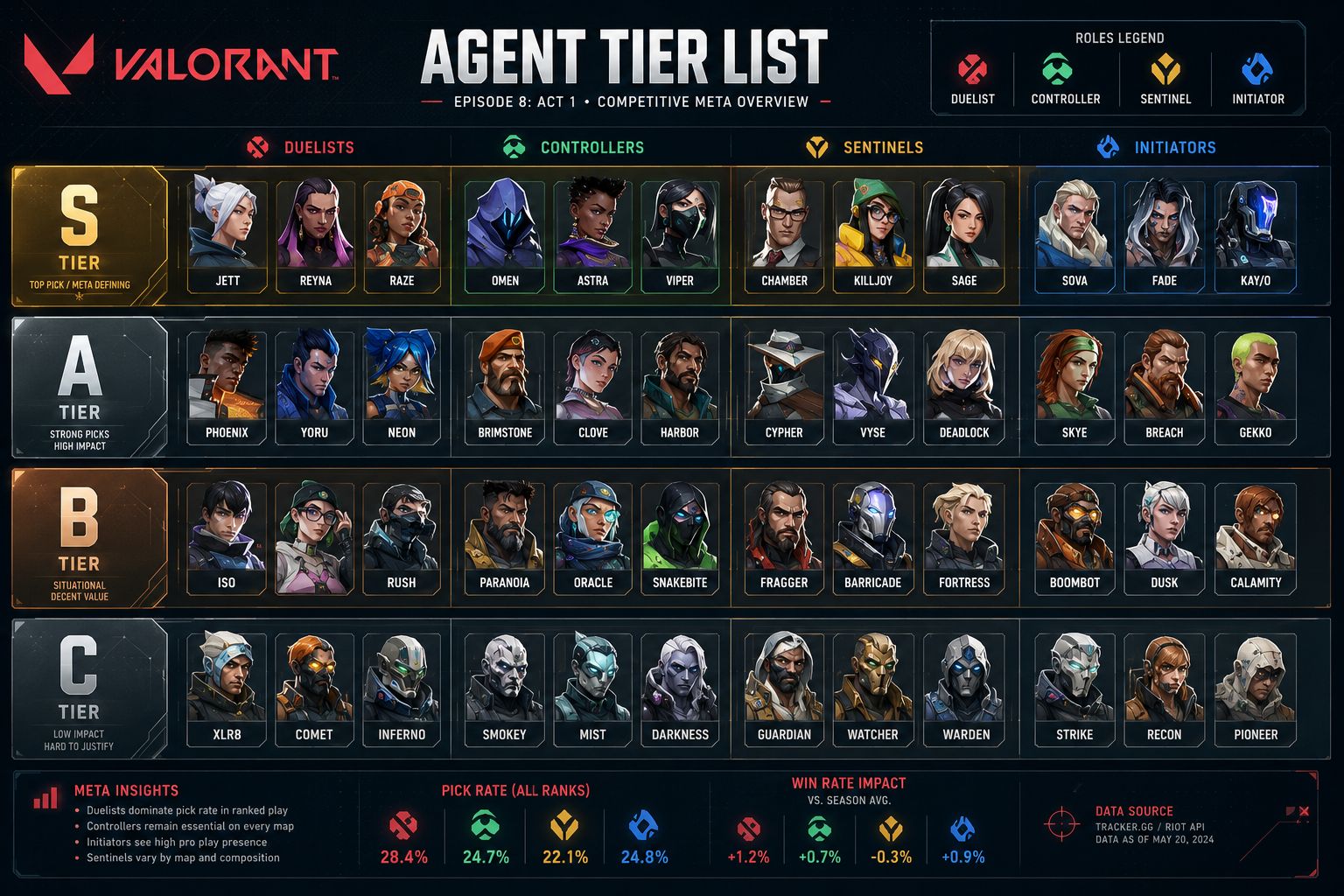
The current Valorant Agent Tier List breaks down into four clear tiers based on win rate data, pro play pick rates, and community consensus as of mid-2026. Here is the breakdown across all roles.
S-Tier (Must-Pick)
- Clove (Controller)
- Vyse (Sentinel)
- Omen (Controller)
- Killjoy (Sentinel)
A-Tier (Strong Picks)
- Jett (Duelist)
- Raze (Duelist)
- Sova (Initiator)
- Fade (Initiator)
- Cypher (Sentinel)
- Astra (Controller)
B-Tier (Situational)
- Sage (Sentinel)
- Skye (Initiator)
- Breach (Initiator)
- Neon (Duelist)
- Harbor (Controller)
- Gekko (Initiator)
C-Tier (Avoid in Ranked)
- Phoenix (Duelist)
- Yoru (Duelist)
- Reyna (Duelist)
- KAY/O (Initiator)
Which Agents Are Most Broken Right Now in Competitive Play
Clove and Vyse are the two agents drawing the most complaints and ban-rate discussions in competitive Valorant as of mid-2026. Clove’s post-death ability to continue acting after being eliminated breaks fundamental round economy logic, while Vyse’s area-denial tools shut down entire site executes with minimal counterplay.
Omen also sits in this conversation. His smokes are among the most flexible in the game, and his teleport makes him nearly impossible to track. In professional play, Omen has appeared in over 70% of team compositions across VCT 2026 regional leagues (based on community-tracked VCT statistics aggregated by sites such as vlr.gg).
Why these agents feel “broken”:
- Clove can use abilities after death, creating round-winning plays with no risk window
- Vyse’s Shear ability stops rushes cold and forces expensive utility dumps from attackers
- Omen’s paranoia and teleport combine to create information asymmetry that is difficult to punish
Common mistake: Assuming these agents are easy to play. Clove and Omen have steep timing requirements. Playing them poorly is worse than picking a B-tier agent you understand well.
How Do Agents Compare for Ranked Climbing
For ranked climbing, the best agents are those that generate value independently of teammate cooperation. Omen, Killjoy, and Jett consistently perform well in solo queue because their value does not depend on coordinated setups.
Killjoy in particular is one of the most reliable ranked climbing picks at every level from Iron through Immortal. Her turret and alarm bot provide passive information, her lockdown ultimate wins post-plant scenarios without needing teammates nearby, and she requires less communication than Initiators like Breach or Skye.
Choose this agent if:
- You want to climb solo: Killjoy, Omen, Jett
- You play in a coordinated duo or trio: Astra, Fade, Sova
- You want the highest skill ceiling with the highest reward: Jett, Raze, Clove
For a broader comparison of how character selection affects competitive climbing in other games, see the Marvel Rivals Tier List Season 2 and Apex Legends Tier List for 2026 for reference on how meta analysis applies across titles.
What Are the Cheapest Agents to Buy for New Players
New players get Sage and Brimstone for free at account creation, and five additional agents are unlocked through early progression. Beyond that, agents cost 1,000 VP (approximately $10 USD) or can be unlocked for free by completing the agent’s contract, which requires earning XP through matches.
The contract system makes every agent technically free, but it takes roughly 20 to 40 hours of play per agent depending on XP boosts and daily missions. Buying with VP is faster but optional.
Best free agents to prioritize via contracts:
- Sova: High value in almost every map and rank
- Cypher: Teaches information-gathering fundamentals
- Sage: Healing and resurrection make her team-friendly and forgiving
Avoid spending VP on Reyna or Phoenix early. Both agents have low utility ceilings and will not help you learn the game’s deeper mechanics.
Why Do Pro Teams Always Pick Certain Agents
Professional teams gravitate toward agents that provide reliable, repeatable utility rather than high-risk mechanical plays. Controllers like Omen and Clove appear in nearly every pro composition because smokes are non-negotiable for site control, and these two offer the most flexible smoke placement in the game.
Initiators like Sova and Fade are staples because information is the most valuable resource in a professional round. Pro teams do not guess; they use Sova’s recon bolt or Fade’s haunt to confirm enemy positions before committing.
The core pro team formula in 2026:
- One or two Controllers (usually Omen + Clove or Omen + Astra)
- One Sentinel (Killjoy or Vyse depending on map)
- One Initiator (Sova or Fade)
- One Duelist (Jett or Raze for entry fragging)
Deviation from this formula happens only when a specific map or opponent calls for it. Teams that run two Duelists in pro play almost always lose the utility war.
What Are Common Mistakes Beginners Make When Selecting Agents
The single most common mistake is picking a Duelist as a first agent because they look exciting, then struggling to create value without understanding how the game works. Reyna in particular rewards kills but teaches nothing about utility, positioning, or team coordination.
Other frequent errors:
- Picking Yoru or Phoenix before understanding ability timing. Both agents require deep game knowledge to use effectively and punish mechanical mistakes harshly.
- Ignoring role balance. If your team already has two Duelists, adding a third makes the composition fragile. Fill the missing role instead.
- Copying pro picks without the skill base. Clove is S-tier, but a new player using Clove poorly is worse than a confident Sage player.
- Neglecting crosshair placement and movement fundamentals. No agent compensates for bad aim mechanics. Pair your agent choice with proper Valorant crosshair settings to build good habits early.
Which Agents Work Best for Solo Queue vs. Team Play
Self-sufficient agents dominate solo queue; coordination-dependent agents shine in organized team play. This is the clearest dividing line in the Valorant Agent Tier List when choosing based on context.
Best for solo queue:
- Killjoy: Passive utility generates value even if teammates ignore callouts
- Omen: Can self-execute sites with teleport and smokes
- Jett: Can create her own space without relying on teammate setups
Best for organized team play:
- Astra: Her global smoke placement requires callouts and pre-planned setups
- Breach: His stuns and flashes are most effective when teammates push simultaneously
- Skye: Her flash requires teammates to be ready to trade on the blind
Edge case: Fade works well in both contexts. Her haunt provides solo information, but her full kit scales dramatically with a coordinated team that can capitalize on her debuffs.
How Hard Is It to Learn Each Agent’s Abilities
Difficulty varies significantly across the roster. Sage and Brimstone are the easiest agents to understand, which is why Riot gives them to new players by default. Their abilities have clear, immediate effects with little room for misuse.
Difficulty tiers:
| Difficulty | Agents |
|---|---|
| Easy | Sage, Brimstone, Reyna, Phoenix |
| Medium | Killjoy, Cypher, Jett, Raze, Sova |
| Hard | Omen, Astra, Fade, Breach, Skye |
| Expert | Clove, Vyse, Yoru, Neon |
Astra is widely considered the hardest agent in the game. Her global smoke system requires memorizing dozens of star placements across every map, and mistakes are punished immediately. Yoru’s teleport decoys require opponents to be fooled, which means the ability’s value depends on enemy behavior rather than your own execution.
What Agents Counter Each Other Most Effectively
Every S-tier agent has a direct counter, which is why team composition matters as much as individual agent strength. Vyse’s area denial is countered by Harbor’s water wall, which blocks the Shear ability. Killjoy’s lockdown ultimate is countered by KAY/O’s suppress, which prevents her from recalling her turret and alarm bot.
Key counter relationships:
- Omen smokes: Countered by Sova recon bolt (reveals positions inside smokes)
- Killjoy Lockdown: Countered by KAY/O suppress or Breach ultimate
- Jett Dash: Countered by Cypher tripwires (forces her to burn dash before engaging)
- Clove post-death ability: Countered by fast rotations and denying the revive window
Understanding counters is more useful than memorizing tier lists. A well-played B-tier agent that hard-counters the enemy’s S-tier pick creates more value than mirroring the meta blindly.
Are Any Agents Getting Nerfed or Buffed in Upcoming Patches
As of June 2026, Riot Games has signaled through official dev notes that Clove is under review for potential adjustments to her post-death ability duration. Vyse’s Shear ability has also been flagged in community feedback channels as a candidate for cooldown increases.
On the buff side, Phoenix and KAY/O have been mentioned in developer discussions as agents that underperform relative to their design intent. Riot has historically buffed underperforming agents by reducing ability costs or increasing effect radius rather than reworking kits entirely.
What to watch:
- Clove nerf (likely): Post-death window reduction
- Vyse adjustment (possible): Shear cooldown or radius change
- Phoenix buff (expected): Curveball speed or Hot Hands healing increase
- KAY/O buff (possible): Zero/Point suppression radius increase
Always check the official Valorant patch notes on the Riot Games website before your next ranked session, as changes can shift the tier list significantly within days of a patch.
Which Agents Have the Highest Win Rates in Diamond and Immortal Ranks
At Diamond and Immortal, Killjoy and Cypher have the highest consistent win rates among all agents, according to community-tracked statistics from tracker.gg (data referenced from 2026 seasonal aggregates). Sentinel agents perform especially well at these ranks because players understand how to use information and post-plant setups effectively.
Omen and Clove also maintain high win rates in these brackets. Interestingly, Reyna’s win rate drops sharply above Platinum because opponents punish her lack of utility more consistently.
High win rate agents at Diamond and above:
- Killjoy: Sentinel utility scales with map knowledge
- Cypher: Information advantage compounds over longer rounds
- Omen: Smoke flexibility rewards experienced players
- Sova: Recon bolt value increases as opponents play more predictable positions
Low win rate agents at Diamond and above:
- Reyna: Utility-free kit becomes a liability
- Phoenix: Outclassed in every utility category by other Duelists
- Yoru: Decoy effectiveness decreases as opponents learn to read fakes
How Do Agent Roles Actually Impact Team Strategy
The four roles in Valorant (Duelist, Controller, Sentinel, Initiator) are not just labels; they define how a round is structured from the first second of play. A team without a Controller cannot safely execute onto a site. A team without a Sentinel struggles to hold post-plant or anchor a site on defense.
Role breakdown:
- Duelists create space. They are designed to take the first fight and open up site entries.
- Controllers manage vision. Smokes block sightlines and allow safe movement across open areas.
- Sentinels lock down areas. Tripwires, turrets, and traps slow rotations and protect flanks.
- Initiators gather information and create openings. Flashes, reveals, and debuffs set up Duelist entries.
A balanced team runs at least one of each role. The most common competitive composition in 2026 is one Duelist, one or two Controllers, one Sentinel, and one Initiator. Teams that stack Duelists win gunfights but lose the utility war in coordinated play.
For more on how character roles and meta selection work across competitive titles, see the Genshin Impact Best Characters Tier List for a parallel look at role-based team building in a different genre.
Final Thoughts
The 2026 Valorant Agent Tier List rewards players who understand utility over raw aim. Clove, Vyse, and Omen lead the current meta, but no tier list replaces game sense and role awareness. Here are the most actionable next steps:
- New players: Start with Sage or Brimstone, unlock Sova through the contract system, and avoid spending VP on Reyna or Phoenix.
- Ranked climbers: Lock in Killjoy or Omen for solo queue. Learn one agent deeply rather than rotating through the roster.
- Competitive players: Build compositions around role balance, not just individual agent strength. Study counter relationships before your next session.
- All players: Check official Riot patch notes regularly. The meta shifts with every update, and an agent’s tier can change significantly within a single patch cycle.
- Optimize beyond agent selection: Pair your pick with the right settings. A strong agent played with poor crosshair placement or bad sensitivity settings is still a handicap.
The best agent is always the one you understand most thoroughly, but starting from the right tier gives you a structural edge before the round even begins.
Frequently Asked Questions (FAQs)
What is the best agent in Valorant right now in 2026?
Clove is widely considered the strongest agent in the current meta due to her post-death ability usage, which no other agent can replicate. Omen and Vyse are close alternatives with fewer mechanical demands.
Which agent should a complete beginner start with?
Sage is the best starting agent for beginners. Her healing and resurrection abilities are easy to understand, provide clear team value, and teach positioning fundamentals without requiring complex timing.
Is Reyna good for climbing ranked?
Reyna is effective in lower ranks (Iron through Gold) where opponents do not punish her lack of utility. Above Platinum, her win rate drops significantly because coordinated teams exploit her inability to contribute smoke, information, or post-plant utility.
How often does Riot update the agent balance?
Riot Games typically releases a major patch every two weeks, with agent balance changes appearing in roughly half of those patches. Significant meta shifts usually follow Act or Episode transitions.
Can you unlock all agents for free?
Yes. Every agent can be unlocked through the agent contract system by earning XP in matches. It takes roughly 20 to 40 hours of play per agent. Buying with VP (real money) is faster but never required.
What is the hardest agent to learn in Valorant?
Astra is generally considered the hardest agent. Her global smoke system requires memorizing dozens of star placements across every map, and her abilities have long cooldowns that punish poor planning immediately.