
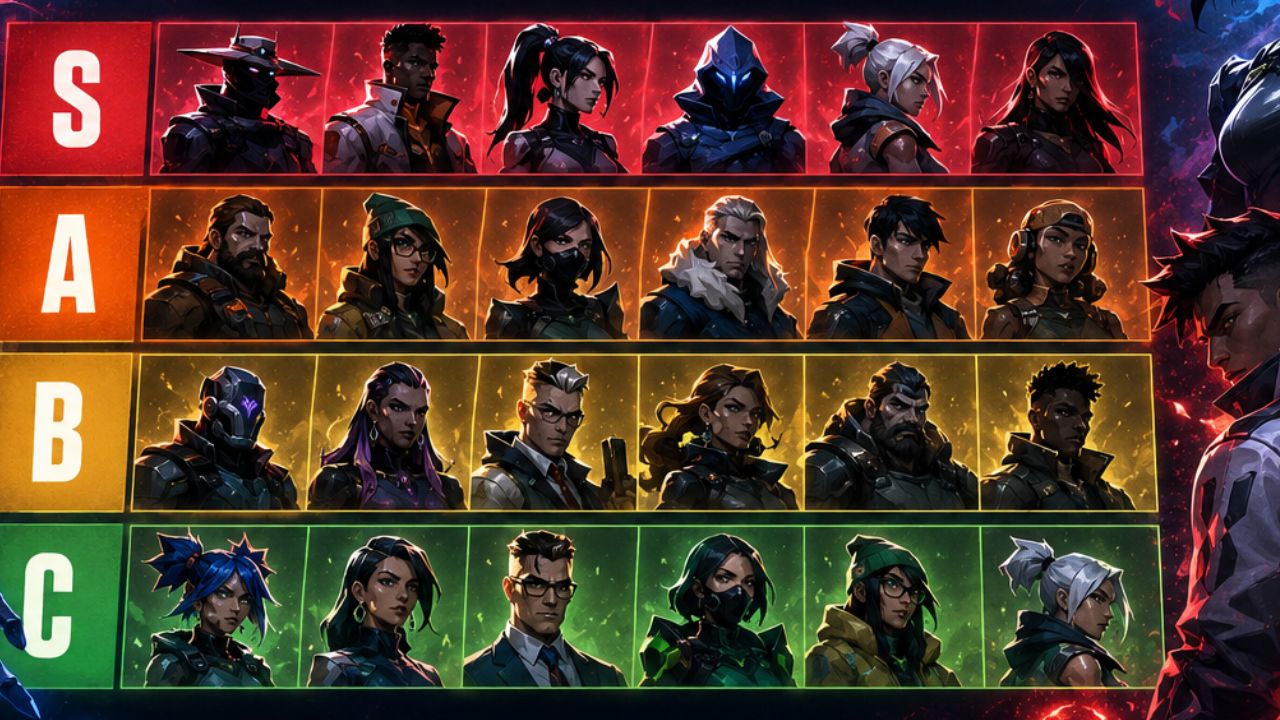
What Is a Valorant Agent Tier List and How Does It Work
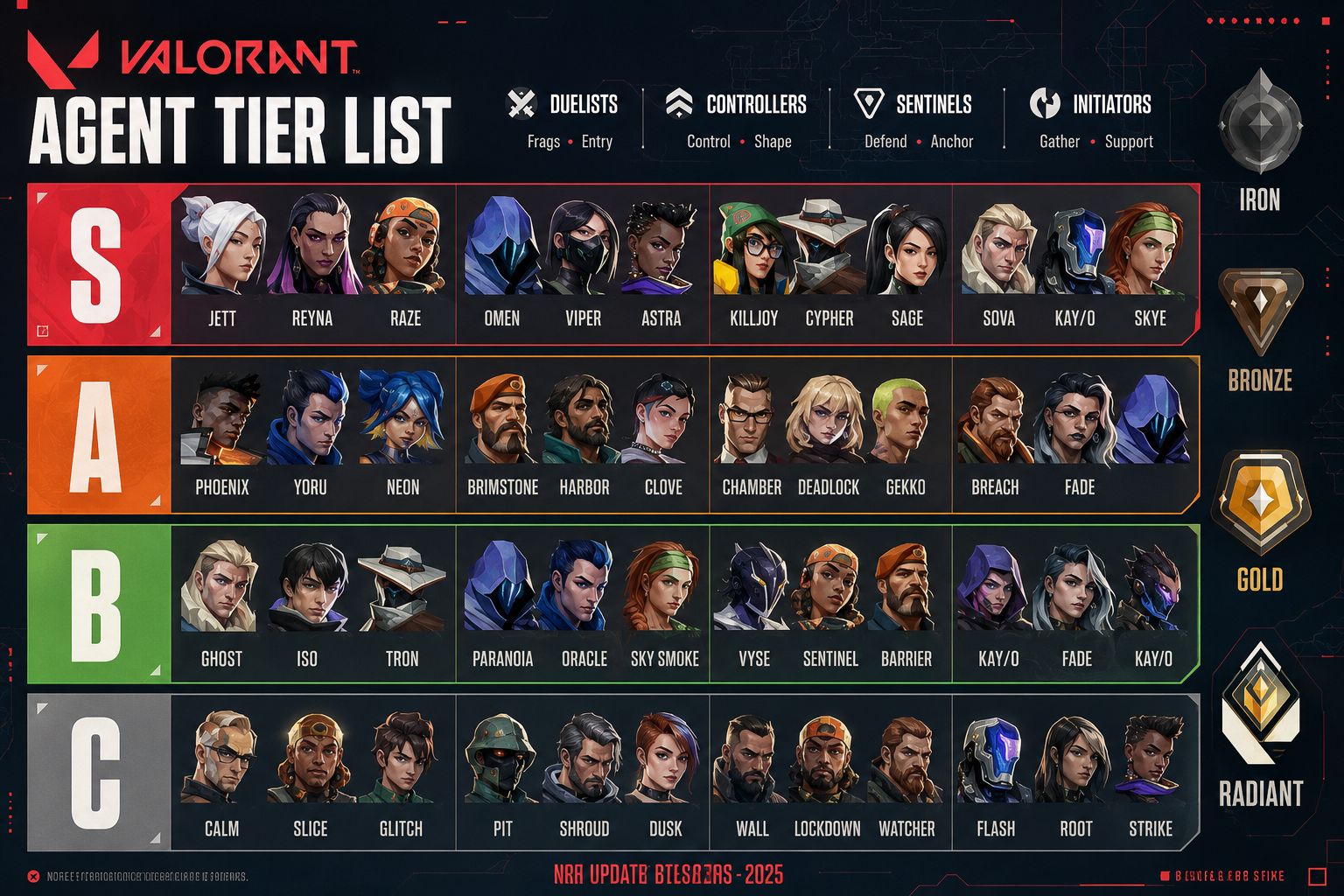
A Valorant agent tier list ranks all playable agents from strongest to weakest based on their current in-game performance, kit utility, and meta relevance. Tiers typically run from S (best) down through A, B, C, and D, with S-tier agents offering the most consistent value across maps and game modes.
Tier lists are built using a combination of:
- Win rate data from high-volume match samples across rank brackets
- Pick rate trends among professional and ranked players
- Patch notes that buff or nerf specific abilities
- Map pool changes that favor or punish certain agent kits
A tier list is not a guarantee. An S-tier agent played poorly will lose to a B-tier agent played well. The rankings reflect ceiling potential and consistency, not absolute outcomes. For a deeper breakdown of every agent’s placement, see the full Valorant Agent Tier List for 2026: Every Agent Ranked.
Valorant Agent Tier List for Competitive Ranked 2026
For competitive ranked play in 2026, the current S-tier agents are Jett, Clove, Vyse, and Deadlock. A-tier includes Omen, Breach, Fade, and Killjoy. Most other agents fall into solid B-tier or situational C-tier picks.
Full Tier Breakdown (All Ranks)
| Tier | Agents |
|---|---|
| S | Jett, Clove, Vyse, Deadlock |
| A | Omen, Breach, Fade, Killjoy, Iso |
| B | Sage, Sova, Skye, Chamber, Gekko |
| C | Reyna, Neon, Harbor, Brimstone |
| D | Yoru, Phoenix, Astra |
Important note: This table reflects general ranked performance across all skill levels. Radiant-level play shifts some agents (Astra, Yoru) significantly higher due to mechanical mastery.
Best Valorant Agents for Beginners: Iron and Bronze
New players in Iron and Bronze should pick agents with simple, forgiving kits that do not require deep game knowledge. Sage, Reyna, and Phoenix are the top three choices for beginners.
- Sage provides team healing and a wall that creates space without needing perfect timing. Her kit is self-explanatory and always useful.
- Reyna rewards aggressive play and snowballs hard when a player is winning individual duels. Her dismiss ability is a strong safety net.
- Phoenix has a self-heal and a respawn ultimate, making mistakes less punishing during the learning phase.
Choose Sage if your team lacks healing support and you want to contribute without needing strong map knowledge.
Choose Reyna if your aim is already above average and you want to carry through individual performance.
Avoid Astra, Yoru, and Neon at this stage. Their kits demand game sense and mechanical precision that beginners have not yet developed.
Valorant Agents Ranked by Win Rate Across All Ranks
Win rate data from community tracking sites in 2026 shows Deadlock, Vyse, and Killjoy consistently posting above-average win rates across all rank brackets. Clove and Jett lead in higher ranks specifically.
Key patterns from win rate analysis:
- Sentinel agents (Deadlock, Killjoy, Cypher) tend to post higher win rates than their pick rates suggest, meaning they are underused relative to their value
- Duelist agents (Reyna, Neon) have high pick rates but average-to-below-average win rates in most brackets, partly because they attract players who overcommit
- Controller agents (Clove, Omen) show increasing win rates as rank increases, suggesting their value scales with game knowledge
Win rate alone should not determine your agent choice. Pick rate, team composition needs, and map-specific performance all matter.
Best Valorant Agents for Each Role: Duelist, Controller, Sentinel, Initiator
Each of Valorant’s four roles has a clear best-in-class agent for 2026. The top picks by role are Jett (Duelist), Clove (Controller), Deadlock (Sentinel), and Breach (Initiator).
Duelists
- S-tier: Jett, Iso
- A-tier: Neon (high skill ceiling), Reyna (low-rank carry potential)
- Duelists create space and take first contact. Jett’s dash and updraft give unmatched escape options.
Controllers
- S-tier: Clove, Omen
- A-tier: Brimstone (simple but limited range), Harbor (niche)
- Controllers smoke off sightlines. Clove’s self-revive passive makes them uniquely resilient for a support role.
Sentinels
- S-tier: Deadlock, Killjoy
- A-tier: Cypher, Chamber
- Sentinels lock down sites and gather information. Deadlock’s net and Killjoy’s lockdown are among the strongest site-anchoring tools in the game.
Initiators
- S-tier: Breach, Fade
- A-tier: Skye, Sova, Gekko
- Initiators set up entry for duelists. Breach’s stun chains are especially powerful in coordinated play.
For a comparison with how roles work in other hero shooters, check out the Overwatch 2 Tier List 2026: Best Heroes Ranked by Role.
Which Agents Are Overpowered Right Now in Valorant 2026
Clove, Vyse, and Deadlock are currently the strongest agents in Valorant’s 2026 meta relative to their counterparts. Clove in particular has not received significant nerfs despite consistently high performance data.
- Clove combines Controller utility with a passive that allows them to continue playing after death, which is a unique and powerful advantage
- Vyse offers wire traps and a map-wide ultimate that forces enemies to use pistols, creating massive round-winning swings
- Deadlock has some of the best defensive utility in the game, with a net ability that stops pushes and an ultimate that captures enemies
Common mistake: Players often ignore Vyse because her kit looks passive. Her ultimate (Shear) is one of the highest-impact abilities in the game when used correctly.
Valorant Agents That Are Hardest to Master
Yoru, Neon, and Astra are the three hardest agents to master in Valorant. Each requires a level of mechanical skill, game sense, or strategic depth that takes hundreds of hours to develop.
- Yoru relies on deception and misdirection. His teleport decoys and clone abilities only work when enemies are uncertain, which requires reading opponent psychology at a high level.
- Neon demands exceptional aim and movement control. Her sprint and slide mechanics amplify her power but also amplify mistakes.
- Astra requires global map awareness and the ability to place stars proactively before fights happen. At lower ranks, this leads to wasted utility constantly.
These agents sit low in general tier lists not because they are weak, but because their skill floor is too high for most players to reach their potential.
Valorant Agents That Are Easiest to Play and Climb With
Sage, Reyna, Killjoy, and Omen are the easiest agents to pick up and use effectively for rank climbing. Each has a simple kit with clear, immediate feedback on whether an ability was used correctly.
- Sage: Place wall to block, heal teammates, resurrect with ultimate. Minimal complexity.
- Killjoy: Place turret and alarm bot on site, collect information, use lockdown ultimate to force enemies off a planted spike.
- Omen: Smoke two sightlines per round, teleport to unexpected positions, use paranoia to blind enemies pushing.
Climb tip: Killjoy is especially strong for players who want to contribute without needing to win individual gunfights. Her utility does the work even when aim is inconsistent. For players looking to sharpen their fundamentals alongside agent selection, our guide on Best Valorant Settings for Pros in 2026 covers the technical side of performance.
Valorant Agent Tier List Differences Between Radiant and Iron
The Valorant Agent Tier List for All Ranks looks very different at opposite ends of the skill spectrum. Agents like Astra, Yoru, and Sova are significantly stronger at Radiant because their kits require precise coordination and game knowledge to use effectively.
| Agent | Iron-Gold Tier | Platinum-Radiant Tier |
|---|---|---|
| Astra | D | A |
| Yoru | D | B |
| Sova | B | S |
| Reyna | B | C |
| Sage | A | B |
| Jett | S | S |
| Clove | S | S |
Key insight: Reyna drops in value at higher ranks because opponents stop making the individual mistakes she needs to snowball. Sova rises because his recon bolt lineups become devastatingly precise in the hands of experienced players.
Worst Valorant Agents in the 2026 Meta
Phoenix, Astra (below Diamond), and Harbor are the weakest agents in the current meta for most rank brackets. Each has a kit that either lacks versatility or has been outclassed by newer agents.
- Phoenix has been progressively overshadowed by Clove and Reyna. His self-heal and flash kit are solid but his ultimate (Run It Back) is unreliable in coordinated play.
- Harbor struggles because his water-based smokes are harder to use effectively than Omen or Brimstone’s and his kit does not offer the same round-winning potential.
- Brimstone is not terrible but his smoke range limitation makes him map-dependent in ways that hurt flexibility.
These agents are not unplayable. Players who have mastered them can still perform well. But for players choosing an agent to climb with, better options exist in every role.
Should You One-Trick an Agent or Learn Multiple Valorant
For most players below Diamond, one-tricking a single agent is the faster path to climbing. Depth of knowledge on one agent outweighs breadth across many, especially in the Iron-to-Platinum range where game sense and mechanics matter more than flexibility.
One-trick advantages:
- Deep understanding of ability timing and lineups
- Consistent muscle memory for movement and positioning
- Faster decision-making because the kit is automatic
Learning multiple agents makes sense when:
- Your main is banned or taken in team composition
- You are Diamond or above and need to adapt to team needs
- You want to understand the game more broadly
A practical approach: master one agent in your primary role, then learn one backup in the same role. For example, Jett as a primary Duelist with Iso as a backup.
For comparison on how one-tricking works in other competitive games, see the League of Legends Patch Tier List 2026: Best Champions Ranked.
Valorant Agents Getting Buffed or Nerfed in 2026 Patch Notes
The most significant agent changes in 2026 patches have buffed Deadlock and Vyse while nerfing Phoenix and Chamber. Riot Games has been pushing the meta toward more utility-focused play and away from pure duelist dominance.
Notable 2026 patch changes (based on official Riot patch notes):
- Deadlock buff: Increased net range and reduced ability cooldown, pushing her firmly into S-tier
- Vyse buff: Shear ultimate received a longer duration, making it harder to escape
- Phoenix nerf: Curveball flash duration reduced, weakening his entry potential
- Chamber nerf: Headhunter cost increased, reducing his economic advantage
Stay current with every change by following the Valorant Episode Patch Notes Explained 2026 guide, which breaks down each update in plain language.
How to Choose the Right Agent for Your Rank in Valorant
Choosing the right agent depends on your rank, your role preference, your playstyle, and your team’s composition needs. The simplest framework: pick the highest-tier agent in your preferred role that you can execute consistently.
Step-by-step agent selection process:
- Identify your preferred role (Duelist, Controller, Sentinel, Initiator)
- Check the current tier list for that role at your rank bracket
- Pick the highest-tier agent whose kit you understand
- Play at least 20 games before switching
- Track your win rate and performance to confirm the agent fits your style
Decision rules:
- Choose a Sentinel if your team always loses post-plant situations
- Choose an Initiator if your team struggles to entry onto sites
- Choose a Controller if your team lacks smoke coverage
- Choose a Duelist only if you are confident in your individual gunfight ability
Crosshair placement and settings also affect how well any agent performs. The Best Valorant Crosshair Settings for 2026: Pro Configs guide pairs well with agent selection for a complete performance setup.
Valorant Agent Tier List for Deathmatch vs Competitive
Deathmatch and competitive ranked require different agent priorities. In Deathmatch, agent choice is largely irrelevant since abilities are limited and the mode is primarily an aim warm-up. In competitive, agent selection is one of the most impactful pre-game decisions.
- For Deathmatch: Use whichever agent you are practicing. The mode does not reflect competitive utility value.
- For competitive: Always reference the current ranked tier list and consider your team’s composition before locking in.
A common mistake is practicing an agent heavily in Deathmatch and assuming that translates directly to competitive performance. Deathmatch does not replicate ability timing, economy decisions, or team coordination that define competitive success.
Final Thoughts
The Valorant Agent Tier List for All Ranks in 2026 shows a meta that rewards utility-focused play, with Clove, Jett, Vyse, and Deadlock leading the pack. Beginners should start with Sage, Reyna, or Killjoy for their straightforward kits. Competitive climbers should match their agent choice to their rank bracket, role preference, and team needs rather than blindly copying pro picks.
Actionable next steps:
- Identify your current rank bracket and cross-reference it with the tier table in this guide
- Pick one S or A-tier agent in your preferred role and commit to at least 20 ranked games
- Review your performance data after those games and adjust only if win rate is consistently below 45%
- Follow patch note updates to catch any shifts in agent strength before they affect your rank
- Pair your agent choice with optimized in-game settings using the Best Valorant Settings for Pros in 2026 guide for a complete competitive edge
The meta will keep shifting, but the fundamentals of agent selection — matching kit to rank, role, and playstyle — remain constant.
Frequently Asked Questions (FAQs)
What is the best agent in Valorant in 2026?
Clove and Jett are the best overall agents in Valorant in 2026. Clove offers Controller utility with a unique passive that lets them continue playing after death. Jett provides unmatched mobility for Duelists. Both are effective across nearly all rank brackets.
Which Valorant agent has the highest win rate in 2026?
Deadlock and Killjoy consistently post the highest win rates among all agents in 2026, particularly in Platinum rank and above. Their defensive utility wins rounds even when individual aim is inconsistent.
What is the easiest agent to rank up with in Valorant?
Killjoy is the easiest agent to rank up with because her turret and alarm bot provide value passively, her kit has a low learning curve, and her lockdown ultimate is one of the strongest round-winning abilities in the game.
Are Yoru and Neon worth learning for ranked?
Yoru and Neon are only worth learning for ranked if you are willing to invest 100-plus hours specifically on their mechanics. Both agents have high skill ceilings and perform poorly in the hands of players who are still developing game sense.
How often does the Valorant agent tier list change?
The tier list shifts with each major patch, which Riot Games typically releases every two to three weeks. Significant meta changes usually happen two to three times per episode, often tied to agent reworks or ability adjustments.
Is Reyna good for climbing in 2026?
Reyna is a solid climbing agent in Iron through Gold because she rewards aggressive aim. Above Platinum, her value drops because opponents make fewer mechanical errors, which limits her snowball potential.